Editor’s Note
This article outlines practical steps for household recycling, highlighting often-overlooked materials like expanded polystyrene. As we mark World Environmental Education Day, it’s a timely reminder that effective waste management begins with individual action.
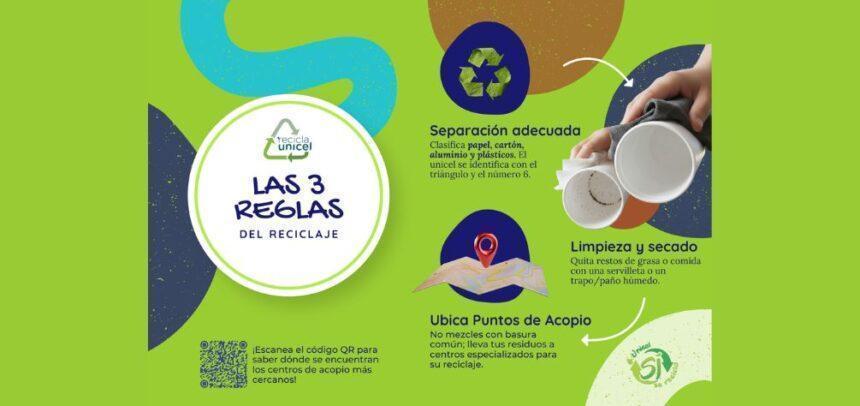
On the occasion of World Environmental Education Day, commemorated every January 26, @ReciclaUnicel calls on citizens to adopt a culture of shared responsibility by promoting three rules for recycling from home.
Faced with the challenge of urban waste management, this initiative seeks to empower families with practical tools so that everyday materials, including expanded polystyrene (EPS) — often overlooked in recycling chains — can be reintegrated into the circular economy.
To achieve efficient recycling and prevent collection points from rejecting materials, it is essential to follow these three steps:
1. Proper Separation: Many of the waste items we generate at home are recyclable. It is important to learn to identify and separate them correctly. It’s not just about differentiating between organic and inorganic waste, but also recognizing specific items like paper, cardboard, aluminum, batteries, and various types of plastics. An example of this is EPS, a 100% recyclable plastic commonly found in food products, packaging, and decorative items. This material can be identified by a triangle with the number 6.
2. Cleaning and Drying: A container with food residue or grease can ruin an entire batch of recycling, so it is vital to remove any food waste or foreign material from the product before taking it to a collection point. In the case of EPS products used for food, simply remove the residue with a napkin or a damp cloth. If necessary, recycled water can be used, avoiding the consumption of clean water.
3. Locate Collection Points: Taking your waste to specialized locations is a simple way to generate a positive and responsible impact on the environment. In the case of EPS, there are centers throughout the country where this material can be properly transformed. You can find the nearest one by visiting: https://cuentamedelunicel.com/donde-reciclo/
According to the Ministry of Environment and Natural Resources, in Mexico, approximately 103,000 tons of waste are generated daily, of which 84% are collected and about 78% are disposed of in final disposal sites. However, only 9.6% of the generated waste is recycled. One of the factors preventing an increase in this figure is the incorrect management of waste by consumers, making it even more important to promote recycling habits among the population.