Editor’s Note
This article presents a method for creating detailed geometric digital twins of irregular stone masonry walls, addressing a key gap in evaluating numerical simulation techniques for such structures.
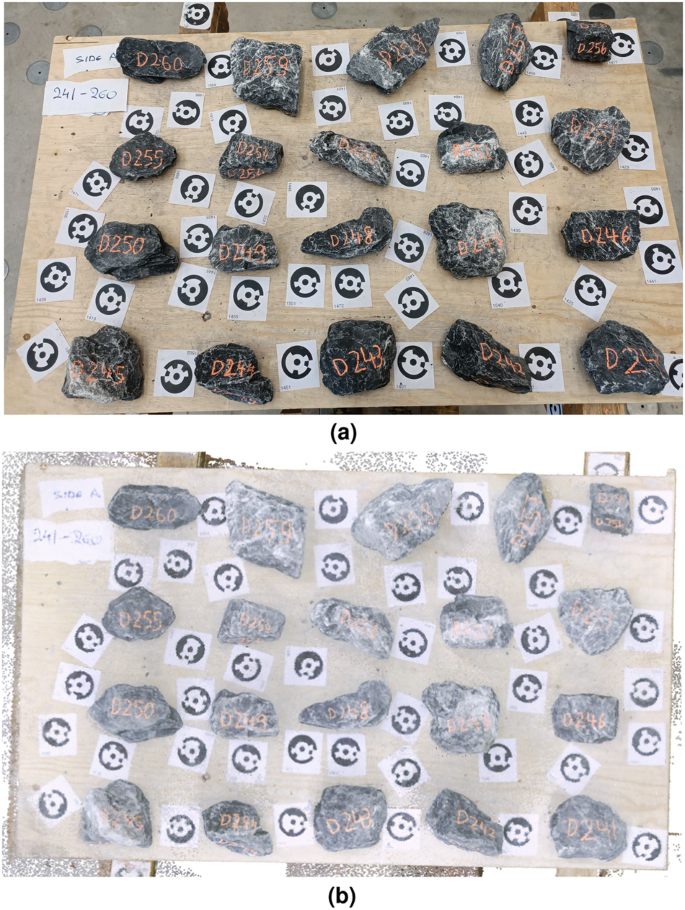
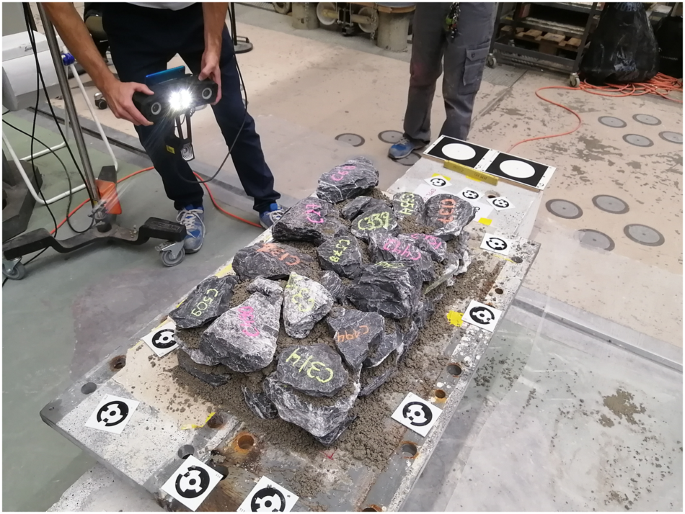
Research on irregular stone masonry walls is hampered by the lack of detailed geometrical models of their internal micro-structure, i.e. the shape and size of each stone and its position within the wall. Without such a geometric digital twin of walls tested in the laboratory, it is difficult to evaluate the accuracy of existing numerical simulation techniques. Here, we describe the generation of geometrical digital twins of three irregular stone masonry walls built in the laboratory. We labelled each stone manually and then obtained the geometry of the individual stones using a portable laser scanning device. With the same device we scanned the wall after the construction of each layer. We then registered the position of each stone in the layer. This paper outlines the methodology for the data acquisition and digital reconstruction and presents the datasets for the walls. The developed geometrical digital twins provide unique information regarding the micro-structure of constructed walls that is key for the development and validation of numerical simulation techniques for stone masonry.
The structural behavior of stone masonry walls is directly related to both the mechanical properties of the comprising stones and binding mortar as well as to the geometrical arrangement of these components, termed the micro-structure of the wall, as evidenced by experimental and numerical studies. While there are standardized experimental procedures for mechanically characterizing the components of a wall, it is still a challenge to determine the structural effect of its micro-structure. This is particularly true for irregular stone masonry walls that do not have a repetitive arrangement of stones and mortar, thus presenting a unique micro-structure that bestows a unique structural behavior (e.g., displacement and strength capacity, stiffness).
Current technical codes consider the effect of wall micro-structure by adopting a wall-typology categorization system. This system defines a certain number of stone masonry categories based on their micro-structure and correlates each category with a range of key mechanical properties. Engineers then assign the investigated masonry typology to one of the defined categories to determine the relevant mechanical properties. While this approach is a first step towards estimating the mechanical properties of stone masonry walls, it has two important limitations. First, the fixed number of categorized typologies does not adequately reflect the wide variety of existing masonry micro-structures. This makes category assignment a subjective decision, as masonry walls commonly display construction characteristics from more than one of the defined categories. Second, even within the same masonry typology, the listed ranges for the mechanical properties are wide enough to require the consideration of numerous uncertainties during structural analysis as evidenced experimentally and numerically.
The Masonry Quality Index (MQI) is an alternative to the wall-typology categorization system for the characterization of stone masonry walls. It is based on assessing seven morphological characteristics of the wall as fulfilled, partially-fulfilled or not fulfilled. A numerical value is given to each of them based on its fulfillment category. MQI is computed as the weighted sum of these characteristics and has shown to correlate well with strength (compressive, shear) and stiffness values of stone masonry. The assessed masonry characteristics are the conservation state, the stone shape and dimensions, the wall leaf connections, the mortar quality and the horizontality and verticality of bed and head joints, respectively. This information is derived from visual inspection and 2D images of the wall, while indices related with the 3D geometry (e.g. thickness and shape and distribution of stones in the interior) are currently missing. Overall, these issues make it difficult to accurately predict the structural response of stone masonry walls with varying geometry through the thickness.