Editor’s Note
The burgeoning market for lab-grown diamonds is reshaping the luxury sector, offering high-quality alternatives at a fraction of the cost of natural stones. As major jewelry brands increasingly adopt these sustainable gems, we examine the economic and industry implications of this significant shift.
The craze for ‘lab-grown diamonds’, also known as synthetic diamonds, is intensifying. Their popularity is soaring due to their low price and identical chemical composition to natural diamonds. Meanwhile, concerns are being raised about declining market competitiveness due to oversupply. Particularly, as high-end luxury brands launch products utilizing lab-grown diamonds, the ‘chicken game’ survival competition in the jewelry market is becoming fierce.
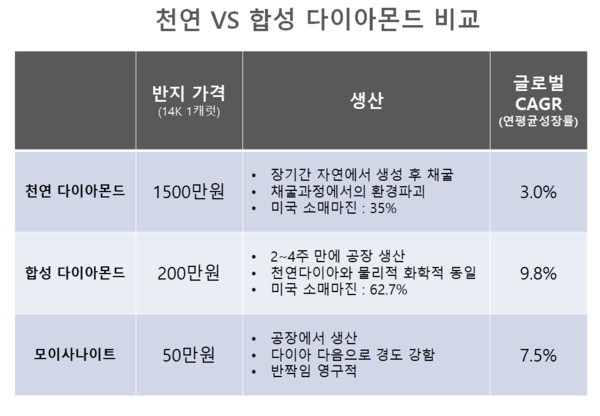
Lab-grown diamonds are not diamonds produced naturally but are artificially created ‘synthetic’ diamonds. The average price per carat is also about 30% cheaper than natural diamonds. Natural diamonds are formed when carbon, subjected to extreme pressure and temperature (around 30,000 atmospheres and 3000 degrees Celsius) as magma erupts from volcanoes from hundreds of kilometers underground. Lab-grown diamonds are created artificially in a similar environment.
Recently, the landscape of the jewelry market has tilted towards the lab-grown diamond industry. According to a report by diamond analyst Paul Zimnisky, the lab-grown diamond market, valued at $2 billion (approximately 2.6 trillion won) in 2021, is projected to nearly double to $3.9 billion (approximately 5.2 trillion won) by 2025. Edahn Golan Diamond Research & Data reported that the sales share of lab-grown diamonds has increased significantly from 2.4% compared to natural diamonds in 2020 to 9.3% this year.
French luxury conglomerate LVMH Group showcased affordable lab-grown diamonds through its jewelry brand ‘Tiffany’. LVMH invested $90 million in the Israeli lab-grown diamond company ‘Lusix’ last July. Swiss luxury watch brand Breitling also recently used lab-grown diamonds in its newly launched watch products.
In South Korea, the jewelry brand ‘Lloyd’, operated by E-Land, is a leading player. Lloyd launched its first lab-grown diamond product, the ‘El Dia Collection’, in 2020 and has been introducing new lineups annually. Sales of Lloyd’s El Dia Collection are growing by 30% each year. KDT Diamond was the first in Korea to produce lab-grown diamonds in-house in 2021. It is currently building a lab-grown diamond production plant in India; once operational early next year, it is expected to have an initial annual production capacity of 36,000 carats, increasing to over 100,000 carats per year thereafter.
The growth of lab-grown diamonds has also brought critical aftereffects to the jewelry industry.
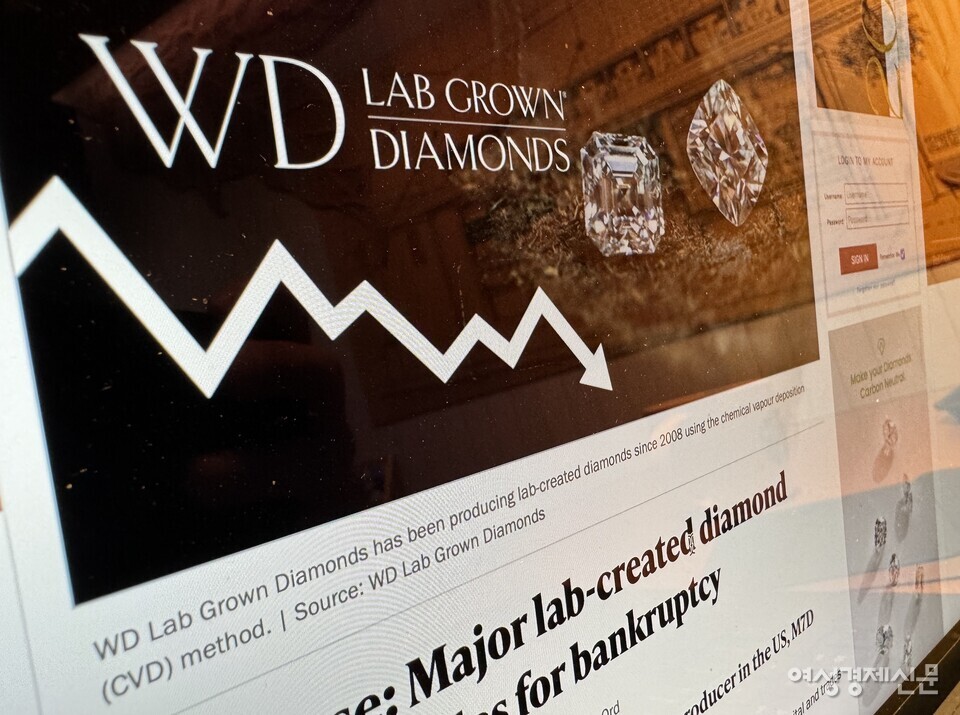
According to foreign media reports including the UK’s Financial Times (FT) on the 6th of this month, ‘WD Lab Grown Diamonds’, the second-largest synthetic diamond company in the US, filed for bankruptcy in a Delaware court in mid-last month. This is due to oversupply and a sharp price drop in the global lab-grown diamond market.
Regarding the WD Lab Grown Diamonds bankruptcy, diamond analyst Paul Zimnisky interpreted it as
The oversupply of lab-grown diamonds has also led to a concurrent decline in natural diamond prices. Analysis data from jewelry specialist Rapaport shows that the price of natural diamonds, which approached $7,000 per carat in Q1 2016, fell to $4,725 in Q1 this year. Lab-grown diamond prices also dropped from the $5,000 range to $1,355.
De Beers, a leading company in the global diamond market, stated that as of late July, the price of rough diamonds classified as ‘select makeables’—referring to rough stones suitable for processing into commercial-quality natural diamonds—had fallen by about 40% compared to June last year.
Given this situation, experts in Jongno, the hub of Korea’s domestic jewelry industry, suggest that strategies are needed to avoid the aftereffects of oversupply. The idea is to avoid the low-price sales strategies of large corporations for lab-grown diamonds and instead pioneer new markets through premiumization.
On Hyeon-seong, Director of the Wolgok Jewelry Industry Research Institute, explained in a phone call with Women’s Economic News,
He further emphasized,