Editor’s Note
The rapid price decline of lab-grown diamonds, now up to 80% cheaper, reflects significant shifts in both production technology and consumer attitudes toward jewelry. This market transformation raises questions about value perception and the future landscape of the diamond industry.
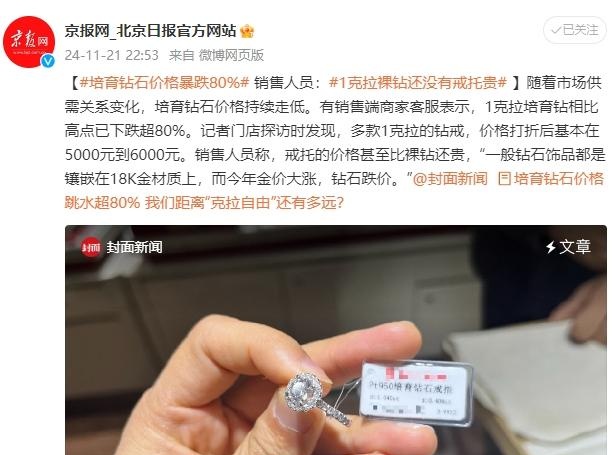
With technological advancements and evolving consumer perceptions of jewelry, lab-grown diamonds have gradually entered the public consciousness. Recently, however, the price of lab-grown diamonds has experienced a sharp decline, with a drop of up to 80%, drawing widespread attention.
Many one-carat diamond rings are now priced between 5,000 and 6,000 yuan after discounts. A salesperson noted, “The price of the ring setting is even more expensive than the loose diamond itself. Diamond jewelry is typically set in 18K gold, and with the significant rise in gold prices this year, diamond prices have fallen.”
— A staff member at a diamond store in Jinan High-tech Zone, as reported by Luzhong Morning News.
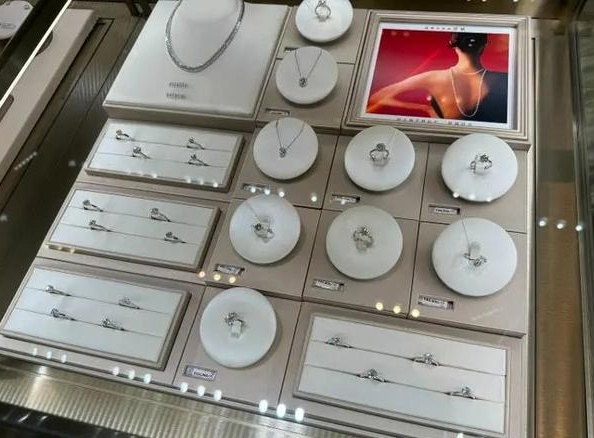
Recently, staff at Chow Tai Fook, Chow Sang Sang, DR, and other stores have stated that they do not sell lab-grown diamonds, only natural diamonds. A one-carat natural diamond, including brand premium, generally starts at 50,000 yuan.
1. Changes in Market Supply and Demand
The sharp drop in lab-grown diamond prices is first related to changes in market supply and demand. With continuous advancements in lab-grown diamond technology and increased production, market supply has grown substantially. However, demand growth has not kept pace with the increase in supply, leading to price declines.
2. Shift in Consumer Perception
In the past, natural diamonds were widely considered more valuable. However, as consumer focus on environmental protection and sustainability increases, more people are beginning to accept lab-grown diamonds as an emerging product. Yet, when a large number of low-priced lab-grown diamonds appeared on the market, consumer purchasing power did not increase accordingly, instead contributing to the price drop.
3. Intense Competition
As competition in the lab-grown diamond market intensifies, various brands and merchants have adopted price reduction strategies to compete for market share. The rise of online sales has also made prices more transparent, allowing consumers to easily compare prices of different products, further exacerbating price competition.
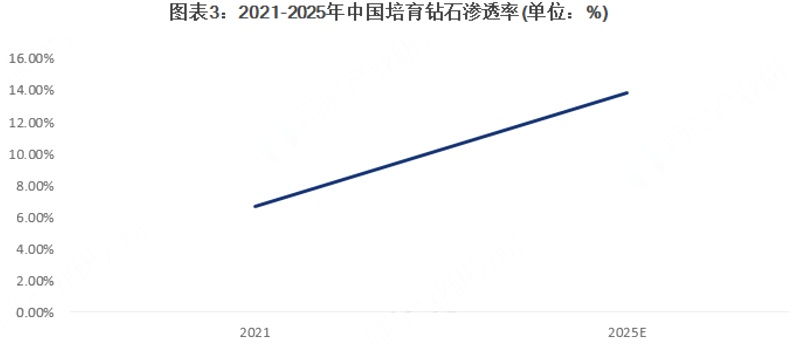
Data from Bain & Company shows that China’s lab-grown diamond penetration rate was around 6.7% in 2021 and is projected to reach 13.8% by 2025.
Several listed synthetic diamond companies have entered the lab-grown diamond business. Currently, companies like Power Diamond, Wolong Diamond, and Zhongbing Hongjian have already deployed in the lab-grown diamond sector, achieving R&D and mass production of colored diamonds and large-grain products, giving them certain market competitiveness. With the growth in lab-grown diamond capacity and sales, a number of brands specializing in lab-grown diamond jewelry have emerged.
In the short term, as of July 2024, India’s imports of lab-grown diamond rough and exports of polished diamonds both showed a further widening year-on-year decline, indicating a decrease in industry sentiment for that month. Additionally, while the year-on-year decline in natural diamond rough imports and polished diamond exports narrowed, polished diamond prices saw a slight retreat, remaining low and volatile. However, from a medium to long-term perspective, with the gradual recovery of the macroeconomy and the further spread of the “self-pleasure consumption” concept, downstream diamond consumption demand is expected to gradually recover. Given that lab-grown diamonds share the same composition and structure as natural diamonds and have a significant price advantage, coupled with media and brand education of downstream consumers in recent years, the penetration rate of lab-grown diamonds is expected to increase further in the future.

Currently, lab-grown diamonds still follow the grading standards of natural diamonds, which is not only unreasonable but also involves relatively high certification costs, hindering the healthy development of the industry. In response, the China Gems & Jewelry Trade Association proposed at the 2024 China Lab-Grown Diamond Industry Development Seminar to accelerate the establishment of a standardization system for the lab-grown diamond industry. This initiative is expected to lay the foundation for the industry’s long-term development, enhance consumer confidence, and promote the standardization of market order.