Editor’s Note
**Editor’s Note:** This piece explores Dorothea Prühl’s enduring dialogue with material and form, showcasing how her jewelry practice strips away embellishment to let metals like gold, silver, and aluminum speak for themselves.
Spanning several decades, the exhibition highlights how Prühl regularly returns to form through a focused range of materials. Works presented include Butterflies (Schmetterlinge), 2008, and Ravens in a Circle (Raben im Kreis), 2020. These pieces rely on materials used without disguise or surface embellishment. Metals dominate, including gold, silver, stainless steel and aluminum.
Artist Dorothea Prühl, whose practice spans decades of jewelry design rooted in form and material. (Photo courtesy Dorothea Prühl)
For Prühl, creating jewelry out of wood or metal is tied inextricably to the idea of form.
“The Jewelry of Dorothea Prühl” is on view through January 3, 2027 at the Museum of Fine Arts, Houston.
By Ericka Schiche // Jan 9, 2026
Dorothea Prühl’s “Migratory Birds (Zugvögel),” 2025, at the Museum of Fine Arts, Houston. (Photo by Matthias Ritzmann)
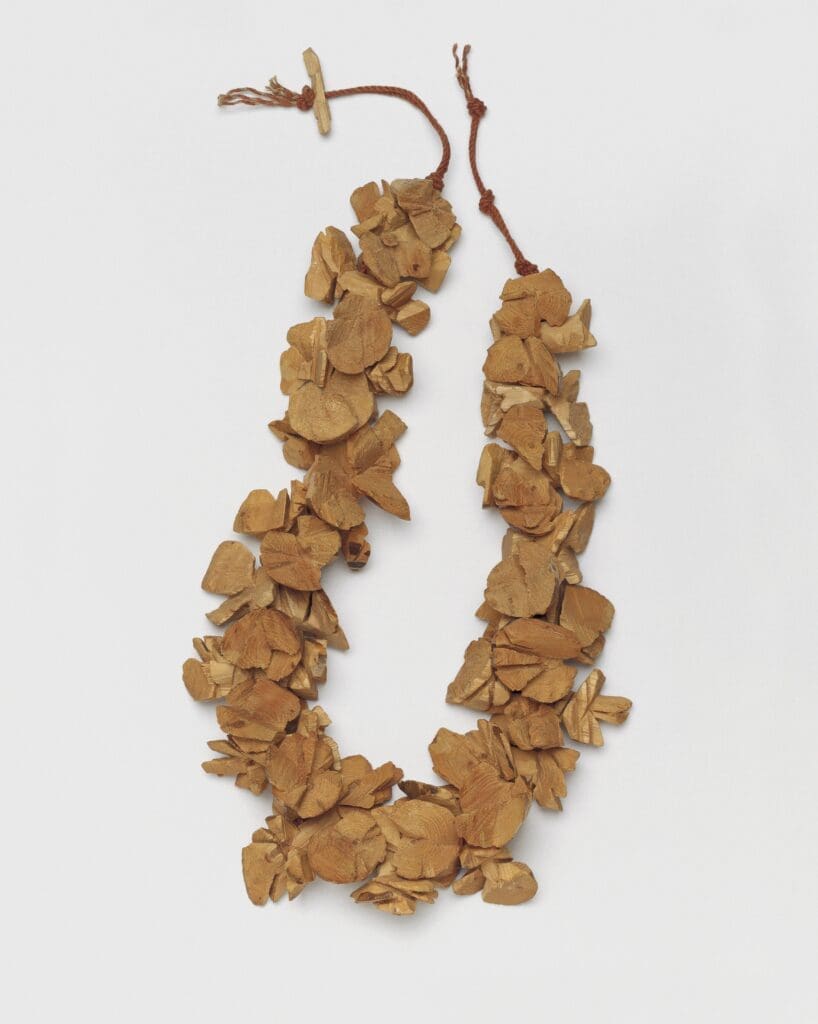
Dorothea Prühl’s “Flowers from Augustenberg (Blumen aus Augustenberg),” 1989, at the Museum of Fine Arts, Houston. (Photo by Helga Schulze-Brinkop. © Dorothea Prühl)
Dorothea Prühl’s “Windflowers (Windblumen),” 1989, at the Museum of Fine Arts, Houston. (Photo by Helga Schulze-Brinkop. © Dorothea Prühl)
Dorothea Prühl’s “Butterflies (Schmetterlinge),” 2008, at the Museum of Fine Arts, Houston. (Photo by Helga Schulze-Brinkop. © Dorothea Prühl)
Dorothea Prühl’s “Night Birds (Nachtvögel),” 2017, at the Museum of Fine Arts, Houston. (Photo by Matthias Ritzmann. © Dorothea Prühl)
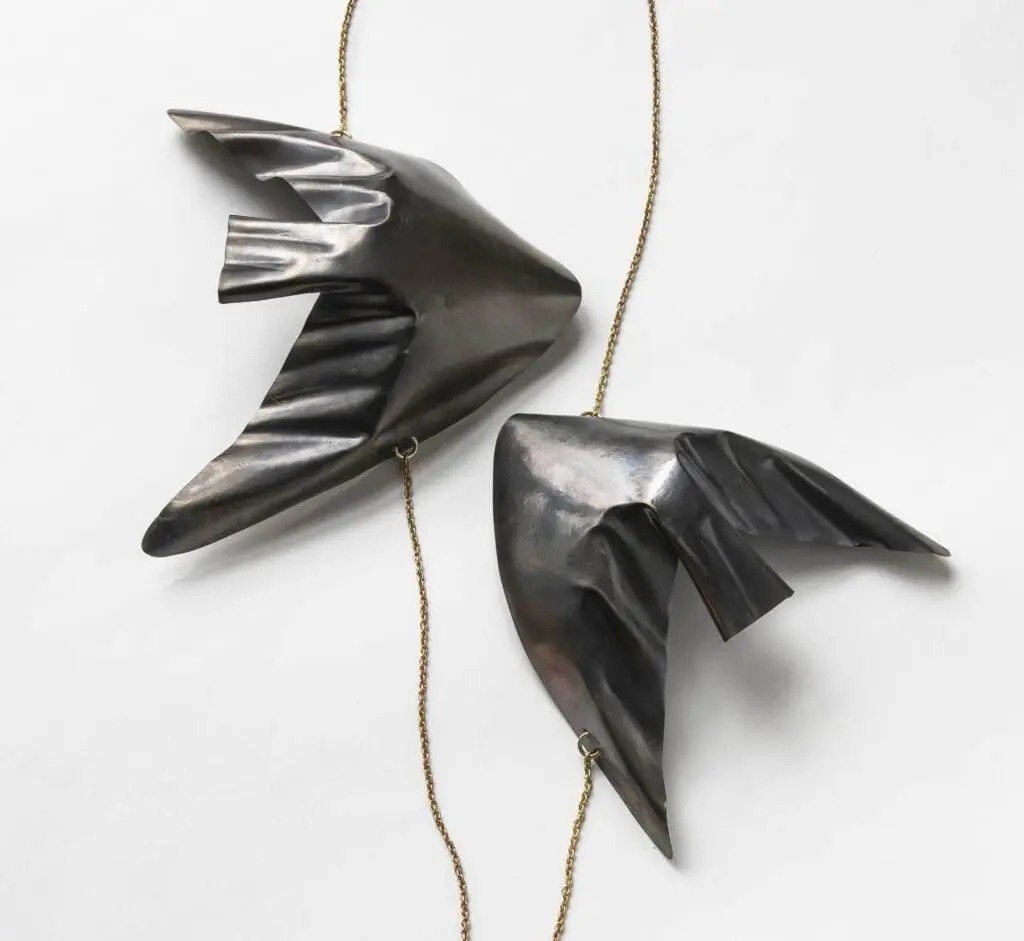
Dorothea Prühl’s “Two Large Birds (Zwei große Vögel),” 2020, at the Museum of Fine Arts, Houston. (Photo by Ericka Schiche)
Dorothea Prühl’s “Animals with Chains (Tiere mit Kette),” 1999, at the Museum of Fine Arts, Houston. (Photo by Ericka Schiche)
Dorothea Prühl’s “Golden Leaf (Goldenes Blatt),” 1984, at the Museum of Fine Arts, Houston. (Photo by Ericka Schiche)
A model wears Dorothea Prühl’s “Ravens in a Circle (Raben im Kreis),” 2020. (Photo courtesy Dorothea Prühl)
Dorothea Prühl’s “Collar (Kragen),” 2014, at the Museum of Fine Arts, Houston. (Photo by Ericka Schiche)
Dorothea Prühl’s “Ravens in a Circle (Raben im Kreis),” 2020, at the Museum of Fine Arts, Houston. (Photo by Ericka Schiche)
Dorothea Prühl’s “Hare (Hasen),” 2024, at the Museum of Fine Arts, Houston. (Photo by Ericka Schiche)
Dorothea Prühl’s Butterflies (Schmetterlinge), 2008, at the Museum of Fine Arts, Houston. (Photo by Helga Schulze-Brinkop. © Dorothea Prühl)
Prühl studied at the Burg Giebichenstein Kunsthochschule Halle in former East Germany. She later taught there for many years. Founded in 1915, the school is considered Germany’s second-most important art institution after the Bauhaus.
A model wears Dorothea Prühl’s Ravens in a Circle (Raben im Kreis). (Photo courtesy Dorothea Prühl)
Prühl’s works possess an abstract, biomorphic quality. They reflect her interest in Germany’s farms, fields and forests. That relationship begins with place.
“She only works in wood or metal,” Strauss says. “Her Halle studio is dedicated to metal. Her second studio sits in Augustenberg, about 90 minutes north of Berlin.” The old stone house and workspace are surrounded by open fields, a setting that mirrors the natural forms running through her work.
That sense of place also shapes how Prühl thinks about memory. One example appears in Flowers in Augustenberg (Blumen aus Augustenberg), 1989, made of alder wood and string. Essner describes the work as a garland rather than a necklace, since it doesn’t rotate on an axis.
Dorothea Prühl’s Flowers in Augustenberg (Blumen aus Augustenberg), 1989, at the Museum of Fine Arts, Houston. (Photo by Helga Schulze-Brinkop. © Dorothea Prühl)
Golden Leaf (Goldenes Blatt), 1984, Wind Flowers (Windblumen), 1989, Water Flowers II (Wasserblumen II), 1989 and Grass (Gras) are also featured.
Describing Wind Flowers (Windblumen), 1989, Prühl emphasizes movement and responsiveness.
She compares the pieces to windsocks that inflate as air currents pass through them.
Each bell-shaped pendant of Wind Flowers captures this dynamic quality.