Editor’s Note
This article outlines the key terms of an interim U.S.-India trade agreement, including a reduction in tariffs on Indian exports and the lifting of U.S. sanctions related to Russian oil purchases. The deal signals a significant step in bilateral economic relations.
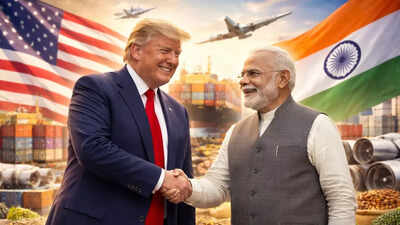
India and the US have released a joint statement for the interim trade deal agreement, which is expected to be formally signed in the coming weeks. With this, the reciprocal tariff rate on India’s exports to the US comes down to 18%.
Simultaneously, US President Donald Trump has also signed an executive order revoking the 25% tariffs that had been imposed on India for its purchase of crude oil from Russia.
Even as tariffs on India are slashed, on its part India will do away with or cut down import duties on all US industrial goods and some US food and agricultural products.
After months of intense negotiations, what does the interim trade deal mean for India? Which sectors will benefit? And what about the sensitive sectors of agriculture and dairy? We decode:
Fundamentally, with an 18% tariff rate, India gets a competitive advantage compared to regional peers in labour-intensive, export-driven sectors. India’s 18% tariff is lower than that of Vietnam, Bangladesh, China, Thailand, Pakistan, and Indonesia.
India’s 18% tariff rate is also a steep cut from the 50% tariff imposed by the Trump administration in August 2025.
According to Commerce Minister Piyush Goyal, the trade deal opens a $30 trillion market access for Indian exports. In this regard, the interim trade deal will especially benefit MSMEs, farmers and fishermen.
Sector-specific benefits will accrue to textiles, leather, gems and jewellery, pharmaceuticals, machinery, automobiles etc. Several labour-intensive sectors will stand to gain from the trade deal:
- Leather and footwear
- Textiles and apparel
- Home decor
- Organic chemicals
- Artisanal products
- Certain machinery
On several products the tariffs will go down to zero, such as gems and diamonds, aircraft parts, and generic pharmaceuticals. This will benefit India’s ‘Make in India’ push.
India will also get a preferential tariff rate quota for automotive parts. This will be subject to tariffs imposed to eliminate threats to national security.
India and the US will also look to enhance the trade in technology products. This includes Graphics Processing Units and other goods used in data centres, and expand joint technology cooperation.
Some of the other benefits cited by the government are:
- Big win for exporters, boost to exports-led growth
- Compliances to come down, procedural delays to reduce
- Quicker access to US information & communication technology goods
- Big push to setting up data centres
- Strengthening electronics & semiconductor value chain
- Huge support to domestic manufacturing
- Consumers benefit with reduced costs
- Several MSMEs, startups to gain through job creation
- Strengthening digital infrastructure
- Accelerating India’s digital AI ecosystem
- Increasing trade in tech products like GPUs & data centre equipment
- Lower costs for our companies with better access to cutting-edge tech
- Greater investments, skill development, jobs, manufacturing partnerships
- Helps avoid repetitive testing & certifications for our exporters
- Lower costs, time for US markets to enter
- Support Indian MSMEs integrate into global value chains
- Help Indian goods meet global standards