Editor’s Note
This case study examines how Amondz leveraged technology and curation to carve out a leading position in the jewelry platform market, highlighting its strategy of connecting consumers with affordable, trendy pieces while supporting domestic designers.
This case tracking details the journey of Amondz, a jewelry vertical platform founded in 2018, as it established itself as a leader in the jewelry platform market. Its strategy involved integrating IT technology to aggregate trendy mid-to-low-priced jewelry for consumers and supporting the growth of domestic jewelry designers. Although launched in 2018, this analysis is based on the latter half of 2020, when the brand’s growth culminated in its own public listing.
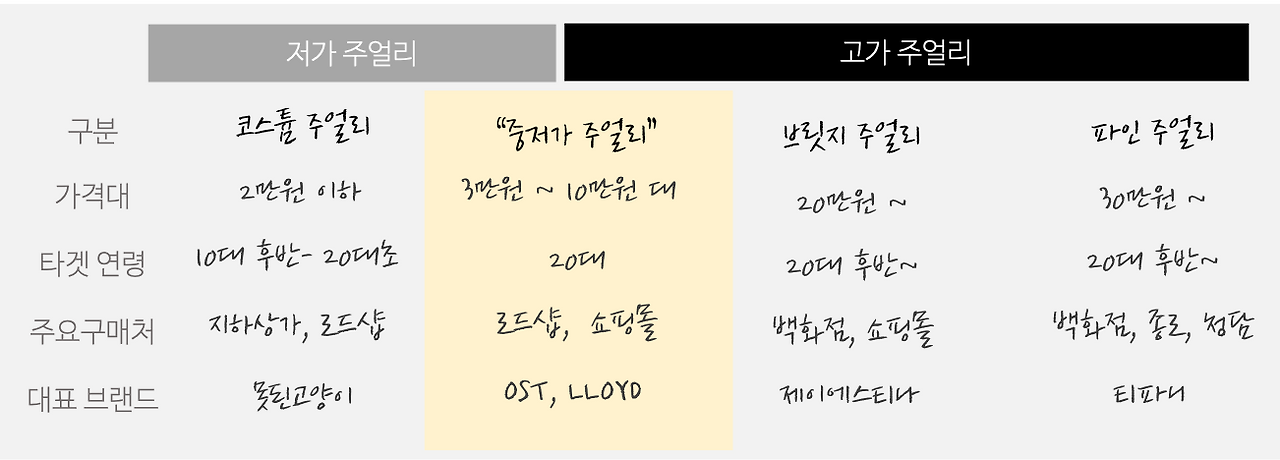
The domestic jewelry market can be segmented by occasion (e.g., bridal vs. non-bridal) and by price and materials (e.g., fine jewelry, bridge jewelry, costume jewelry). It is also broadly divided into low-end and high-end markets. The rising demand for ‘mid-to-low-priced jewelry’ between these segments has opened a new market.
Meanwhile, the total size of the domestic jewelry market is estimated at approximately 5 trillion won (as of 2020) and is steadily increasing. This growth is driven by non-profit foundations conducting various projects to revitalize and enhance the competitiveness of the jewelry industry, and domestic fashion companies expanding their jewelry lines for business diversification and global market penetration. In fact, Korean jewelry exports, particularly to the US, have surged significantly. Additionally, the COVID-19 pandemic, which limited offline jewelry purchases, led to an increase in jewelry buying through online channels.
Source: Wolgok Jewelry Industry Research Institute
According to the Wolgok Jewelry Industry Research Institute, the average annual purchase price consumers spend on jewelry is rising. Concurrently, the vertical platform market, which provides services focused on a single specific field, is emerging. A vertical platform targets people interested in a particular area, offering services in subdivided fields like music, shopping, education, or fashion, or providing intensive service based on a single function. For products where user experience is crucial, vertical platforms are leading the market. Fashion vertical platforms, including those for jewelry, have grown steadily and expanded significantly with the rise of untact consumption during COVID-19.
A relatively large portion of the domestic jewelry market consists of individual proprietorships. Unless they contract with a brand or join a platform, they essentially operate their own online stores solely through individual effort. However, they generally face difficulties in brand management. Furthermore, the overall jewelry industry structure requires distribution to go through multiple stages, not just design. Additionally, mid-to-low-priced jewelry brands faced a crisis due to a lack of policy support to back them up and losing competitiveness against the recognition of famous foreign jewelry brands. The impact of COVID-19 also caused a sharp decline in performance, leading some to close down.
Meanwhile, to cater to consumers accustomed to fast delivery, fast shipping became a basic premise for platforms, with ‘fulfillment services’ responsible for this speed. While most platforms contracted with fulfillment service providers to focus on delivery, this was not being implemented in the jewelry vertical platform space.
Strengths
In 2018, Amondz emerged as the first jewelry vertical platform, securing a competitive advantage in the market. Furthermore, CEO Huh Se-il leveraged his parents’ experience running a goldsmith shop and his own IT career to combine the jewelry market with IT, developing Amondz’s unique capabilities that differentiate it from other platforms.
Weaknesses
Amondz, as a jewelry vertical platform, is primarily active online. However, the main consumers of mid-to-low-priced jewelry, the 20s-30s generation, still tend to value ‘offline experience,’ highlighting the limitation of online platforms where products cannot be seen or touched directly.
Opportunities
In 2020, chain-based items became a fashion trend, increasing consumer demand for chain jewelry. Moreover, as jewelry came to be used as a fashion item rather than merely an asset, unique and diverse material jewelry gained attention. Men also developed a need for mid-to-low-priced jewelry as a fashion item; globally, the men’s jewelry market is growing significantly. Meanwhile, small-scale designers, seeing their products gain attention, needed a platform for greater exposure to consumers. A platform is an essential tool that can help with the difficulties small designers face in branding and marketing.
Threats
In the past, fashion platforms primarily handled clothing, shoes, and bags. Recently, as fashion platforms have grown larger, competition for market share among them has intensified. In this fierce competition, each fashion platform expanded its ‘jewelry line’ for business diversification, posing a threat to ‘jewelry platforms.’ Additionally, during the COVID-19 period, increased online consumption and the MZ generation’s luxury craze led overseas luxury jewelry brands to expand their business in Korea, threatening domestic mid-to-low-priced jewelry brands.
SO Strategy: Leverage Amondz’s unique IT technology to be the first in the jewelry industry to combine jewelry and IT, establishing itself as a leader in the jewelry vertical platform. Provide a suitable platform for jewelry designers who need space to grow and consumers seeking trendy jewelry, thereby meeting their needs.
Strategy 1) Introduce a fulfillment service to Korea’s first jewelry vertical shopping platform to build differentiated capabilities and attract consumers!
Amondz was indeed born as Korea’s first jewelry vertical platform. It introduced a fulfillment system by pre-selecting jewelry based on data and securing inventory, building capabilities that differentiate it from other jewelry platforms. Jewelry is often associated with ‘slow delivery,’ so the same-day delivery service received positive evaluations.
Strategy 2) Maximize the advantage of being a platform gathering multiple designers by creating an offline jewelry edit shop. Provide designers with an opportunity to showcase their products and offer consumers curated diverse jewelry experiences to increase purchase rates among the target demographic.
Amondz actually opened Korea’s first jewelry edit shop, ‘Amondz Lab,’ in Apgujeong. At Amondz Lab, various themes are selected monthly, and the store operates reflecting jewelry trends analyzed by the company. For individual brands, it’s challenging to showcase products offline due to cost and operational issues; this provides them exposure to consumers offline. Meanwhile, consumers receive detailed curation through store MDs and have the opportunity for unique jewelry experiences.
Strategy 3) Create a private brand based on consumer analysis data. Provide the management insights accumulated from operating this brand to partner brands to foster ‘co-growth,’ and offer consumers trendy, need-based products through ‘data’!
Amondz actually launched its PB brand, We Amondz. Through big data collected from jewelry consumers, Amondz presents the most popular designs. Furthermore, Amondz announced it would provide new insights gained from operating its own brand to jewelry brands on its platform. This stems from Amondz’s management philosophy of mutual growth and symbiosis with partner brands, aiming to strengthen both partner brand growth and customer convenience.
Strategy 1) Introduce a fulfillment service to Korea’s first jewelry vertical shopping platform to build differentiated capabilities and attract consumers!
It was impressive that it was both Korea’s first jewelry vertical platform and the first to introduce a fulfillment service. Especially for designer brands within jewelry, which often use a made-to-order model, slow delivery is considered the norm. Combining this with fast delivery is an issue that can attract consumer attention and potentially reshape the jewelry market landscape.
Strategy 2) Maximize the advantage of being a platform gathering multiple designers by creating an offline jewelry edit shop. Provide designers with an opportunity to showcase their products and offer consumers curated diverse jewelry experiences to increase purchase rates among the target demographic.
Online jewelry brands realize their online limitations and want to expand offline. Providing an opportunity to join an edit shop is a good choice when opening their own store is burdensome. Above all, it seems to sufficiently meet the needs of today’s consumers who want to see jewelry in person and view products from various brands in one space. Introducing a ‘curation service’ will also allow for clear differentiation in the market and secure a competitive advantage in the industry.
Strategy 3) Create a private brand based on consumer analysis data. Provide the management insights accumulated from operating this brand to partner brands to foster ‘co-growth,’ and offer consumers trendy, need-based products through ‘data’!
Given that Amondz’s CEO’s management philosophy is ‘co-growth’ with partner brands, creating its own brand to provide insights to them seems very helpful for small and emerging brands. Moreover, since the private brand is created based on consumer data, it is relatively trendy. Consumers can encounter trendy products at more reasonable prices, making this a good ‘win-win’ strategy for Amondz, partner brands, and consumers.
Kim Jin-young, Department of Linguistics, Korea University
[email protected]