Editor’s Note
This article challenges conventional assumptions about mining’s environmental impact by examining a surprising case study in Madagascar. While the extractive industry’s ecological risks remain well-documented, the research highlights how informal sapphire mining in a biodiverse rainforest yielded unexpected, and less destructive, outcomes—prompting a more nuanced discussion on conservation strategies in regions where local livelihoods and resource extraction intersect.
If tens of thousands of miners turned up in the middle of a protected rainforest to mine for sapphires, you might expect that to cause lots of deforestation and harm local wildlife.
Mining has a very bad reputation. It is often assumed to be one of the worse land uses – destroying and polluting the environment and creating barren, moon-like landscapes. Where mining occurs in areas of high biodiversity, it is considered a serious threat.
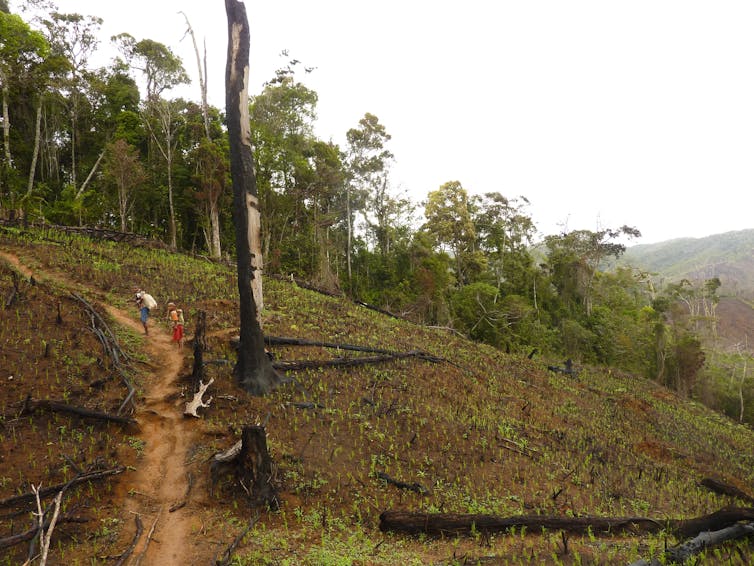
But in the eastern rainforests of Madagascar, over 10,000 people mining for sapphires didn’t cause more damage to the forest than farmers clearing land for agriculture, which remains the most important driver of deforestation in this area.
My recent research focuses on quantifying the effects of sapphire mining on the forests of Madagascar. My discoveries challenge some of the preconceptions about the impacts of small-scale mining. I show that, despite being attention-grabbing, some forms of mining can be surprisingly low-impact and less damaging than other land uses.
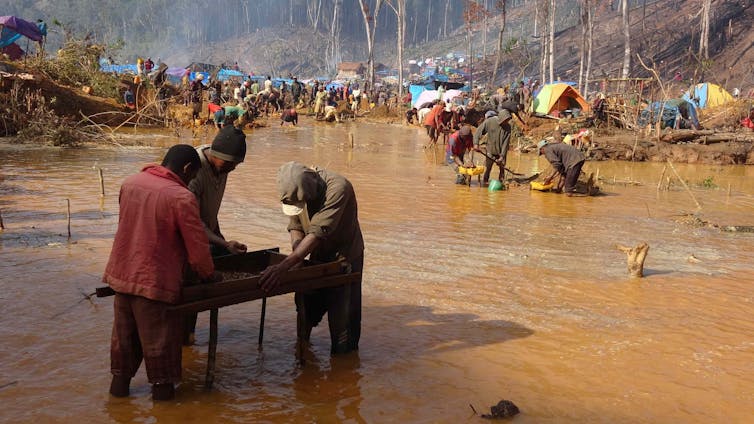
In October 2016, a valuable deposit of sapphires was discovered by people searching for gold within the protected rainforests of the Ankeniheny-Zahamena corridor in eastern Madagascar. These rainforests are really important for biodiversity as they are home to many unique species at risk of extinction, including lemurs such as the indri and black and white ruffed lemur. Word of the sapphire discovery quickly spread. Within weeks tens of thousands of people from across the island were illegally mining in the Bemainty valley deep within the forest.
Unlucky miners left the site poorer than they arrived. Some struck it rich, while others made enough money to survive and perhaps save a little extra to invest in education, land or businesses. This type of mining, termed artisanal and small-scale mining, is not unique to Madagascar. It is widespread, supporting an estimated 40 million people around the world.
The mining rush at Bemainty attracted international media attention due to fears over its environmental impacts, with reports that it was causing substantial deforestation and threatening endangered lemur populations. This caused substantial concern amongst conservationists.
My research aimed to evaluate the deforestation claims. To properly assess the impact of something, an essential step is to estimate what would have happened without it: the counterfactual. To roughly calculate how much deforestation would have happened at Bemainty without mining, my colleagues and I used the average area of deforestation within a set of control forest areas, chosen to be as similar as possible to Bemainty but crucially, without mining. We then compared deforestation at Bemainty to this counterfactual.
Limited negative effects of mining on deforestation at Bemainty could be for several reasons. First, the sapphires were found within river sediments, confining mining to the valley floor.
Second, much of this area had been cleared for farming decades before when the first settlers arrived. Third, the miners did not use heavy machinery, and sapphire mining does not use toxic chemicals (like the mercury that’s used in gold mining).