Editor’s Note
This article has been updated to reflect the announcement by Tesla CEO Elon Musk regarding the operational launch of the company’s lithium refinery in Texas.
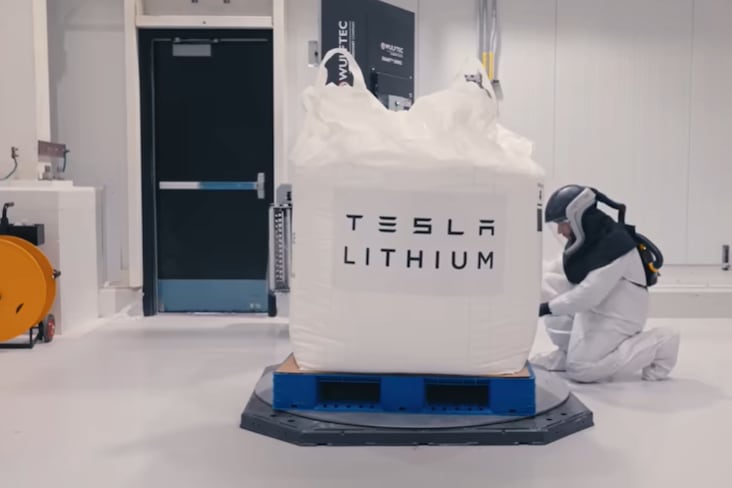
With this brief message posted on social media platform X on January 14, Tesla CEO Elon Musk announced the startup of the automotive group’s first lithium refining plant in Corpus Christi, Texas. The site, which cost around one billion dollars, allows the automaker to secure its lithium supply – the main ingredient for electric batteries – by transforming raw spodumene ore into lithium hydroxide, a chemical compound usable in high-performance batteries.
Tesla remains discreet about this new asset – built in record time by conducting feasibility studies, design, and plant construction in parallel – and its actual capacities. Ultimately, the Corpus Christi plant must produce enough lithium to manufacture batteries for one million cars per year, Elon Musk explained when announcing the project in 2023. This represents 45,000 to 50,000 tonnes of lithium hydroxide per year, according to calculations by L’Usine Nouvelle.
In a brief explanatory video with striking images, employees of the automaker highlight the “more sustainable” and “cheaper” refining process chosen. Tesla boasts that its plant, unlike conventional refineries, does not use acid to leach lithium from crushed and calcined rock, but an alkaline solution coupled with purification and then crystallization steps. This choice avoids the production of sodium sulfate, an effluent harmful to aquatic environments and complicated to manage (especially outside China, where there are few commercial outlets for this chemical compound). Instead, the plant produces an inert by-product called analcime, usable in the cement industry, explains an employee. A downside: according to Bloomberg, the plant’s water consumption, higher than expected, is the subject of strong local criticism in the arid Texas region.
For the billionaire behind Tesla, accessing battery-grade lithium has long been a concern. In 2022, when white gold prices peaked at $80,000 per tonne, he mentioned the possibility of launching his automotive company into the field, judging that the lack of refined lithium was the “limiting factor” for the electric mobility boom! Hence the choice, original for an automotive player, to handle the refining of its products itself. Because while the light metal is abundant in the earth, it must be extracted from mines, then purified and transformed into carbonate or hydroxide before being usable in electric batteries. This last step, refining, requires significant investments, overwhelmingly made in China in recent years. According to the International Energy Agency (IEA), the Asian giant hosted, at the end of 2024, 70% of global lithium refining capacity, far ahead of Chile and Argentina. This figure even rises to 95% for lithium rock ore, notably from Australia, which remains by far the world’s largest producer of white gold. This worrying situation has led to the emergence of numerous projects worldwide, particularly in Australia and Canada. A sign of the strategic nature of the subject, in the United States, the company Lithium Americas (in which automaker GM holds a 38% stake) obtained a massive loan in October – over $2.2 billion from the Department of Energy – for its large integrated mine and refinery project at Thacker Pass, aiming for a startup in 2027. In Europe, Vulcan Energy recently announced securing €2.2 billion in financing for its geothermal lithium project in Germany’s Rhine Valley. In France, Eramet and Lithium de France are also exploring the geothermal lithium vein in Alsace, while others like Imerys in Montluçon (next to its mine project in Allier), Livista in Le Havre (Seine-Maritime, in partnership with Chinese giant Tianqi), or Viridian near Strasbourg (Bas-Rhin) have presented refinery plans, although the associated financing is not yet secured…
It must be said that despite the expected market growth, following the increasing adoption of electric vehicles, low lithium prices since 2023, against a backdrop of surplus on the global market, complicate refiners’ tasks. Chinese giants in the sector, like Tianqi or Ganfeng, even recorded significant losses in 2024 and the first half of 2025… Did Tesla make a mistake by betting on the subject, while Musk spoke of refining as a “license to print money”? It’s not certain. The winter weighing on the lithium market since 2023 is considered unsustainable by most analysts, and the situation seems to be turning around. Faced with supply tensions and growth in stationary storage, battery lithium prices started rising again in November 2025 and have exploded in recent weeks. On the LME, the tonne of hydroxide went from about $11,000 per tonne in early December to over $18,000 in mid-January 2026! Prices not seen since autumn 2023, which could help the startup of Tesla’s Corpus Christi plant, which must now prove its ability to ramp up.