Editor’s Note
Recent financial reports from major gold jewelry retailers highlight a dual trend: continued physical store closures and a market-wide price adjustment following new tax policies. While traditional retail faces pressure, e-commerce emerges as a key growth driver, signaling a pivotal shift in the industry’s landscape.

Recently, multiple gold jewelry companies have released their third-quarter financial data. The data shows that store closures are still ongoing, while the new gold consumption tax policy implemented on November 1 has triggered collective price increases in the market. Interviewed experts believe that branded store operations are still expected to face pressure.
However, the financial data simultaneously reveals that e-commerce channels are becoming a bright spot for revenue growth in the branded gold jewelry business.
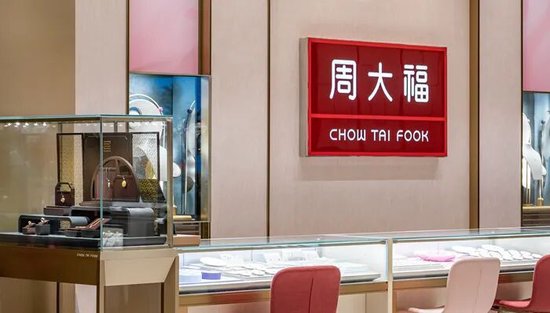
Chow Tai Fook’s (01929.HK) financial data shows that as of the end of September, the company’s retail point network totaled 6,041 stores, a decrease of 603 stores from 6,644 at the end of March. The reduction was most pronounced in the mainland China market, with Chow Tai Fook’s retail points in mainland China at 5,663, a decrease of 611 stores from the end of March.
Chow Tai Fook stated that during the quarter, the group continued to close underperforming stores and selectively opened new stores with higher productivity.
Correspondingly, in the third quarter, Chow Tai Fook’s same-store sales in the mainland China, Hong Kong China, and Macau China markets decreased by 8.6% and 10.0% year-on-year, respectively.
However, benefiting from price increases, overall sales performance improved somewhat. In mainland China, same-store sales for self-operated stores turned to a positive growth of 7.6% during the quarter, while same-store sales for franchise stores grew by 8.6%. Same-store sales in Hong Kong and Macau also increased by 6.2% year-on-year.
Companies like Chow Sang Sang (002867.SZ) and Luk Fook Holdings (00590.HK) showed similar trends of store reduction and sales improvement.
As of the end of September, Chow Sang Sang had 4,675 retail outlets, including 4,275 franchise stores and 400 self-operated stores. The total number of retail outlets decreased by 560 compared to the end of the same period last year and by 333 compared to the beginning of the year. Among them, franchise stores decreased by 380, while self-operated stores increased by 47.
From January to September 2025, Chow Sang Sang’s cumulative operating revenue was 6.772 billion yuan, a year-on-year decrease of 37.35%; operating gross profit was 2.014 billion yuan, a decrease of 9.46% compared to the same period last year. However, benefiting from optimized product structure adjustments and pricing benefits brought by rising gold prices, the overall gross profit margin for the reporting period increased to 29.74%, an increase of 9.16 percentage points compared to the same period last year.
As of the end of September, Luk Fook Holdings had a total of 3,113 stores globally, a net decrease of 49 stores during the quarter. The mainland China market decreased by 51 stores, the Hong Kong market decreased by 2 stores, while overseas markets increased by 4 stores.
Similarly, due to rising gold prices, overall product prices have increased. Taking the mainland market as an example, the average selling price (excluding VAT) of Luk Fook’s gold products in the mainland market increased by 17% from 7,100 yuan in the same period last year to 8,300 yuan, while the pricing of first-piece products increased by 21% from 2,400 yuan last year to 2,900 yuan.
This drove a recovery at the revenue end. During the quarter, Luk Fook Holdings’ overall retail value (including self-operated stores, brand stores, and e-commerce business) and retail revenue (including self-operated stores and e-commerce business) increased by 18% and 15% year-on-year, respectively.
On one hand, the continuous rise in gold prices has brought significant pressure on store expansion and inventory turnover.
Recently, gold prices have seen a correction, but looking at the full year, the increase is still significant. Wind data shows that the spot price of London gold has risen by about 51% from the beginning of the year to now.
Zhang Shixiong, Director of the Futures Investment Consulting Department at Zhaoshang Futures, told Jiemian News reporters that store closures are mainly due to sluggish sales of traditional gold jewelry products caused by excessively high gold prices. The retail gold market is experiencing a phenomenon of “ice and fire,” with investment gold bar sales booming while traditional gold jewelry remains sluggish. Because the retail market requires adding processing fees, as gold prices continue to rise, processing fees also rise, making the total selling price of gold jewelry even higher.
Hui Shibi, Secretary-General of the Shenzhen Precious Metals & Jewellery Exchange Association, told Jiemian News reporters that product selling prices continue to rise, while consumer purchasing power in various regions is limited, thereby suppressing consumer demand. Moreover, gold jewelry demand in the past was mainly driven by wedding needs, but now the declining marriage rate has also led to a decrease in demand.
World Gold Council data shows that in terms of the Chinese gold jewelry market, third-quarter gold jewelry demand reached 84 tonnes, a quarterly increase of 21%, but still a year-on-year decrease of 18%.
On the other hand, the implementation of the new gold consumption tax policy is expected to have a significant impact on the industry.
On November 1, the “Announcement on Gold Consumption Tax Policies” issued by the Ministry of Finance and the State Administration of Taxation was implemented. CITIC Construction Investment’s research report believes that for non-investment gold enterprises (such as jewelry, industrial use), due to reduced input tax deductions (from 13% to 6%), costs may increase. Combined with current gold prices, cost increases are estimated to be above 60 yuan/gram.
The market reacted quickly to the new policy. Jiemian News reporters recently visited the Shenzhen Shuibei market and some brand stores, finding that gold prices have普遍 increased by over 60 yuan per gram in the past two days. Chow Tai Fook reported 1,198 yuan/gram on November 1, 1,259 yuan/gram on November 3, 1,265 yuan/gram on November 4, and fell back to 1,255 yuan/gram on November 5. The Shuibei market also rose from 931 yuan/gram on November 1 to 991 yuan/gram on November 4.
Zhang Shixiong believes that against the backdrop of the new gold consumption tax policy, the retail market may be further suppressed, and the previously more active investment gold bar demand may also be affected.
It is worth noting that e-commerce channels have become a growth bright spot for multiple gold jewelry companies.
From January to September this year, segmented by business channel, Chow Sang Sang’s self-operated offline business achieved operating revenue of 1.342 billion yuan, a decrease of 0.86% compared to the same period last year; franchise business achieved operating revenue of 3.345 billion yuan, a decrease of 56.34% compared to the same period last year; while e-commerce business achieved operating revenue of 1.945 billion yuan, a year-on-year increase of 17.68%.
In terms of contribution, the proportion of operating revenue from e-commerce channels jumped to 28.72%, compared to 15.29% in the same period last year.
Chow Sang Sang stated that during the reporting period, the company strengthened self-operated and e-commerce channel construction, increased the supply of lightweight and high-value-for-money products. The sales proportion of “self-use” and “light jewelry” type products increased, effectively offsetting the demand weakness caused by high prices of traditional gold product categories. Self-operated and e-commerce business performance was better than the overall, becoming a growth bright spot.
Chow Tai Fook also emphasized that, benefiting from improved customer interaction and successful IP collaborations, the retail value of its e-commerce business in mainland China maintained strong momentum during the quarter, with a year-on-year increase of 28.1%. Its contribution to mainland China retail value was 6.7%, and its contribution to sales volume was 15.5%.