Editor’s Note
This report highlights the growing sophistication of lab-grown diamonds, as a stone submitted to the International Gemological Institute was found to be synthetic despite bearing a laser inscription matching a natural diamond’s identity. It underscores the critical need for expert verification in the gem trade.

The International Gemological Institute (IGI), the world’s largest independent gemmological laboratory, recently analyzed a 6.01-carat pear-cut gemstone with a laser inscription corresponding to a natural diamond but concluded it was lab-grown. Submitted to IGI’s Tel Aviv location for verification, the lab-grown stone’s carat weight, physical spread, and primary qualities closely matched the natural diamond’s online data.
While the main qualities of the stone paralleled the GIA report data, IGI’s gemmologists soon deduced that it was not a natural diamond.
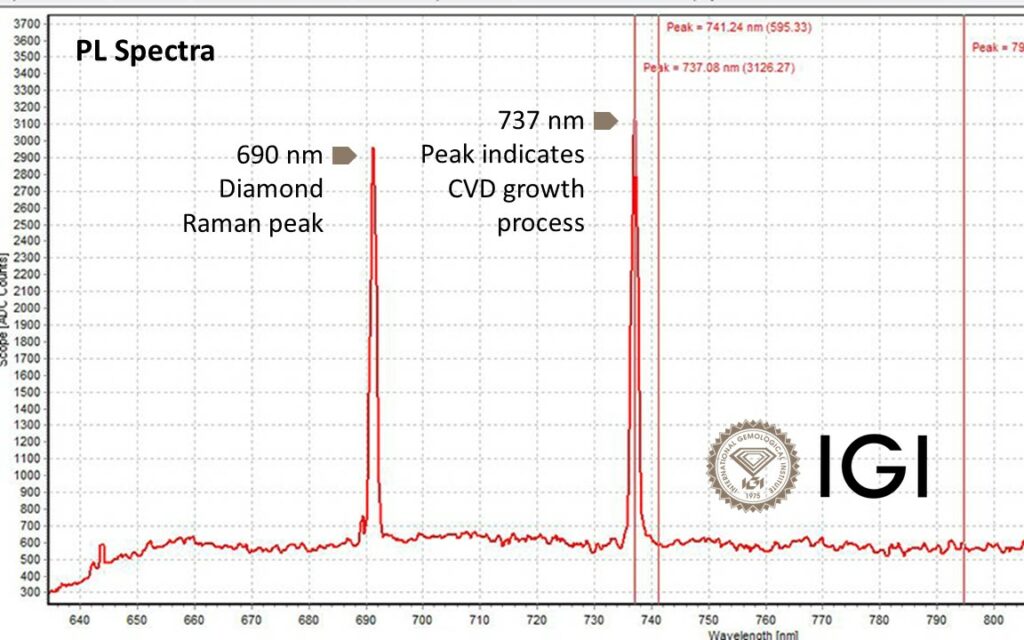
Photoluminescence spectroscopy revealed a doublet at 737 nm due to SiV defects, indicating laboratory growth using the Carbon Vapor Deposition (CVD) process. This was further supported by microscopy, which showed a carbon inclusion in place of the feather indicated by GIA and a cloud, resulting in a lower clarity grade from IGI. A slight depth mismatch was also revealed. Such discrepancies could go unnoticed outside of a laboratory, particularly once the stone is set into a piece of jewellery.
IGI’s discovery comes on the heels of other industry alerts stating that lab-grown diamonds are being sold as natural.