Editor’s Note
This article explores how additive manufacturing has evolved in the jewelry industry since its early applications, highlighting the ongoing challenge of scaling production responsibly while leveraging innovation.
One of the very first applications of additive manufacturing in the jewelry sector dates back to 2008: a 3D printed ring in gold, one of the most sought-after precious metals for fine jewelry. Over time, innovation in this field has allowed jewelers and service bureaus to harness the possibilities offered by AM. The problem is that, as with any manufacturing business, it is necessary to scale up, and to do so responsibly – and this is something the jewelry industry is striving to achieve with precious metals and AM.
Described as rare metals with high economic value, precious metals are chemically inert and less reactive than other elements. Unlike in the past where they were primarily used as currency, they are now considered investments and industrial raw materials that can be exploited in specific industries.
For this niche market, the discussion arises at a time when consumers have high expectations for what they buy. Ethical sourcing and sustainability issues are now too important to be ignored, even by the most luxurious brands that built their empire on an unspoken policy of “don’t ask, don’t tell” which would preserve the mystical character of their amazing works – or perhaps make them more appealing in the eyes of the buyer.
The current presumption is that, since AM is by nature a “sustainable manufacturing process,” it would be much easier to demonstrate the sustainable approach of luxury jewelry brands manufacturing products with precious metals. How close are we to this presumption? That’s the billion-dollar question we wish to address in this exclusive dossier.
To address this topic, we will explore:
I – Types and main characteristics of precious metals
II – Types of AM technologies capable of processing precious metals
III – The business case for the circular economy and the reason why it is difficult to develop AM of precious metals in the jewelry industry.
Even though the focus is on jewelry applications, it should be noted that precious metals can also be used in other vertical industries. These industries could be cited when and where necessary.
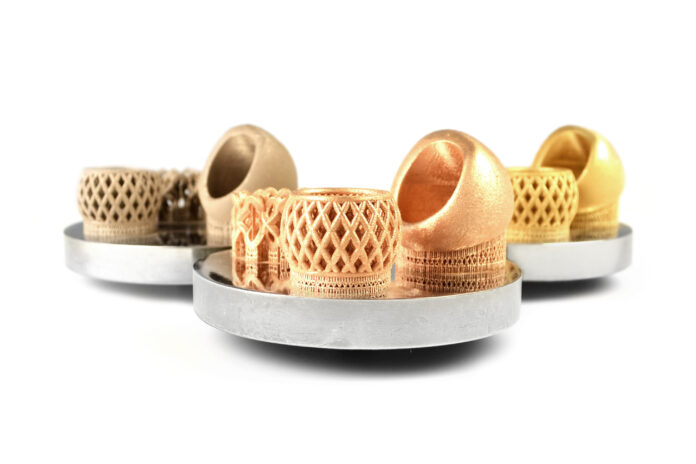
Regarding AM, the technology is suited for industrial applications when dealing with fine spherical powders of precious metals in gold, silver, platinum, and palladium alloys. Once refined for AM, they incorporate a very fine-grained microstructure, which can be easily handled and offer high purity and excellent fluidity.
The latter is an expert in 3D printing of precious metals and former business development manager for AM at Cooksongold, the UK’s largest one-stop shop for jewelry manufacturers.
Available in different forms, granular or sponge/powder forms are the most suitable for industrial use.
Gold – one of the best known in jewelry – is unique for its durability, malleability, and ability to conduct both heat and electricity.
Used in jewelry and other industrial applications, silver is known for its conductive, antibacterial, and malleable properties.
Platinum, on the other hand, is in high demand by the automotive industry, where it is used to reduce the harmfulness of emissions. Transformed into an alloy, it enables key applications in jewelry and dentistry.

Unlike other precious metals, platinum is easy to 3D print due to its low reflectivity and low thermal conductivity. For example, an application that can be produced in three hours with platinum can take up to ten hours with silver.