Editor’s Note
This article examines the complex ethical questions behind the global jewellery industry, tracing the journey of gemstones from mine to market. As demand for luxury gifts rises, it challenges consumers to consider the true cost of sparkle.
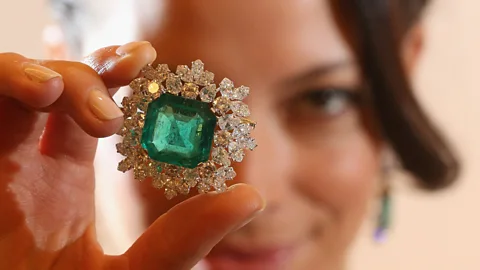
Jewellery is the ultimate luxury gift – but how can we be sure it’s also an ethical choice, asks Bel Jacobs.
When Marilyn Monroe sang “Diamonds are a Girl’s Best Friend” in the 1953 movie *Gentlemen Prefer Blondes*, she summed up the association of gemstones with glamour, sex, money and femininity – for a generation and beyond. Every year, consumers spend almost $300bn buying jewellery. And, as Christmas approaches, fine jewellery remains the ultimate luxury gift.
But behind the shine lie human and environmental concerns. Today’s consumers are increasingly jumpy about making the world’s problems worse but, with notably complex supply chains spread across the globe – many in countries where consideration of land and human rights are considered mere frippery – how is a concerned shopper to pick a piece of guilt-free jewellery?
Take a pair of shimmering 14-karat rose-gold earrings, adorned with blue and white diamonds, currently for sale at a top department store. At £3,000, they’re a present for that very special someone indeed. And yet, gold has been associated with human and environmental violations, while diamonds are still used as currency by warring factions in some of the world’s poorest countries. Suddenly, not so shiny.
Fundamentally, all mining – whether it’s for quartz, bauxite, cobalt or diamonds – is a brutal business; masses of earth hewn away for shards of minerals embedded within. Mines churn up vast swathes of land, pollute waterways with toxic chemicals, devastate wildlife. And because so much mining takes place in poorer countries, the need for the money it raises is urgent, and the battle for resources often violent.
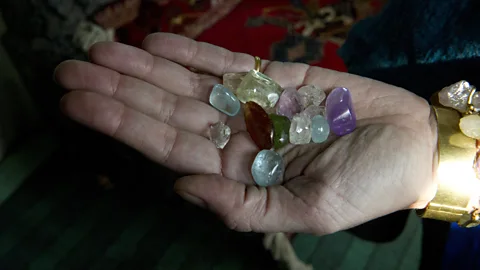
When Human Rights Watch (HRW) published its report *The Hidden Cost of Jewellery* earlier this year, it documented numerous abuses in the gold and diamond supply chain. Apparently, diamonds are only friendly for some. And the picture darkens further when it comes to coloured gemstones. Diamonds, which make up to 85 per cent of the precious-stones market, may be mined in industrial-scale operations; most coloured gemstones are prised from the earth in small-scale and artisanal mines, where miners use small machines or, in many cases, their hands. The idea of small mines run by local people may look good on paper but the reality is often anything but.
Driven by poverty, this is where conditions are at their worst. More than a million children work in artisanal mines, for example, in violation of human-rights laws, in countries where children are still considered a legitimate part of the work force. As a result, they risk respiratory diseases from dust, physical injury from carrying heavy loads, and brain damage from working with the mercury required to extract gold. But, conversely, if the West stops buying from community mines, families will literally be unable to feed themselves.
Ideally, the journey of gemstones from mine to market would be measured by reliable processes, monitored by independent third-party auditors.
The journey of coloured gemstones are the most difficult to follow.
Or as Greg Valerio, pioneer of fair-trade gold, puts it:
To understand the challenge is to measure HRW’s criticism of the Kimberley Process Certification Scheme. Set up in 2003 to prevent the trade in ‘conflict diamonds’, the process, for example, applies only to rough diamonds, which means that cut or polished stones fall outside its remit.
Despite that, two standards in the gold industry – Fairmined, introduced by the Alliance for Responsible Mining, and Fair-trade, by Fair-trade International – show what can be done when you set your mind to it. Fairmined and Fair-trade certify ethical small mines, allowing jewellers to trace the metal all the way back to source.
Taking all this on board is no easy feat for a potential purchaser. Giving old jewellery new life – turning Granny’s heirloom brooch into something more modern, for example – is an effective way of side-stepping ethical issues in modern mining, and avoids taking precious natural resources from the Earth. And synthetics – spookily similar to their natural counterparts – are also gaining popularity, with brands such as Carat and Ti Sento spearheading their use.