Editor’s Note
This article explores the genesis of NASA’s iconic space photography, revealing how a collaboration with leading photographic companies produced images of profound beauty and scientific value, originally intended for mission planning but destined to captivate the world.
When the astronauts left Earth, every picture they took was a first, pushing the boundaries of the possible. In Houston, NASA operated the world’s most advanced photo lab, producing photographs of unparalleled aesthetic and symbolic significance in close collaboration with Hasselblad, Zeiss (cameras and lenses), and Kodak (film and paper). A selection of images, primarily intended for the agency’s scientists to prepare for future missions, was presented to the public, sparking astonishment and a global awakening. In addition to these photographs, now etched into our collective memory, the auction includes some of the most historic photographs ever taken but never released by NASA. For more than 25 years, Victor Martin-Malburet has sought out these extraordinarily rare treasures, buried in scientific archives and the collections of former NASA engineers.
The collection belongs to Victor Martin-Malburet, who at age 15 developed a passion for the visual heritage of humanity’s great leap forward when he attended a space exploration auction with his father, a collector of contemporary art. His internationally recognized collection has been featured in major museum exhibitions. Alongside images that have become icons of pop culture, the auction brings forgotten treasures to light: breathtaking photographs that represent masterpieces of humanity’s artistic heritage.
With estimates starting at 300 euros, this historic sale, taking place online from April 14 to 28, 2025 in Paris, offers collectors and enthusiasts a rare opportunity to acquire a fragment of eternity. Highlights of the lots include the first photos taken in space and on the surface of another world, the first extravehicular activities in space and on the Moon, the footprint on the lunar surface, the far side of the Moon, as well as the iconic Earthrise and the Blue Marble, and many other incredible images.
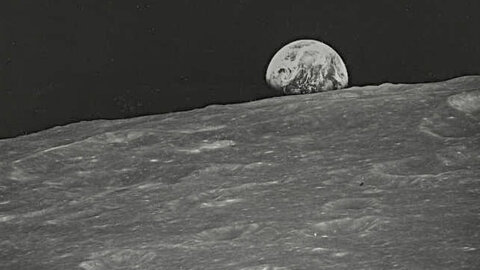
The auction honors Apollo 8 astronaut William Anders, who passed away in 2024. His unforgettable photos of the first Earthrise ever seen by humanity fundamentally changed our self-image and our place in the universe. The three images he captured – including two that remained unpublished for a long time – are offered in the sale.
Some of the photos up for auction:
– **The first photo of Earthrise**, taken by William Anders during Apollo 8 (Estimate: €12,000 – €18,000) – one of the most influential images in human history – was not immediately recognized as such after the mission and remained inaccessible in NASA archives for years. At the moment of capture, Anders exclaimed. To capture the effect, the color photo Anders took moments later was selected for the cover of LIFE magazine’s “100 Photographs That Changed the World.”

– **Neil Armstrong’s first photograph on the lunar surface** (Estimate: €7,000 – €10,000) was not released by NASA after Apollo 11. After taking the first step, Armstrong, overwhelmed by the wonder of this new world, deviated from the mission plan – which originally called for taking an emergency sample from the Moon in case of re-entry – and declared:
Thus, photography became the first human activity on another world.
– **The only photo of Neil Armstrong on the Moon, taken by Buzz Aldrin** (Estimate: €18,000 – €25,000). After the Apollo 11 mission, NASA claimed there were no photos of the first man on the Moon. However, this unique image showing the astronaut next to the lunar module Eagle was rediscovered 17 years later. Under pressure to quickly provide a selection of images to the scientific community and media after the missions, NASA’s Public Affairs Office did not always recognize the historical and artistic significance of some photos. Some were published out of context, others remained unpublished in the archives.
– Even the now-iconic **first selfie in space** (Estimate: €8,000-€10,000), a key image in the history of exploration, was at risk of being forgotten. NASA originally described the Gemini 12 photo quite simply: “Astronaut Aldrin was photographed with the spacecraft hatch open.” Much later, Buzz Aldrin himself claimed the image, captioning it “THE BEST SELFIE EVER.”

– **The first photo taken by John Glenn** during the first orbit of the Friendship 7 spacecraft. This historic 1962 image marks the beginning of humanity’s visual heritage in space. At the time, photography was still experimental – Glenn, the first American to orbit Earth, even bought his own camera for this shot. Estimate: €4,000-€6,000.
– Another iconic image, taken by James McDivitt.