Editor’s Note
**Editor’s Note:** This article explores the shifting consumer mindset where premium packaging is no longer seen as superficial but as an integral part of the product experience. From Cartier-inspired cakes to elaborate chocolate calendars, we examine why buyers are increasingly willing to pay extra for that perfect unboxing moment.
The saying “the packaging is flashy” is no longer an insult. Packaging is the final touch of product completion. For the recipient, it is the first impression of the item, akin to a teaser advertisement. The proverb “if given a choice, prefer the red skirt” may be more fitting in our era. A decent package steals people’s hearts, and leaving a ‘certification shot’ on social media platforms like Facebook and Instagram is no longer embarrassing—this is the current cultural trend.
Consider the cake sold in collaboration between Four Seasons Hotel Seoul and luxury jewelry brand Cartier. Enjoying a 39,000 won white square cake at the lobby lounge comes with complimentary coffee or tea (worth 10,000 won). However, this coffee/tea service is excluded for takeout—the opposite of typical cafe benefits. Yet, 70% of customers choose takeout, opting for the box with the Cartier logo. This box certifies the cake’s scarcity value. Yoon So-yoon, PR team leader at Four Seasons, said,
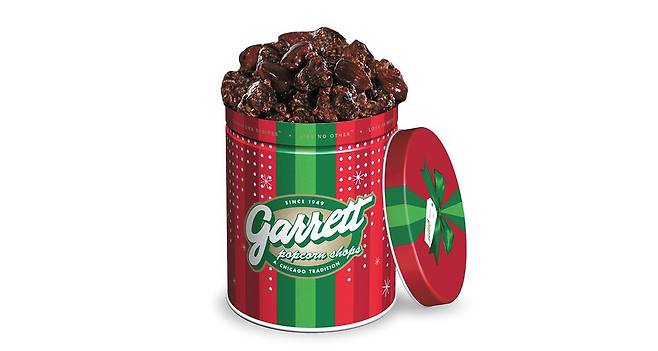
Sometimes, the navel is bigger than the belly. At Garrett Popcorn Shops, a Chicago-based artisan popcorn brand with locations at Lotte World Mall in Jamsil, Seoul, customers can choose between paper bags or cylindrical tins. The most popular Chicago mix in a small size (140g) costs 4,200 won in a paper bag, while a quart tin (145g) costs 13,800 won. Yet, from January to October this year, tin purchases accounted for one in five customers (20.14%). Seasonal limited-edition designs boosted tin sales further; in February, the ‘Platinum Tin’ for White Day accounted for 27.2% of total sales. Popcorn itself is hard to differentiate visually, but the unique tin enhances the ‘certification shot’.
The emphasis on packaging is most active in the visually-oriented dessert sector. The Korean dessert market is experiencing explosive growth. According to the Korea Agro-Fisheries & Food Trade Corporation (aT), the domestic dessert market grew from 300 billion won in 2013 to 1.5 trillion won last year—a fivefold increase in two years. This year, the market is expected to reach 2.2 trillion won.
In a growing market, product differentiation and premiumization are essential. Industry sources say that paid packaging in the confectionery and bakery sector was pioneered by high-end desserts imported from abroad, such as macarons and cupcakes. Dong Min-ho, senior designer at SPC Group’s Design Center, said,
Fashion 5 charged an additional 2,000-3,000 won for box packaging from the start. This led to paid packaging boxes incorporating brand identity and enhanced design and functionality. SPC Group’s Design Center even has a dedicated team researching package design for Paris Croissant and Paris Baguette.
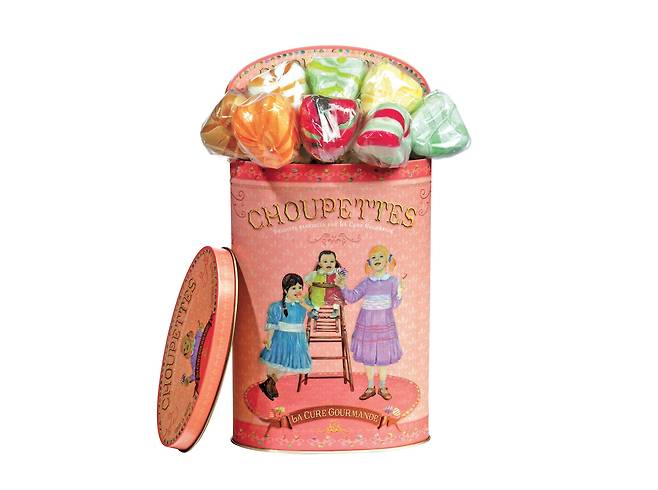
Some collectors now buy and collect packaging boxes separately. La Cour Gourmande, a French antique artisan confectionery, is one such product with high demand. They sell products in three types of tin cases depending on weight and shape, priced between 30,000 and 50,000 won. Many buy the tin cases themselves for interior decoration, with about 10 tins sold weekly at Lotte Department Store’s main branch. Among the Discovery (6,000 won), Gourmet (9,000 won), and Bucket (15,000 won) tins, the pastoral landscape Discovery is the most popular.
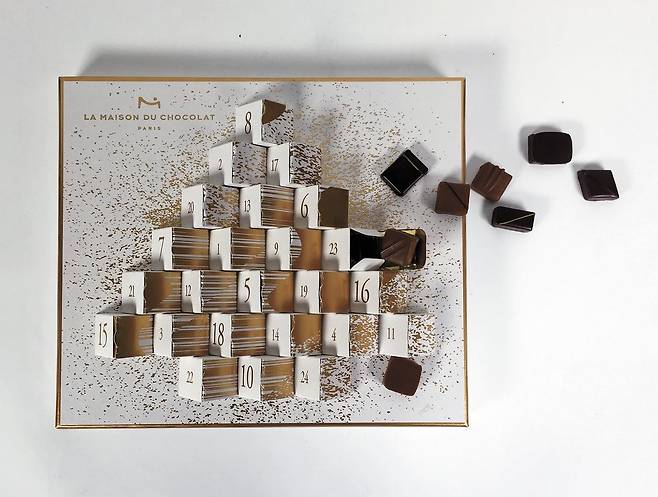
In response, brands release seasonal special editions to offer new sensations and fun. Premium chocolate brand La Maison du Chocolat, which releases Christmas editions annually, introduced an Advent Calendar product this year. With 24 cubic compartments each containing a chocolate (13 types, 24 pieces total), it allows counting down to Christmas Eve. After eating the chocolates, the empty box can be used to store accessories like earrings.
Packaging boxes themselves can express a brand’s identity. Hugo & Victor, a French chocolate brand inspired by Victor Hugo’s works, has packaging boxes called ‘notebooks.’ Launched by Hugues Pouget, former head pastry chef at Michelin three-star restaurant Guy Savoy, these boxes look like bound books when placed on a desk, and enthusiasts collect them in various colors.
The primary utility of packaging is functionality. Adding a trendy atmosphere makes it even better. Thus, premium paid packaging is expanding beyond desserts. Grand Hyatt Hotel’s flower shop Fiori developed a carrier (5,000 won) that allows carrying bouquets like a shopping bag, freeing hands and making the bouquet a fashion accessory. Bang Dong-min, head florist, said,
Packaging is also synonymous with sincerity and formality. Cosmetics brand Sulwhasoo offers two types of wrapping services at its flagship store on Dosan-daero: free and paid. The paid option uses high-quality silk with elegant knots. Shin Han-gyeol, a PR manager at Sulwhasoo, said,
Sulwhasoo also offers wedding gift wrapping services, priced at 55,000 won including the wrapping cloth, envelope, and knot decorations, and it consistently attracts customers.
Most items wear out or disappear with consumption, but packaging boxes remain, preserving the memory of the day’s taste and style. Even luxury brand boxes like Chanel are traded second-hand. Thus, dismissing packaging as vanity or pretense is no longer meaningful. In the era of ‘certification shots,’ where unpacking is introduced step by step and leftover boxes are used as interior decor, what ultimately survives may be the ‘total luxury’ that has nothing to discard from start to finish.