Editor’s Note
**Editor’s Note:** With gold prices reaching historic highs, we put the selling process to the test in Chaumont. This piece offers a firsthand look at how jewelers assess value and what consumers can expect when cashing in.
High Gold Prices: We Tested Selling Jewelry
By Delphine Catalifaud
3 minutes
February 5, 2026
Chaumont
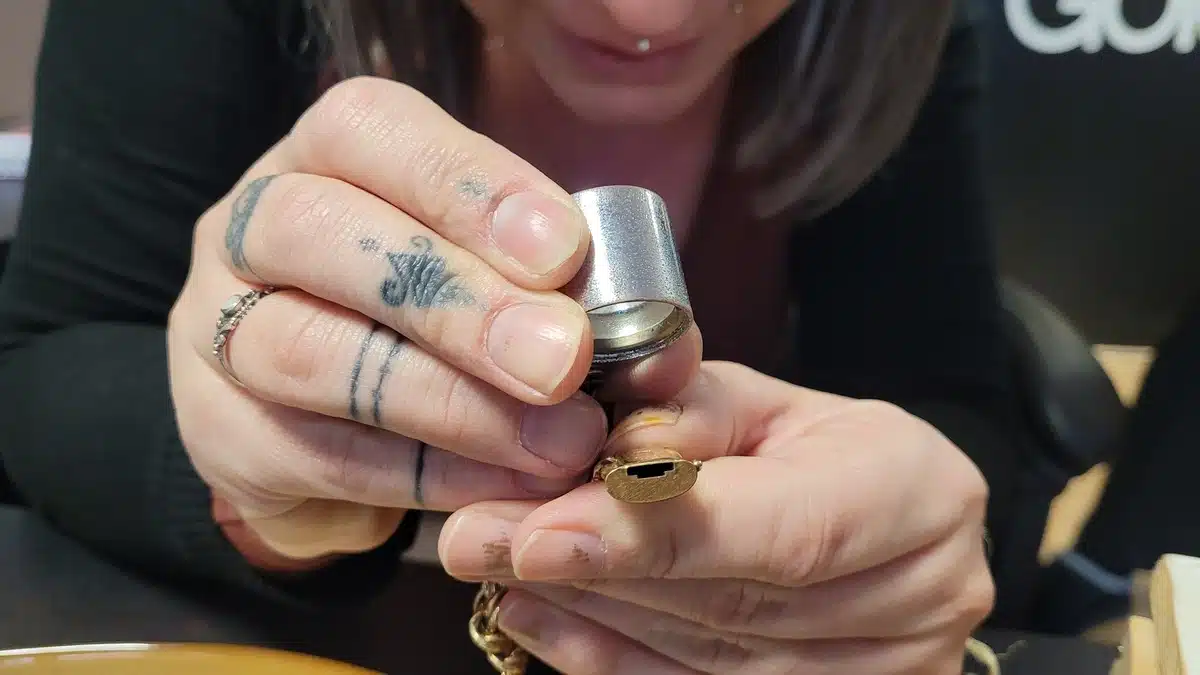
With a magnifying glass, Amandine Kesler examines the hallmarks on jewelry, which determine its value. (Photo: D. C.)
The price of gold has never been higher than at the end of January. Although it has slightly decreased since then, its value remains very high, to the point that sales of gold jewelry, coins, and bars have seen a sharp increase in activity. How does it work? We tested it in Chaumont.
An appointment was made for 10 a.m. on the morning of February 2. We ring the bell. For obvious security reasons, the door is locked. The manager of Goldnord, the gold buying/selling agency located in the center of Chaumont, welcomes us. January, she says, was very active, as the price of gold has never been so high. On January 29, its value rose to €151.30 per gram.

In her position since March 2023, she has seen the price soar. At that time, its value was only €60 per gram.
Amandine Kesler and Meriem assure: if the price of gold is high right now, it could collapse at any time.
Before any free appraisal, Amandine Kesler listens. Her clients are about to part with objects of high financial value, but also often sentimental value.
Especially since, after the 48-hour withdrawal period, the jewelry is definitively sold and sent to be melted down.

On her desk: a magnifying glass, a touchstone, and small bottles of acid in a box. These are her work tools. For our test, Amandine Kesler will appraise two pieces of jewelry. This bracelet immediately catches her attention. A glance at the hallmark. It has one. But, she was certain: it’s written next to it in full, it’s gold-plated. Its value remains very modest and does not interest the manager, who is looking for gold.
This bracelet is not gold, the gold-plated hallmark confirms it.
The watch she places on her tray, however, is of a different caliber. This object appears to be 18 karat, the eagle head hallmark confirms it. But a verification is necessary, with appropriate acid.
After scratching the bracelet and its dial on a touchstone, which does not damage the jewelry at all, Amandine Kesler brushes a little acid onto the marks left on the stone. If they disappear, it’s not gold. The mark remains; the jewelry she shows us will now be weighed – excluding the weight of the mechanism and the glass – to be appraised.
The test is simple: scratch the jewelry on a touchstone, then apply specific acid to the mark. If it disappears, it’s not gold. (Photo: D. C.)
No fees, no commission, she assures, just the price determined by the gold price at that moment. All that remains is to fill in all the client’s details, take a photo of the item, and record all the data in a register book. No cash here; payment is made by bank transfer, within about 48 hours. Recently, a client who came to appraise jewelry found in an attic and from which she expected little, left with nearly €30,000. A golden deal!
Delphine Catalifaud
