Editor’s Note
This article highlights a concerning trend for major luxury conglomerates, with LVMH’s latest results showing an accelerated revenue decline. However, it also points to a resilient bright spot: the enduring strength of the high jewelry segment. This divergence underscores a shifting landscape where ultimate craftsmanship and rarity may be weathering the storm better than broader luxury categories.
Sales of major overseas luxury brands continue to slump. The revenue of LVMH, the world’s largest luxury group, last year was 80.807 billion euros (approximately 139 trillion won), a 4.5% decrease compared to the previous year. Revenue had also decreased by 1.7% the year before that, indicating the rate of decline has accelerated. Last year’s net profit also plunged by 13.3% to 11.222 billion euros. The fashion and leather goods division, which accounts for 47% of revenue, was hit hard as sales fell by 8% from about 41 billion euros to 37.7 billion euros. In simple terms, this means people aren’t buying Louis Vuitton and Dior handbags as much these days.
Kering Group, which owns Gucci, Yves Saint Laurent, and Bottega Veneta, is in a similar situation. Based on the most recent performance in the third quarter of last year, revenue was about 3.4 billion euros, a 10% decrease compared to the same period last year. The poor performance of its flagship brand, Gucci, was particularly notable, with third-quarter sales plummeting by 18%.
In fact, the crisis for luxury brands is partly self-inflicted. By continuously raising prices, they have effectively created the impression of deceiving consumers. A prime example is Chanel. One of its representative models, the ‘Classic Maxi Handbag,’ is currently sold in Korea for 20.33 million won, while its price at the end of 2020 was 10.14 million won. The price has doubled in five years. Chanel’s most recently disclosed performance was for 2024, where revenue decreased by 5.3% year-on-year to about 18.6 billion euros. Operating profit plunged by 30.1% to 4.4 billion euros.
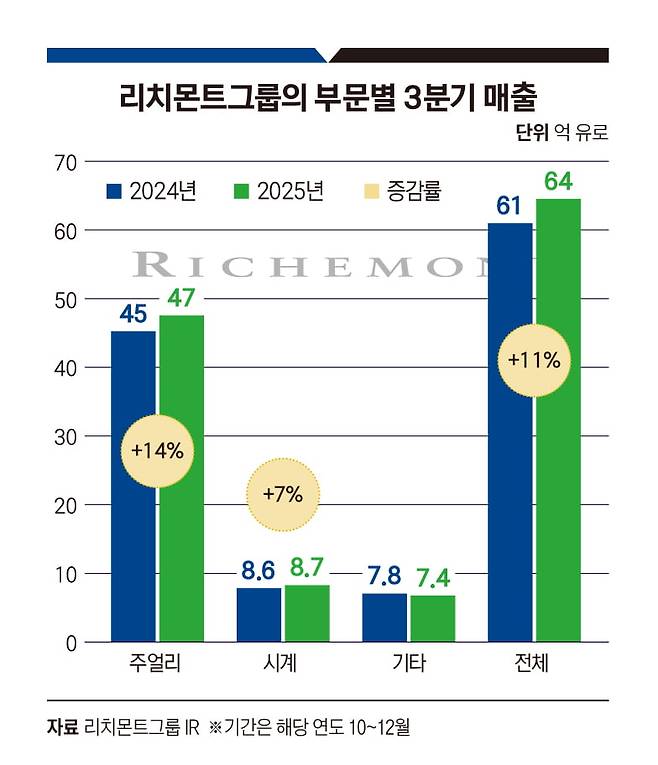
However, upon closer inspection, not all luxury brands are facing a crisis. Some luxury items are selling well, with Richemont being a prime example. The company’s revenue for the third quarter (October-December) of last year was 6.4 billion euros, an 11% increase compared to the same period last year. This company’s representative brands are ‘High Jewelry’ like Cartier and Van Cleef & Arpels. In fact, the company’s jewelry division sales in the third quarter increased by 14%.
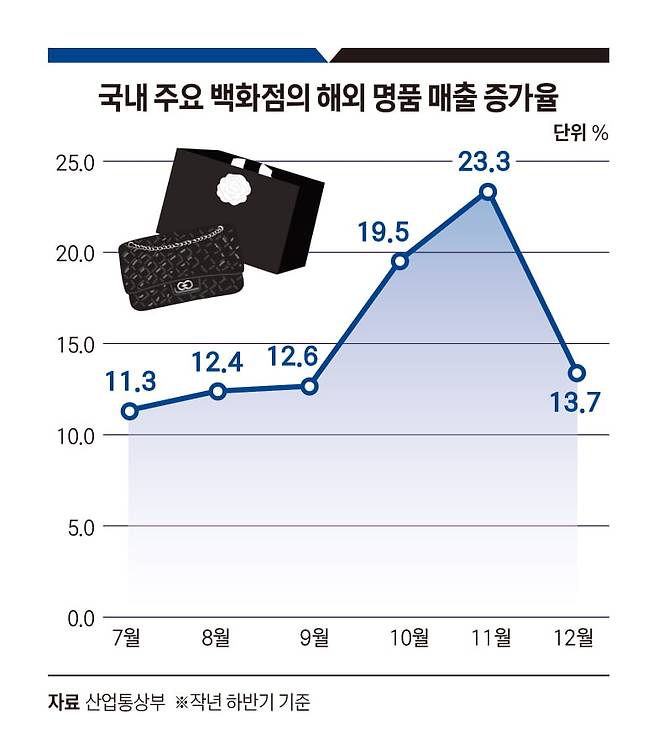
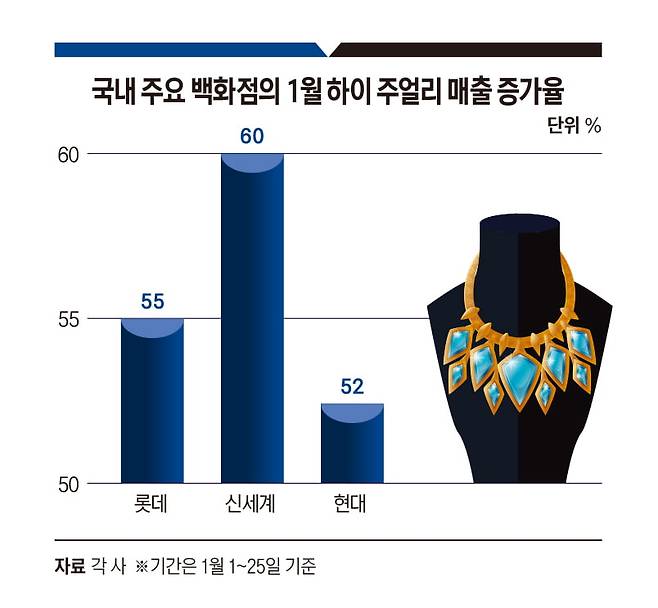
High jewelry sales are also surging this year in major domestic department stores. According to the Ministry of Trade, Industry and Energy, sales of overseas luxury goods in domestic department stores increased by 10.2% last year. This is not because Chanel or Louis Vuitton bags sold well, but because high jewelry sales increased. In fact, upon checking with department stores, as of January this year, Shinsegae Department Store’s high jewelry sales increased by 60% compared to the same period last year. Lotte Department Store and Hyundai Department Store also saw growth rates exceeding 50%. We looked into what high jewelry is and why consumer spending is flocking to it.
First, for those unfamiliar with high jewelry, here’s a brief explanation. High jewelry, simply put, is ‘expensive gemstones.’ Jewelry also has grades. There are accessories made of silver or plated materials, focused on design. There is ‘Fine Jewelry,’ a popular jewelry line mainly using gold like 14K, 18K, 24K and natural gemstones. And finally, there is ‘High Jewelry,’ manufactured with rare gemstones and craftsmanship. It can be seen as the pinnacle of jewelry.
High jewelry is also called ‘Haute Joaillerie’ in French, meaning ‘high-end jewelry masterpieces’ combining the finest gemstones and craftsmanship. Sometimes it takes years to obtain a single gemstone, and production also requires an enormous amount of time. There are also many ‘unique pieces’ that are the only one in the world.
In the high jewelry industry, there is the ‘Big Four’: Cartier, known as the ‘Jeweler of Kings’; Van Cleef & Arpels, famous for its ‘Alhambra’ series; Bulgari, characterized by its brilliant colors; and Tiffany, a symbol of American luxury. Also, Graff, known as the ‘King of Diamonds,’ and Boucheron, popular for wedding bands these days, also hold high status.
So why is high jewelry selling well? The most important reason is that consumers have begun to perceive high jewelry as an ‘asset.’ As raw material prices have soared, people have started to think that jewelry is not merely a luxury item but has value worth investing in. For example, last year, silver prices surged by 167%. Platinum prices rose by 149%, and gold prices also increased by 57%.
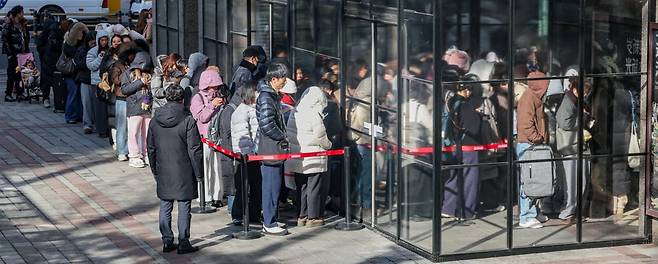
Naturally, high jewelry prices have also soared. In the case of Cartier, which typically raised prices once or twice a year, it increased prices more than three times last year and again once more this January. Before the price increase on January 27th, long lines formed at major stores, creating quite a scene. For the popular model ‘Damour,’ despite a significant price increase, it’s said that purchasing is difficult for the time being due to lack of inventory.
On the other hand, the resale price premium for fashion products like handbags or clothing is dropping significantly. Hermès is a prime example. Hermès is famous for being difficult to buy even if you have money, leading to active second-hand or auction transactions. However, the average resale premium for Hermès’s representative models, the Birkin and Kelly bags, fell from 2.2 times in 2022 to 1.4 times in November last year. A 1.4x premium means a $10,000 bag sells for $14,000 in the second-hand market, which is lower than the 10-year average premium of 1.69x for these bags. In particular, for the Birkin Togo 30, the current premium is almost non-existent. Burberry is also analyzed to have seen its second-hand market price drop by about 12-18% last year.
Another reason for the shift in demand to high jewelry is ‘scarcity.’ Immediately after the COVID-19 pandemic, luxury brands enjoyed a boom as consumers, unable to travel abroad, flocked to them, but as a result, luxury goods became more common. The term ‘3-second bag’ even emerged, reflecting the increase in middle-class, or ‘aspirational buyers.’
As the middle class massively entered the luxury purchase market, the ‘truly wealthy’ no longer wanted to carry luxury handbags. This tendency is stronger among VIPs within the top 5% of department store sales.
In fact, this is also a strategic failure of luxury brands. To maintain luxury status, brand management should take precedence over sales, but in the effort to increase sales, they produced too many items, diminishing scarcity. While doing so, they only raised prices, breaking the balance between supply and demand.
Pricing strategy also played a part. As the price of Chanel’s representative bag exceeded 20 million won, with that money, one could now buy a mid-to-high-end Alhambra necklace from Van Cleef & Arpels. From the consumer’s perspective, if it’s the same 20 million won, they judged that jewelry made of diamonds or gold would be better than a calfskin handbag.
Finally, there’s the ‘wealth effect.’ As the KOSPI index surpassed 5000 and real estate prices in Seoul’s Gangnam district soared, asset holders became even wealthier. Recently, not only asset-rich individuals but also ‘salaryman rich’ are increasing. For example, SK hynix paid performance bonuses averaging 1.5 times an employee’s annual salary last year due to record performance. For an annual salary of 100 million won, that means receiving a performance bonus of 150 million won alone. Samsung Electronics’ semiconductor division is also known to have received performance bonuses approaching 50% of their annual salary. This liquidity is flowing into the high jewelry market.
How long will the high jewelry boom last? Experts believe it will continue for the time being. According to Industry Research, the high jewelry market size is expected to grow from about $180.8 billion this year at an average annual rate of 7.8% to reach $355.6 billion by 2035. This is because about 60% of high jewelry buyers are ultra-high-net-worth individuals, and as wealth concentration intensifies, their purchasing power is also increasing.
Globally, the number of individuals with investable assets exceeding $1 million has surpassed 22 million, with particularly rapid growth in Asia and North America. The biggest reason they buy high jewelry is ‘long-term value preservation.’ High jewelry cannot be mass-produced like luxury handbags, making it highly scarce. Ultimately, it seems the luxury industry is also changing, with the ‘mass-tige’ market targeting the middle class shrinking and the focus shifting towards ultra-high-net-worth individuals.