Editor’s Note
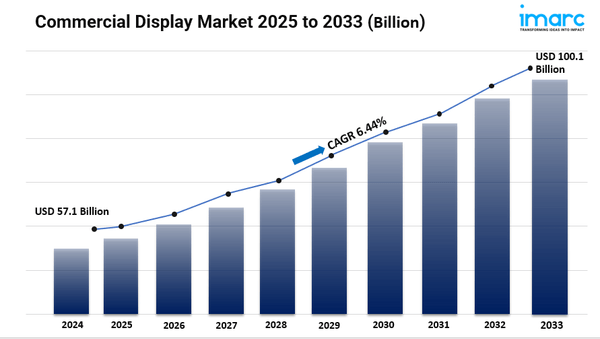
This article presents a concise overview of the global commercial display market, highlighting its projected growth from USD 57.1 billion in 2024 to USD 100.1 billion by 2033, with a steady CAGR of 6.44%. The data underscores the sector’s expansion, primarily fueled by the rising adoption of digital advertising and interactive technologies.
Historical Year: 2019-2024
Forecast Year: 2025-2033
Market Size in 2024: USD 57.1 Billion
Market Forecast for 2033: USD 100.1 Billion by 2033
Growth Rate (CAGR) 2025-2033: 6.44%
The global commercial display market size reached USD 57.1 billion in 2024. Looking forward, the market is projected to reach USD 100.1 billion by 2033, exhibiting a growth rate (CAGR) of 6.44% during 2025-2033. The market is experiencing steady growth, driven by the increasing focus on digital advertising to capture the attention of a broader consumer base, the rising need to create immersive in-store experiences, and the adoption of 4K and 8K resolutions to enhance clarity and detail.
The commercial display market is evolving significantly due to technology and consumer needs. A key trend is personalization. Companies are using data to create content that appeals to specific audiences. This improves engagement and conversion rates, making personalized displays essential for marketing. Furthermore, the advent of 5G technology enhances connectivity and enables instant updates. This allows businesses to adapt quickly to market changes. The rise of hybrid work will also increase the need for displays in offices. These displays improve collaboration between remote and in-office workers. By 2025, we can expect more high-resolution displays for video calls, digital signage, and interactive presentations. This will transform business operations and customer interactions. In summary, the market is poised for robust growth, driven by a focus on innovation, sustainability, and enhancing customer experience.
The commercial display market is shifting towards interactive technologies. These are now essential in retail, education, and corporate settings. Businesses aim to attract customers and enhance experiences. Interactive displays achieve this by capturing attention and enabling interaction. They use touchscreens, gesture recognition, and augmented reality (AR) to create immersive experiences. This not only engages customers but also provides real-time information. Retail spaces are leading this trend. Here, displays showcase products, offer virtual try-ons, and provide personalized promotions. By 2025, demand for interactive displays is expected to grow. This is due to the need for businesses to stand out and advancements in display technology. Improvements in resolution and responsiveness will make these solutions indispensable in commercial environments.
Breakdown by Product Type:
• Digital Signage
• Display Monitors
• Display TVs
Digital Signage is the most popular product type.
Breakdown by Technology:
• LCD Displays
• LED Products
• Others
Technology: LCD Displays are the most widely used technology.
Breakdown by Component:
• Hardware
• Software
• Services
Component: Hardware is the leading component in the market.
Breakdown by Panel Type:
• Flat Panel
• Curved Panel
• Other Panels
Panel Type: Flat Panel Displays are the most common type.
Breakdown by Size:
• Below 32 inches
• 32 inches to 52 inches
• 52 to 75 inches
• Above 75 inches

Size: Displays between 32 inches and 52 inches are the most popular size.
Breakdown by Application:
• Retail
• Hospitality
• Entertainment
• Stadiums & Playgrounds
• Corporate
• Banking
• Healthcare
• Education
• Transportation
Application: Retail is the largest application segment.
Breakdown by Region:
• North America
• Asia Pacific
• Europe
• Latin America
• Middle East and Africa
Region: North America dominates the market due to a heightened focus on advertising and branding.