Editor’s Note
This article discusses the extreme rarity of Fabergé’s Imperial Eggs, with only seven remaining in private hands. As expert Kieran McCarthy explains, their status as unique historical artifacts means they are becoming virtually priceless, moving beyond the realm of mere commodities.

There may soon — potentially very soon — be a time when even the world’s greatest riches are unable to purchase one of Fabergé’s legendary Imperial Eggs. The storied St. Petersburg jewelry house only ever produced 50 for the Russian Tsars Alexander III and Nicholas II between 1885 and 1916. Seven are missing, and most of the others are in institutions or museums, leaving just seven in private ownership.
According to Fabergé expert Kieran McCarthy, co-managing director at Wartski, only three remain in what he called “truly private” hands and could ever be realistically acquired.
Now, for the first time in over two decades, one of the three is up for auction. Auction house Christie’s estimates that the 1913 Winter Egg will fetch “in excess of” £20 million ($26 million) in London on December 2. Should this price be realized, the 112-year-old curio would not only set an auction record for a Fabergé egg — it would obliterate the one the Winter Egg itself set in 2002.

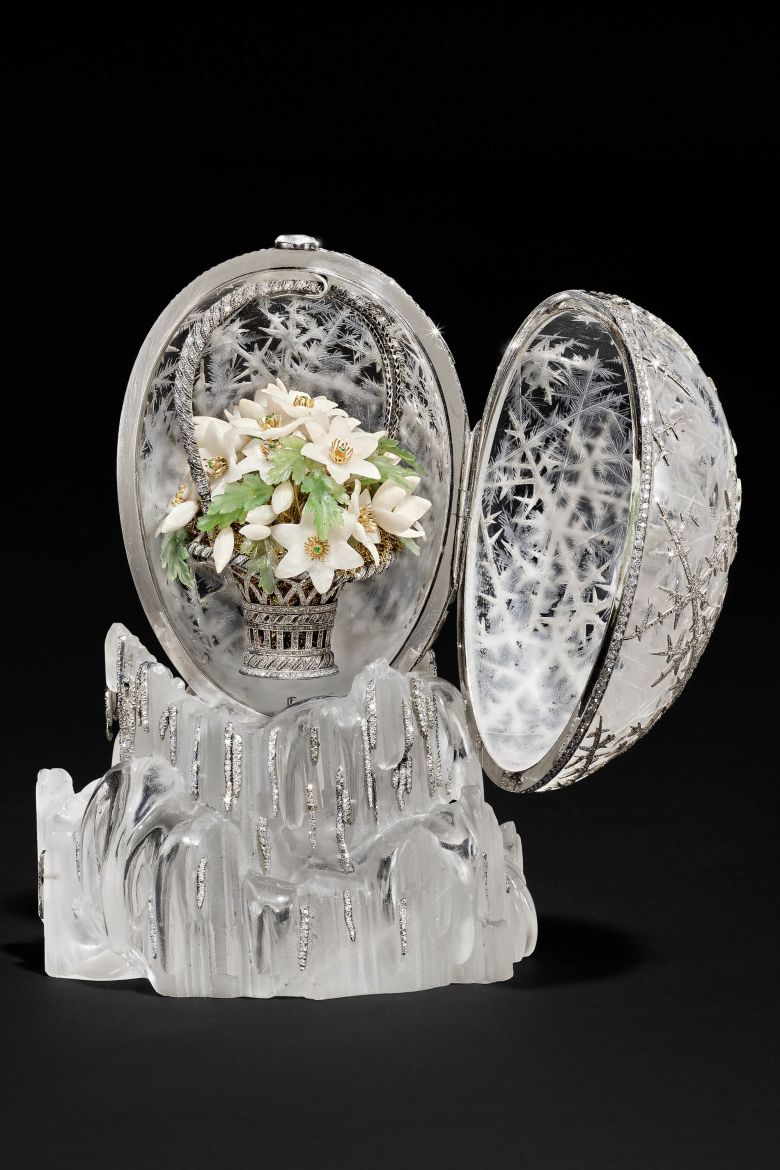
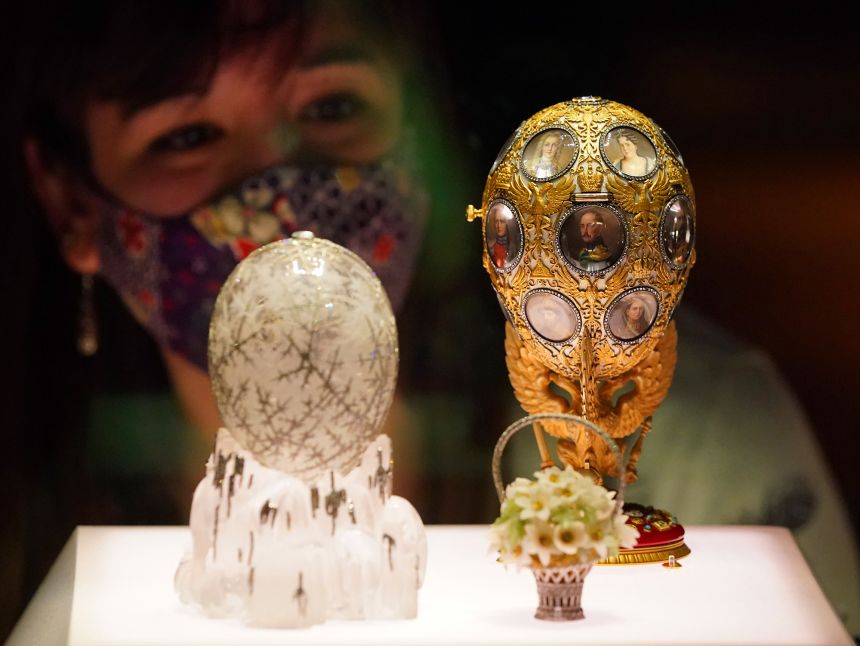
Supply and demand aside, Christie’s believes its astronomical estimate reflects the object’s unique artistic qualities. Made from a block of clear quartz, the egg looks as if it has been carved from ice and dusted with frost. Engraved snowflakes sparkle with rose-cut diamonds; platinum trickles down the base as if it were thawing in spring sunshine.
Like all Imperial Eggs, this one also opens to reveal a “surprise”: a hanging basket filled with wood anemones. Their tiny petals are carved from white quartz and sat on nephrite stems, with bright green garnets dotting their stamens.
McCarthy, who curated the 2021 exhibition “Fabergé in London: Romance to Revolution” at the Victoria & Albert Museum, said the Winter Egg is “perceived to be the greatest of them all,” calling it “the most iconic Russian work of art, quite arguably, ever.”
The head of Christie’s Fabergé and Russian artworks department, Margo Oganesian, concurred, describing it as “the most spectacular, artistically inventive and unusual” of the 50 Imperial Eggs. She pointed to invoices proving it has always been among the most valuable. Nicholas II paid 24,600 rubles for it — the third-highest sum Fabergé ever charged for a work.
The Winter Egg’s price tag was relative not to the materials it was carved from, but to the craftmanship required to transform them into snow and ice.
Nicholas II commissioned the Winter Egg as a gift for his mother, Dowager Empress Maria Feodorovna. The eggs took the best part of a year to produce and were ordered shortly after the latest had been delivered. The tsar never gave Fabergé specific instructions or ideas — he, too, seemingly enjoyed the surprise.