Editor’s Note
As China’s tea beverage market booms, a supply chain paradox emerges: surging demand clashes with product shortages, revealing deeper industry pressures behind the “subsidy wars.”

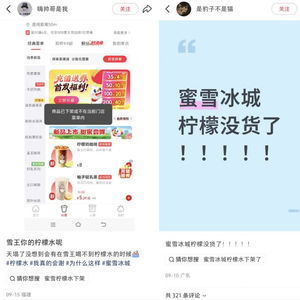
Since this summer, stimulated by the “subsidy wars” on food delivery platforms, the tea beverage industry has seen booming sales. However, an unusual scene is playing out at Mixue Ice City stores across the country—the signature lemonade product has quietly been taken off the shelves.
This supply chain storm triggered by lemons has not only disappointed many loyal fans of this budget-friendly beverage giant but has also exposed the fragility of the entire new tea beverage industry’s reliance on a single-source raw material supply system. As extreme weather overlaps with surging market demand, the business logic of trading price for volume is facing an unprecedented test.
China News Weekly visited several Mixue Ice City stores in Beijing, where multiple managers reported that lemonade sales had been suspended for about a week. Even with “panic buying,” the daily quota is only enough to sustain sales for a day and a half. A manager at a Mixue Ice City store near Renmin University of China revealed that since September 20, they have had to use a specific app to purchase at 7 a.m. daily, with each store limited to one or two boxes. “Getting it is a win, not getting it means you can only watch helplessly.”
The situation of too many mouths and too little gruel exposes the shortcomings of leading brands in supply chain management: over-reliance on the economies of scale from a single production area actually amplifies systemic risks during crises.
Tongnan District in Chongqing is one of the world’s three major high-quality lemon production areas and the main source of raw materials for Mixue Ice City’s Iced Fresh Lemonade.
In 2023, Mixue Ice City sold over 1 billion cups of Iced Fresh Lemonade, consuming approximately 115,000 tons of lemons.
According to a CIC report, based on 2023 procurement volume, Mixue Group is China’s largest lemon purchaser. Based on 2023 beverage cup sales, Mixue Ice City’s Iced Fresh Lemonade, Fresh Ice Cream, and Pearl Milk Tea are the three highest-selling single products in China’s freshly made beverage industry. Among them, over 8 out of every 10 cups of freshly made lemonade come from Mixue Ice City.
Mixue Ice City, through its wholly-owned subsidiary “Snow King Agriculture,” has established close cooperative relationships with lemon growers in Tongnan. Yu Yang, Deputy General Manager of Snow King Agriculture, previously told the media that the company annually evaluates the infrastructure, pesticide application records, and tree health of cooperative orchards. Only orchards meeting the standards are included in the cooperation. “For those lemon growers who have established long-term relationships with us, we usually promise a minimum purchase volume and a fixed purchase price to protect their interests,” Mixue Group mentioned in its IPO prospectus.
However, in a market environment of supply-demand imbalance, the once common lemon has become a scarce commodity.
From the perspective of the harvesting cycle, the main harvesting season for yellow lemons, primarily produced in the Sichuan-Chongqing region, is concentrated from September to November each year; Guangdong and Yunnan in South China produce “spring fruit” from February to April. Freshly harvested lemons require professional storage methods such as low-temperature refrigeration and ventilation humidity control to enhance aroma and balance flavor.
This year, the price of yellow lemons has surged 3 to 5 times in a short period. In the retail market, the price per jin (500g) has even exceeded 20 yuan. Many small and medium-sized merchants, pressured by costs, have had to remove numerous beverages containing yellow lemons from their menus.

According to monitoring data from the Ministry of Agriculture and Rural Affairs, as of September 17, the national average wholesale price for lemons had reached 15 yuan/kg, nearly double that of the same period last year. This global wave of lemon production reduction stems from a combination of extreme weather events in major producing regions like Southern Europe and South America—drought, heavy rain, and low-temperature frost damage followed one after another, leading to a sharp reduction of about 6% in international supply. Domestic core producing areas such as Anyue in Sichuan and Tongnan in Chongqing were also affected. Last year’s persistent drought impacted pollination during the flowering period, and this spring saw abnormal low temperatures, causing a significant drop in the fruit-setting rate of yellow lemons.
This lemon crisis is by no means accidental; it is an eruption of long-accumulated structural contradictions within the tea beverage industry.
Over 70% of China’s yellow lemons are produced in Anyue, Sichuan, and Tongnan, Chongqing, forming an industrial pattern of “putting all eggs in one basket.” In contrast, the coffee industry can disperse risks through procurement from multiple locations like Brazil and Colombia, while China’s lemon industry has not yet established a globalized layout, leaving it with weak risk resistance. More worryingly, 90% of tea beverage stores use ordinary yellow lemons, indicating severe variety homogenization.
Statistics from the Ministry of Agriculture and Rural Affairs show that the fruit tree planting cycle lasts 3 to 5 years, while the tea beverage market expands at an annual rate of 20%. In 2025, the national lemon planting area is projected to increase by only 8% year-on-year, far lower than the 15% expansion rate of beverage store numbers. This supply-demand mismatch is particularly fatal in the new tea beverage industry, where blockbuster single products account for over 60% of sales. Any raw material fluctuation triggers a chain reaction.
An important source of demand-side growth is the “lemonade” product becoming a blockbuster track within the tea beverage industry. As a “versatile tool” in the beverage world, lemon’s application scenarios continue to broaden, and its market size keeps expanding.
According to the “2025 China Beverage Industry Product Report” released by Kamen, in 2024, among 1,578 new products launched by 38 mainstream tea beverage brands, lemons were used 228 times, ranking at the top of the fruit application list for two consecutive years. Taking Mixue Ice City as an example, the single product “Iced Fresh Lemonade” sells over 1 billion cups a year.
Besides beverages, lemons are widely used in catering seasoning, baking, pharmaceuticals, cosmetics, and other fields. This diversified demand further intensifies the supply-demand contradiction.
Furthermore, as the “main force” for domestic lemon exports, Anyue lemons must fulfill export orders while facing reduced production. From January to May this year, its self-operated export value increased by 22.3% year-on-year. Against the backdrop of global lemon production reduction, domestic market demand for lemons continues to grow. According to analysis and forecasts by the China Research Puhua Industry Research Institute, in 2025, the market size of China’s lemon industry, composed of fresh lemons, beverage raw materials, and deep-processed products, will reach 58 billion yuan, an increase of 7 billion yuan from 2024, with a year-on-year growth rate of 13.7%. The combination of internal and external factors has further widened the supply-demand gap for lemons.
For Mixue Ice City, which focuses on “4 yuan lemonade,” this crisis directly impacts its profit foundation. In its cost structure, lemons account for over 30%. If purchased at current market prices without being able to pass on the cost, the loss per cup could reach 1 to 2 yuan. Based on daily sales of 500,000 cups, the direct daily loss could be as high as 500,000 to 1 million yuan. More severely, the brand’s “high cost-performance” positioning limits room for price increases, forcing the company to make difficult choices between maintaining volume and protecting profit.
The pressure is transmitted to the terminal, with small and medium-sized franchisees bearing the brunt. Multiple stores reported that after suspending lemonade sales, daily turnover dropped sharply by about 30%, while fixed costs such as rent and labor still need to be paid. The manager of Mixue Ice City’s Dazhongsi store in Beijing said helplessly: “The scene of selling out the entire day’s quota by 11 a.m. and customers leaving disappointed happens every day.”
China News Weekly’s on-site visits found that among 30 stores interviewed, 14 had suspended lemonade sales, meaning about 40% of Mixue Ice City stores had stopped selling lemonade for nearly a week.
A China News Weekly survey of 20 consumers showed that 50% of customers purchased lemonade more than 6 times a week, and 60% of them explicitly stated they would not choose other alternative beverages. “Many customers come specifically for lemonade. Now we can only watch them leave empty-handed,” said a staff member at the Mixue Ice City Renmin University store. When core SKUs are forced off the shelves due to raw material shortages, brand loyalty will be tested.
Supply chain stability has become the “lifeline” for a brand’s sustainable development. The “affordable era” of tea beverages cannot rely solely on market dividends; it requires continuous improvement of the supply chain and precise control at the source. The storm triggered by lemons leaves the entire industry with urgent reflections—when extreme weather becomes the new normal, no enterprise can win by relying on a single factor.