Editor’s Note
This article highlights a remarkable fusion of traditional craftsmanship and modern technology, as India’s Imaginarium uses 3D printing to create a record-setting diamond ring. It underscores how additive manufacturing is enabling new frontiers in design and precision for the jewelry industry.
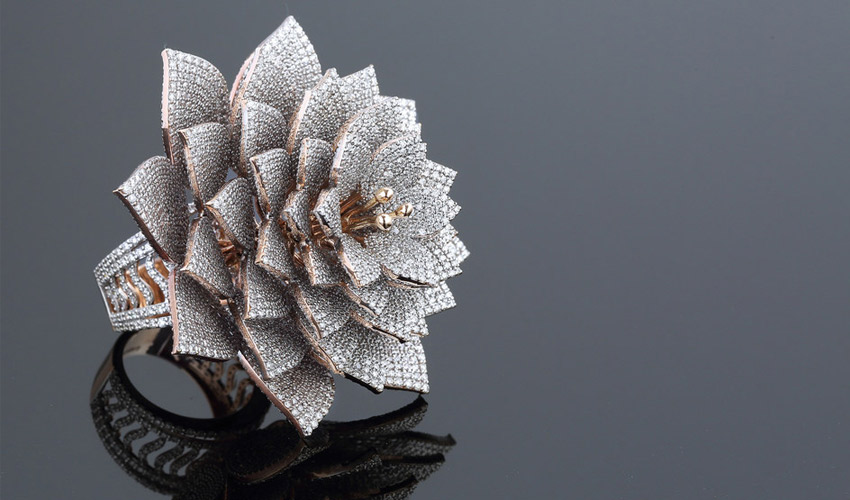
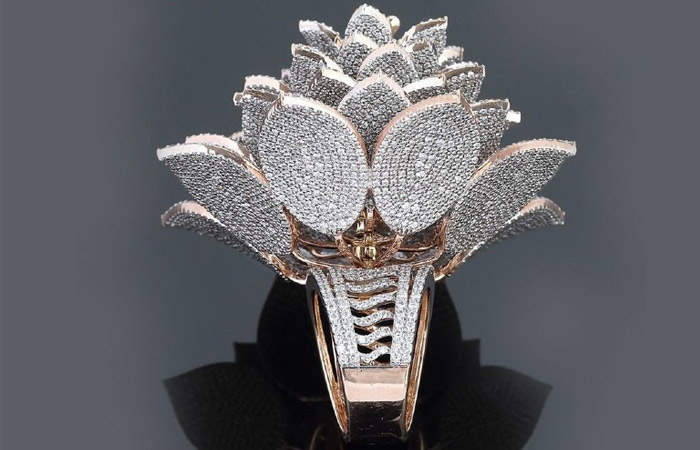
Imaginarium, a 3D printing service based in India, has set a surprising record: it created the ring with the most diamonds in the world, precisely 7,801! This record, inscribed in the Guinness Book of World Records last September, was made possible thanks to additive manufacturing. Named “The Divine – 7801 Brahma Vajra Kamalam,” the ring was 3D modeled, and its mold was 3D printed using a resin machine before being cast in gold. This long-term project reportedly began in September 2018. The result is stunning and well worth sharing!
In the jewelry sector, more and more players are turning to 3D printing to create more complex custom molds. Most often, the lost-wax casting process is favored. The goal is to 3D print the jewelry model with wax. It is then enveloped in a refractory material, thus obtaining a mold. The wax contained inside is then heated, creating a void inside the mold, which is then filled with molten metal – gold, silver, bronze. The mold is then broken to obtain the final piece of jewelry. Thanks to additive manufacturing, jewelers can imagine original designs impossible to achieve through conventional manufacturing processes.
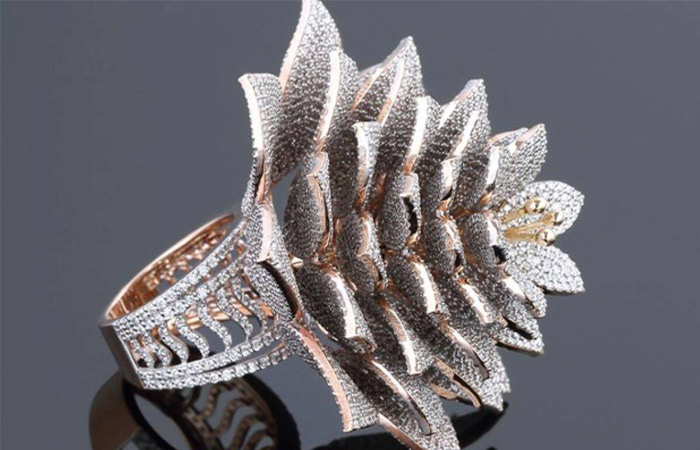
This is likely what motivated Kotti Srikanth, manager of the Diamond Store by Chandubhai, to use the Imaginarium printing service. His goal was to design a ring with as many diamonds as possible, which required knowing precisely where each one would be placed. After imagining several iterations, the ring’s designers explain that they finally opted for a flower shape, more specifically a Himalayan camellia flower. This would offer a perfect balance between traditional and more modern forms.
CAD modeling reportedly allowed them to see how many diamonds could be placed, and once the file was ready, collaboration with Imaginarium could begin. The 3D printing service explains that it divided the ring into seven sections: six flowers and the band. Each flower has a different size, allowing them to be stacked on top of each other. A RapidShape resin machine was used to 3D print the model of the ring: the material is reportedly directly castable, which allowed for easy creation of the gold piece.
Kotti Srikanth adds that one thing is sure: the ring does not go unnoticed!
It seems this record was broken again last November with a total of 12,638 diamonds, but we felt it was important to highlight the role played by additive manufacturing in this specific case.