Editor’s Note
**Editor’s Note:** This article examines the projected growth of the gemstone manufacturing and precious metal processing equipment market, highlighting key drivers such as ethical sourcing, sustainability, and technological innovation.
The market for gemstone manufacturing and precious metal processing equipment is projected to grow significantly, driven by ethical sourcing, sustainability, and technological advancements.
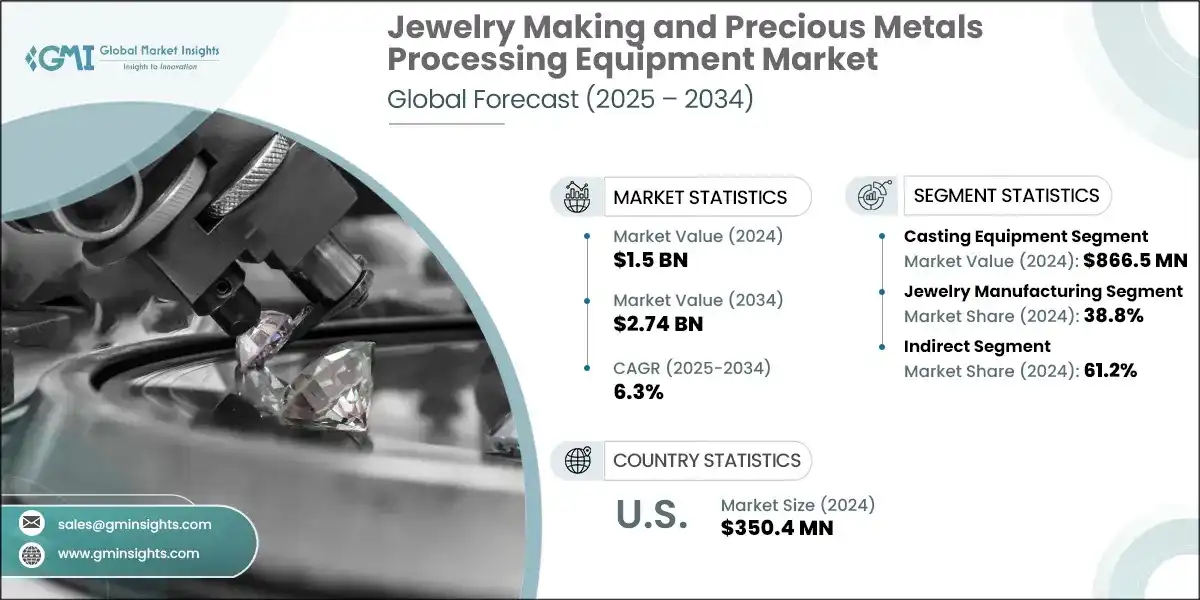
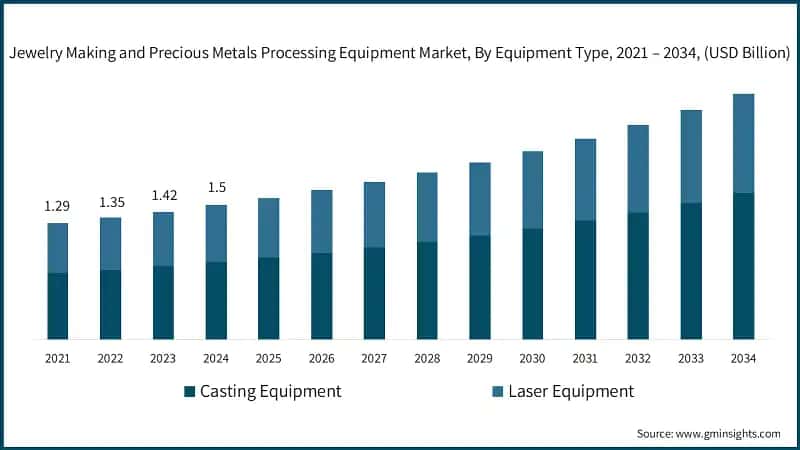
According to a recent study by Global Market Insights Inc., the global gemstone manufacturing and precious metal processing equipment market was estimated at USD 1.5 billion in 2024. The market is expected to grow at a compound annual growth rate (CAGR) of 6.3%, from USD 1.57 billion in 2025 to USD 2.74 billion by 2034.
– **Market Size (2024):** USD 1.5 billion
– **Forecast Market Size (2034):** USD 2.74 billion
– **CAGR (2025–2034):** 6.3%
– Increasing demand for customized and high-end jewelry
– Technological advancements in processing equipment
– Growing adoption of automation and digital design tools
– High cost of advanced equipment
– Volatility in precious metal prices
– Emergence of 3D printing in jewelry manufacturing
– Rising demand for sustainable and ethically sourced gemstones
– **Market Leader:** Rio Grande led the market with a share of over 11.6% in 2024.
– **Top 5 Companies:** Rio Grande, Durston Tools Ltd., SuperbMelt, Gesbain Co. Inc., and Pepetools collectively held a 13.5% market share in 2024.
The precious metal processing equipment and gemstone manufacturing sector is growing rapidly due to several factors. The most important is the increasing demand for high-quality, customized jewelry. Individuals, especially younger consumers in developed and emerging economies, prefer jewelry that reflects their identity, lifestyle, or culture. The demand for high-precision, small-scale production is rising, leading manufacturers to implement advanced technologies to provide precise designs.
Advanced technologies such as laser cutting using CNC machines and vacuum casting have enhanced manufacturing, minimized material waste, and improved production speed and product quality. Automation and computer-aided design software, including CAD/CAM programs and 3D printing technology, have also improved the speed of jewelry prototyping and product customization. These technologies reduce labor costs and enable designers to produce complex designs with consistent quality.
The APAC region leads the market due to its robust manufacturing base, efficient human resources, and high demand from both domestic and international markets. India, China, and Thailand are renowned for producing both mass-produced and customized jewelry. This region benefits from low labor costs, government incentives, and cultural values that favor gemstone exports.
In 2023, India’s manufacturing sector accounted for 17.4% of its GDP, while China’s manufacturing sector represented 27.7% of its GDP in the same year, demonstrating a strong industrial base. Rising incomes and urbanization in APAC are also fueling demand for new, high-quality designs. Additionally, most Western brands source production from APAC, solidifying its position in the international market.
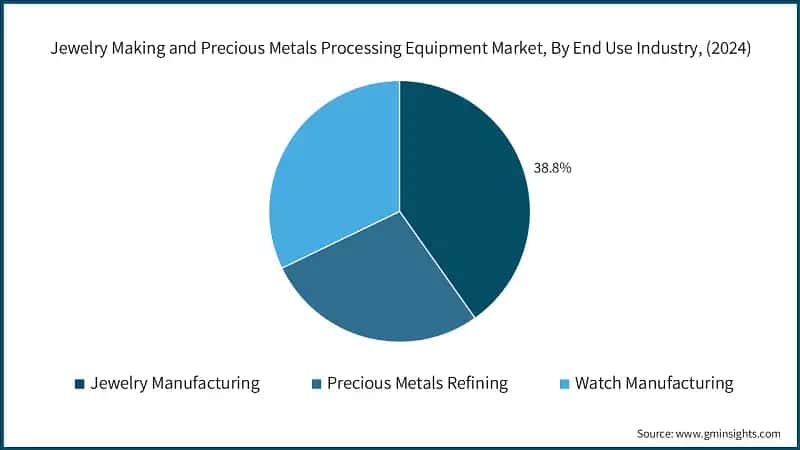
Casting machines are the most widely used equipment in gemstone production. Casting allows manufacturers to produce complex designs at low cost and in large quantities, making it suitable for both commercial and custom jewelry. This technology is applicable to most precious metals and alloys and has evolved alongside improvements such as vacuum and centrifugal casting. These processes minimize material waste and improve the quality of the final product. As manufacturers emphasize scalability and precision, casting equipment continues to be a major investment in this sector.
Jewelry manufacturers are increasingly using computer-aided design and manufacturing (CAD/CAM) software and 3D printing technology to revolutionize jewelry design and production. Since 2020, jewelers have used these technologies to produce precise and personalized models faster and more accurately. With CAD/CAM, designers can create computer models, which are then used to make molds or directly 3D print wax or resin models for casting.
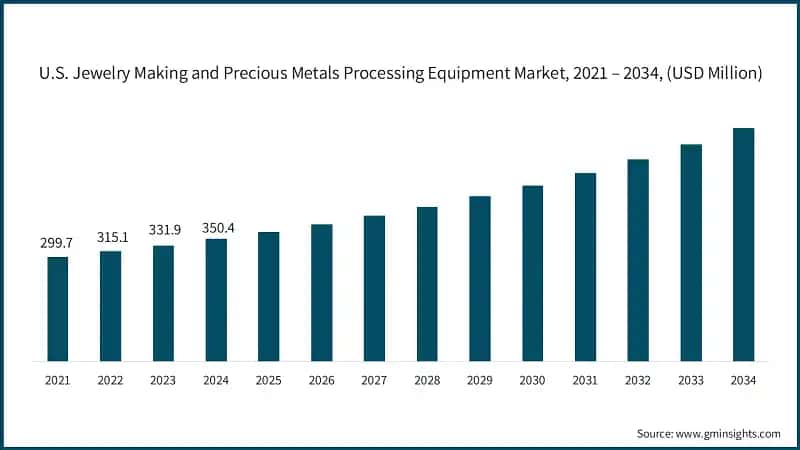
3D printing has also reduced prototyping and small-batch production costs and increased variety compared to traditional methods. According to the U.S. Census Bureau, the adoption of advanced manufacturing technologies such as CAD/CAM and 3D printing in the jewelry sector grew at an annual rate of 14% between 2020 and 2023. This adoption is expected to continue through 2030, with more manufacturers in regions like Asia-Pacific and Latin America increasingly embracing these technologies.
Sustainability and ethical sourcing are becoming increasingly important in the jewelry industry, influencing product production and consumption. Since 2021, and especially from 2023, companies have been using recycled metals, minimizing chemical waste, and installing energy-efficient machinery. Consumers and regulatory bodies are demanding transparency in the supply chain, pushing the industry toward more responsible practices.