Editor’s Note
This article discusses the All India Jewelers and Gold Smith & Sarafa Association’s move to introduce standard retail sale rates for gold and silver, aiming to bring clarity to consumers amid varying market charges.
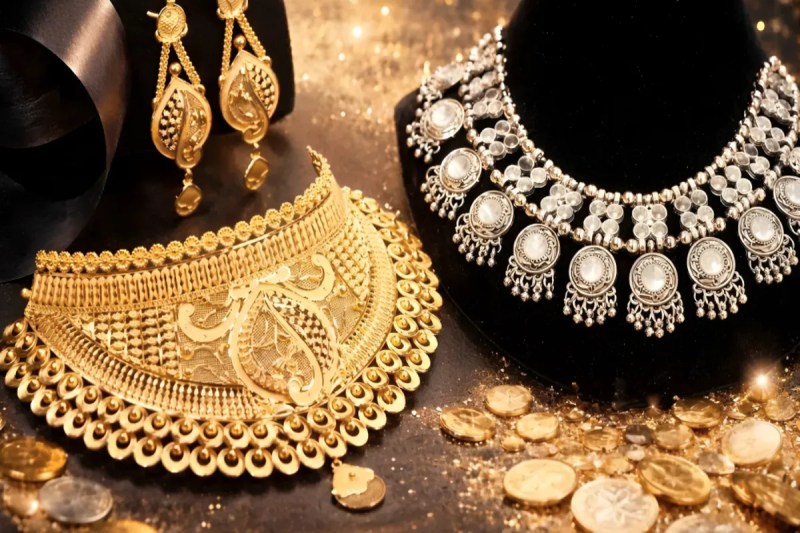
In response to consumer confusion arising from varying making charges and rates in the Sarafa (bullion) market, the All India Jewelers and Gold Smith & Sarafa Association has announced standard retail sale rates for customers for 10 grams. The new rates for gold and silver will be exclusive of GST, making charges, and hallmarking fees.
For a long time, disparities in making charges and rates have been observed across the country’s Sarafa markets. Customers often face confusion due to different rates in different cities, markets, and among individual jewelers. In this context, the All India Jewelers and Gold Smith & Sarafa Association has taken the initiative to announce standard retail sale rates for customers, modeled on a branded pricing system.
The rates announced by the association are determined for retail customers based on 10 grams. However, it has been clarified that GST, making charges, and hallmarking fees will be added separately to these rates. This step is considered significant in bringing transparency and uniformity to the market.
24 Carat – ₹1,57,500
22 Carat (92%) – ₹1,45,900
18 Carat (76%) – ₹1,20,600
Additionally, the rate for silver (jewelry) has been stated as ₹2,47,000.
The Sarafa market has long faced the problem where every jeweler sets their own making charges differently. One shop may charge 8% making charges, while another may charge up to 15%. Similarly, there has been a lack of clarity regarding hallmarking and other fees. Customers often get confused about the purity of gold and the final bill. Differences in rates at different shops also lead to a lack of trust. In such a scenario, this initiative by the association is seen as an important step towards strengthening customer confidence.
The All India Jewelers and Gold Smith body says that just as major brands set uniform prices for their products, a standard rate system should be implemented in the Sarafa market as well. This will give customers the confidence that no matter which part of the country they go to, they will get gold and silver at approximately the same base rate. However, market experts also acknowledge that gold and silver prices change daily based on the international market, the dollar rate, and demand-supply. Therefore, these rates will also be revised from time to time.
This initiative is expected to provide three key benefits to customers:
Transparency – Clarity on the base rate will increase transparency in billing.
Ease of Comparison – Customers will be able to compare making charges and other fees at different shops.
Increased Trust – Rates issued by the association will strengthen trust in the market.
However, making charges and GST contribute significantly to the final price, so it is essential for customers to get full information before purchasing.
Some jewelers believe this step will balance competition in the market. Meanwhile, some say that the cost structure differs in every city and market, so complete uniformity may be practically challenging. Nevertheless, most traders are of the opinion that announcing a minimum standard rate will send a positive message to customers and reduce unnecessary confusion.
Hallmarking is extremely important in gold purchases. The hallmark certified by the Bureau of Indian Standards (BIS) guarantees the purity of gold. 22-carat gold is considered 92% pure, while 18-carat contains 76% pure gold. Customers are advised to purchase only hallmarked jewelry and to always take the bill.
If the wedding and festive season begins in the coming months, an increase in demand for gold and silver can be seen. Traditionally, Indian families prefer to buy gold for both investment and jewelry. The association believes that the standard rate system will bring transparency and ease to purchases during festivals.