Editor’s Note
**Editor’s Note:** Our latest lab tests on fashion jewelry reveal a troubling reality: many affordable, trendy pieces contain harmful levels of nickel, cadmium, or lead. With one in four women allergic to nickel, these findings underscore the urgent need for stricter safety compliance.
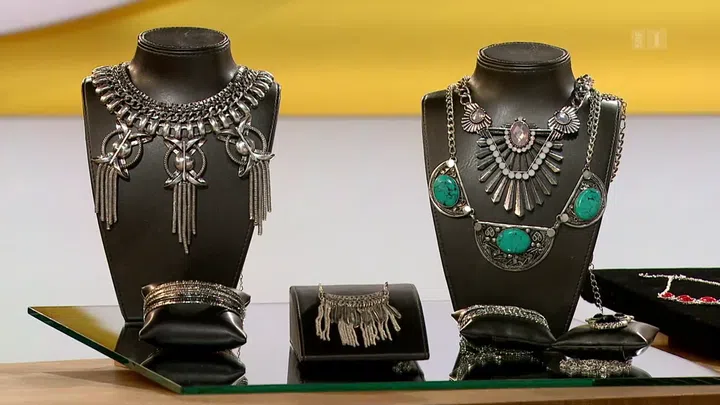
Fashion jewelry in nickel test: Bijoux with side effects
One in four women is allergic to nickel. Fashion jewelry must therefore not release nickel onto the skin. For the toxic heavy metals cadmium and lead, there are maximum limits. “Kassensturz” had jewelry tested in a laboratory and received sobering results.
Fashion jewelry is not only trendy but also inexpensive. Manufacturers quickly copy the latest trends from fashion designers, using cheap metals, mostly “Made in China.” However, not every piece can be worn without risk. It can release nickel or contain the heavy metals lead and cadmium.
Nickel can trigger allergies on the skin, leading to redness and blisters, which in worst cases must be treated with cortisone. Ten percent of the population is allergic to nickel. Among women, it is even 25 percent, according to Alexander Navarini, head of the Contact Allergy Department at the University Hospital Zurich.
Legal limits for lead and cadmium have only existed since 2014. These heavy metals can seriously endanger health because they are highly toxic. Both substances can cause a range of problems, as dermatologist Alexander Navarini explains:
The laboratory found lead or cadmium or even both in three products, but the amounts contained in none of the jewelry pieces exceed legal limits and pose no health risk.
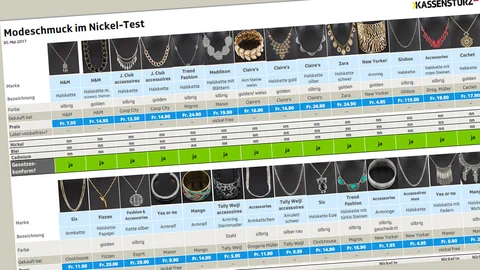
Caution for nickel allergy: These jewelry pieces contain the substance.
In the nickel test, however, 6 out of 28 jewelry pieces do not meet legal requirements. For cantonal chemist Pius Kölbener, this 20 percent is a high rate:
The necklace from Manor’s own brand “Yes or No” is even labeled as nickel-free. This is consumer deception, criticizes Kölbener from the Cantonal Laboratory St. Gallen:
The necklaces from Six, purchased at Clockhouse C&A and Migros, released too much nickel at the clasp in the lab test. For the bangles from New Yorker, the laboratory found issues with the silvery rings. The men’s necklace from New Yorker released too much nickel everywhere. Equally health-hazardous are the complete jewelry pieces—both necklace and pendant—from Manor and Mango.
Cantonal chemist Pius Kölbener would object to all six products that released too much nickel in the “Kassensturz” test. The result is sobering compared to the nationwide campaign of cantonal chemists in 2015:
New Yorker, which had two products in the test that released too much and legally impermissible amounts of nickel, writes to “Kassensturz”:
Mango has not yet responded to “Kassensturz’s” letter. If this provider does not voluntarily withdraw the nickel-containing jewelry pieces, the responsible cantonal laboratories are likely to act quickly.
For the nickel test, the strip is rubbed over all parts of the jewelry piece. If the test strip changes color, the nickel release exceeds the limit, making it health-hazardous and no longer allowed to be sold. The more intense the color, the stronger the release.
Testing for lead and cadmium is done in two stages. First, a chemist checks whether the X-ray fluorescence spectrometer can detect the heavy metals cadmium or lead on the jewelry surface. If so, they examine more closely: First, they separate the suspicious jewelry parts. Then they dissolve them in acid. In a so-called atomic absorption spectrometer, a sample is vaporized. In the vapor, a light beam measures how much cadmium or lead a jewelry piece contains.
Author: Karin Gfrörer

30.05.2017, 08:53