Editor’s Note
**Editor’s Note:** This article highlights a key mid-infrared spectral feature—CO2-related bands at ~2456 and 2418 cm⁻¹—found in unheated natural sapphires, particularly those from low-iron metamorphic sources like Sri Lanka. The strong peak at ~3161 cm⁻¹ serves as a valuable diagnostic tool for gem identification.
In synthetic material, natural sapphires displayed CO2-related bands at ~2456 and 2418 cm⁻¹. The mid-infrared (IR) spectral feature (figure 1) is an important tool in the identification of unheated sapphires, especially in material from low-iron metamorphic environments such as Sri Lanka. This feature is a series of bands, composed of a strong peak at ~3161 cm⁻¹.
Both quartz and moganite will crystallize together as agate forms, but moganite is not stable at Earth’s surface and will convert to quartz over tens of millions of years (Heaney, 1995; Gíslason et al., 1997; Moxon and Rios, 2004). Thus, older agate contains less moganite. Agate from Idar-Oberstein is Permian in age (around 280 million years old), while agate from the Brazilian state of Rio Grande do Sul generally formed during the Cretaceous (around 120 million years ago). It is thought that Rio Grande do Sul would have been a primary source of material exported to Europe because it is one of Brazil’s oldest and largest agate producers.
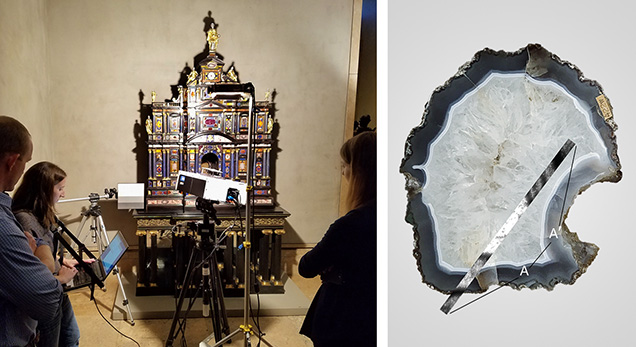
When examining the cryptocrystalline parts of agate from comparative collections, Brazilian agates from the collection of the Natural History Museum of Los Angeles County (NHMLA; figure 1, right) had 8% or higher moganite concentration, whereas the Idar-Oberstein agate (on loan from the Smithsonian National Museum of Natural History) had less than 2% moganite. The moganite distribution in the agate is heterogeneous, likely due to different growth stages and changing geological conditions during agate formation. Using the Raman maps, we were able to isolate the areas that contained moganite + quartz and measure the ratios in those specific bands (figure 2). This narrow-band approach to determining quartz to moganite ratio, when compared to broad-band and whole-sample approaches, was shown to be more reproducible in distinguishing Brazilian from German agates.
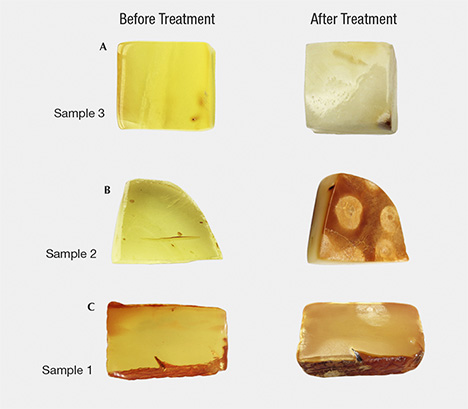
Since at least 2000, corundum has been subjected to a beryllium (Be) heat treatment technique in Chanthaburi, Thailand. For this study, samples of transparent to translucent milky-white to yellow, purple to violet, and light to medium blue sapphires from Sri Lanka (metamorphic origin) were heat treated with Be in three types of furnaces (gas, electric, and fuel) at various temperatures and in both oxidizing and reducing atmospheres. The technique of Thai gem heating specialist Thawatchai Somjaineuk was used to intensify blue color, improve clarity, and distribute uneven color. Somjaineuk’s technique has been used to enhance Sri Lankan corundum with a milky/silky appearance since 2004, and supplies approximately 50 kg of beryllium-treated blue sapphire per year to the gem market.
The samples were studied after each step of heating for basic gemological properties, spectroscopic properties using ultraviolet/visible/near-infrared (UV-Vis-NIR) and Fourier-transform infrared (FTIR) absorption spectroscopy, and chemical composition using laser ablation–inductively coupled plasma–mass spectrometry (LA-ICP-MS). The corundum samples were first heated in a traditional O₂/LPG mixed-gas furnace to about 1500°C for two hours in an oxidizing atmosphere. The white to yellow and light to medium blue sapphires turned colorless, whereas the purple to violet sapphires became pink. The second step of heating was performed with Be in an electric furnace at about 1700°C for 48 hours in an oxidizing atmosphere. After this process, the milky/silky colorless sapphires became a more transparent yellow, while the pink sapphires turned orange-pink. These stones were enhanced in the final step by reheating in a fuel furnace at about 1700°C for 72 hours in a reducing atmosphere. All samples became blue with light to strong saturation and tone.
IVCT. However, chemical data were analyzed for those samples and showed relatively high Mg and Be concentrations in comparison with the Ti composition, which does not fit well with the model that indicates [Ti⁴⁺/Fe²⁺] IVCT.
Although Australia has assumed a major role in the production of sapphire, research on this material has not been comprehensive. This study aims to analyze the gemology and spectroscopy of Australian sapphires and provide a theoretical basis for their treatment.
An absorption peak (figure 1, left) related to structural OH groups within the sapphire revealed that these samples grew in reducing conditions. LA-ICP-MS indicated that the Cr/Ga ratio was less than 1 and the Fe/Ti ratio was generally 10–100 (figure 1, right), the typical ratio of magmatic sapphire. The iron content was between 3230 and 9431 ppm. Color varied with the content of Fe, Ti, Si, and Mg. UV-Vis absorption peaks (figure 2) at 377, 387, and 450 nm were caused by the d-d electronic transition of Fe³⁺.
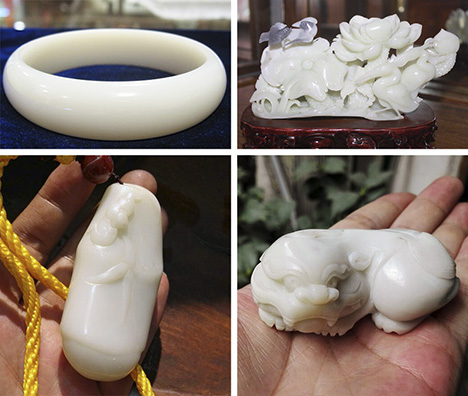
In oval-cut jadeite jade with a low degree of transparency, most of the light is reflected at the point of incidence or absorbed. Little light reaches the underside, and therefore a relatively dark area forms at the other side of the curved surface.
– Gem Testing Laboratory, Jaipur, India
– 3Chanthaburi Gem and Jewelry Manufacturer Association, Chanthaburi, Thailand
– 2Gem Testing Center of China University of Geosciences, Wuhan