Editor’s Note
**Editor’s Note:** This piece explores how the contrasting creative styles of two goldsmiths—one spontaneous, one perfectionist—merge to define the unique identity of their jewelry brand, Simuero.
They say their jewelry is a reflection of themselves. The pieces that pass through the hands of Rocío Gallardo (Alicante, 1992) are wild, spontaneous, and irregular; while those molded by Jorge Ros (Valencia, 1992) take on refined, sculpted, and almost perfect forms. “He is very perfectionist, I am more of a go-with-the-flow person,” she says. This perfect balance is reflected in Simuero, the jewelry brand with a melodramatic name that they began shaping as soon as they signed up for some pottery classes. A year and a half after returning to the oilcloth tablecloth (like when they were children) and about to celebrate the first anniversary of their online store, they are enjoying unexpected success. “We are freaking out,” they express sincerely. They receive orders from all over the world, their buyers become voluntary brand advocates, and they have managed to create a solid and personal brand image – something difficult in the age of Instagram.
However, when this meeting takes place, Jorge takes out his iPhone, opens a note, and says:
In this distribution, which ultimately follows logic, it turns out that, for example, they dedicate a good part of their day to writing by hand the dedications for each package they send (in fact, they call the pieces by the names of their future owners), that the most successful photos on social media are those of Rocío’s hands, unedited and unretouched, with the jewelry, and that he is finishing the visual identity of ‘El fruto’, their next launch. For now, Simuero is a complement to their main jobs. Of course, they steal hours from the day to get everything done. Jorge takes his bicycle to visit the suppliers who handle the few processes they outsource. Rocío uses the time left by wax modeling to answer customer questions that arrive in their Instagram inbox or email, even at odd hours. In the background, you might hear anything from Jean Pierrot to Camarón.
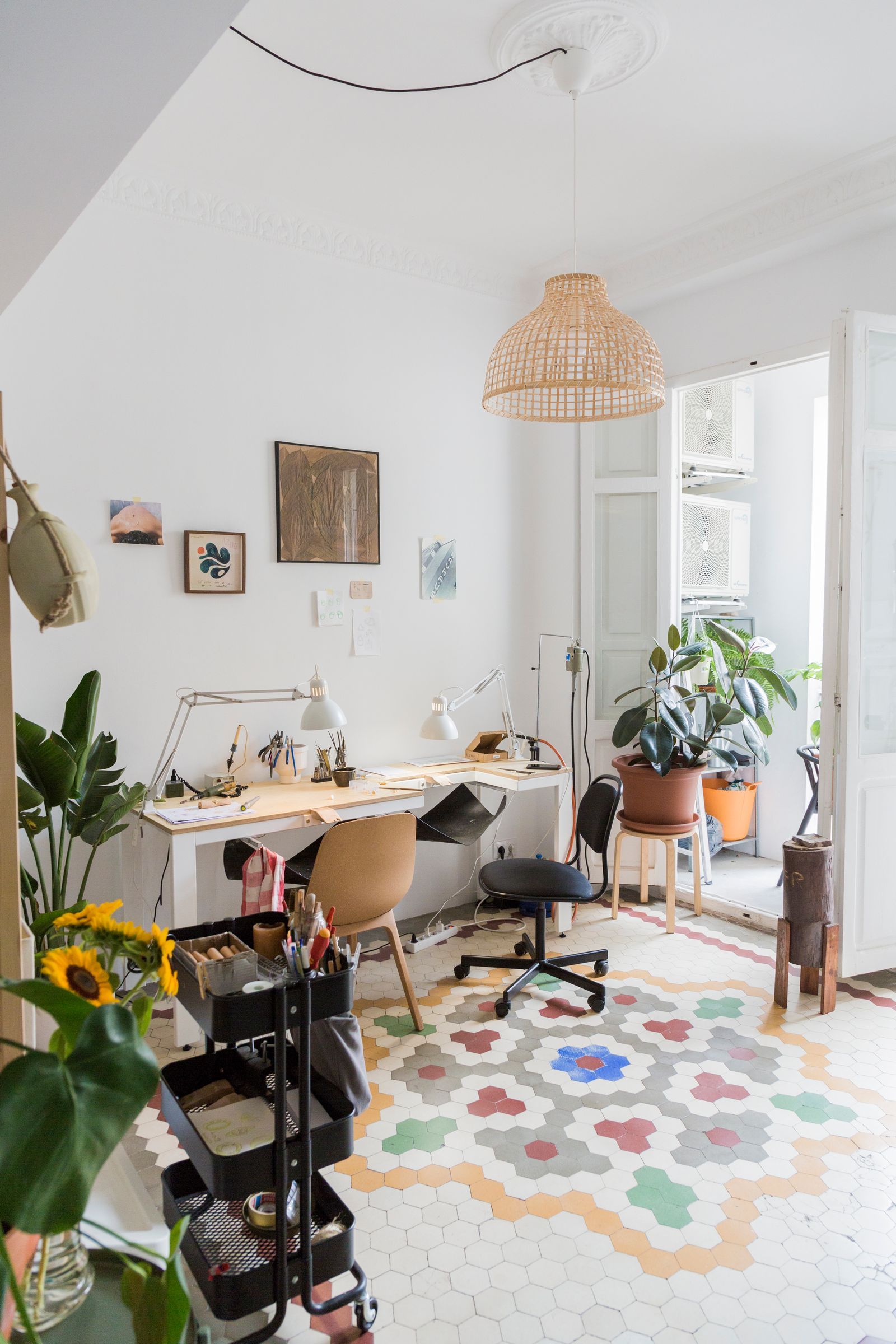
Located in Ruzafa, the young neighborhood of Valencia, their workspace is also their home. “We considered having two separate spaces or just one that is much better… And we chose the second option. This house has a lot of light, it is bigger than the previous one, something fundamental because the workshop grows every day,” they acknowledge. Their urban oasis totals around 80 square meters and maintains in some areas the classic hydraulic tiles of the region, a multitude of plants – “many are rescued cuttings,” she says, “near my house in Alicante there is a greenhouse with a section of plants about to die that they almost give away” – and design objects, such as a vase by their friend, the artist Ovidi Benet, as well as sketches of pieces everywhere. All of them recreate the freest and most sincere forms of nature, especially the coastline – although one of their latest successes is a dolphin-shaped ring – and the names of the collections make it clear: ‘La Costa’ and ‘Agua’. On the shelves, encyclopedias of minerals coexist with books like ‘How Objects Are Born?’ by Bruno Munari, ‘Evocation of the Female Image’ by Joan Miró, and ‘In Praise of Shadows’ by Junichiro Tanizaki. And, of course, jars full of shells and hundreds of boxes with sample pieces and some experiments, like a chili pepper dipped in gold.
When night falls, they hunker down on the sofa, cook themselves something for dinner (probably kiwis in Rocío’s case, her latest obsession) and turn on the projector. That is, if they are not trapped with some piece. “Many times, the last hours of the day are the most productive.” They feel comfortable in what they are beginning to call home, but also office, and workshop. However, they do not hide their growing need to escape to nature, to a wilder and quieter life, especially considering it is their main source of inspiration. “This summer we were in Ibiza. We discovered several empty coves where we had never been. Nature has been the winner in this pandemic and it is very healing to see how some places have been able to recover.”
“But the great discovery was Menorca, where we hadn’t spent so much time and we enjoyed some donkeys that accompanied us on the farm. I can’t think of anything more inspiring than that,” values Rocío. Between walls and in the middle of the city, they have their own resources. “I pay attention to spaces and interior design, and to emerging craft workshops or studios. I am fascinated by following their processes and how the material responds according to each one’s identity,” contributes Jorge. They also have pieces from other creatives, such as a vase from a carpenter artisan in Valencia. “He hangs leather pieces to collect the rest of the materials, which we later recycle,” they explain. Regarding packaging, they state: “We ensure the packaging is reusable and we do not integrate any plastic material,” demonstrating their commitment to sustainability.
The Cañón del Sil in Galicia or a lost and lonely cove in Ibiza, perhaps in Menorca, inspire some of their pieces. Great observers, Jorge Ros and Rocío Gallardo, founders of Simuero, sometimes act as treasure hunters collecting everything that could become jewelry. For support, they keep close at hand ‘The Naturalist’s Guide’ by Gerald Durrell and Lee McGeorge Durrell, and an encyclopedia of minerals.
.jpg)