Editor’s Note
**Editor’s Note:** This piece explores how a simple administrative decision redirected Jason Baerg’s path from industrial design to a celebrated career in art and fashion, highlighting the serendipity that often shapes creative lives.
At 25, Jason Baerg went back to school. He wanted to become an industrial designer, but the course was full, so he was enrolled in art fundamentals instead. That little administrative blip changed the course of his life. He spent the next 25 years growing into an acclaimed painter and OCAD associate professor, landing pieces in both museums and corporate collections.
Not content to make just one kind of art, he blossomed into the fashion space, too, with Ayimach_Horizons. Baerg, who is of Cree-Métis and German descent, uses colour symbolism and materials that support his Indigenous values, including natural fibres and recycled items, out of respect for the land.
Baerg’s horsehair accessories are especially striking, whether it’s dangling earrings or an emerald-green purse adorned with two swishing tails.
Looking at the pieces, you can immediately picture sashaying down the street with them, majestic strands swinging in the breeze.

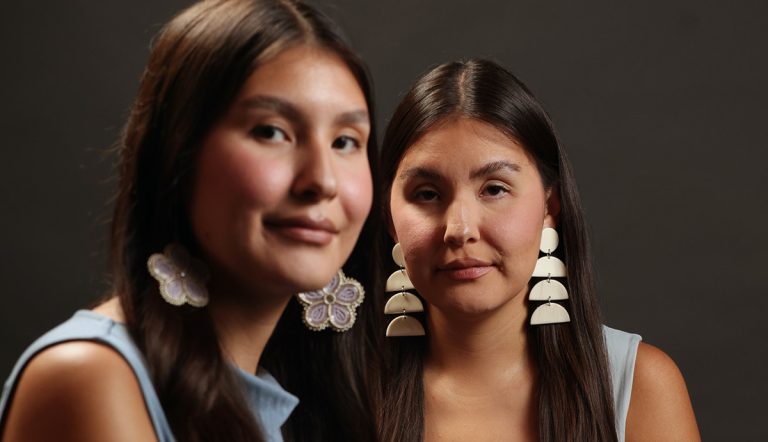
Jewellery makers and twin sisters Jacquelyn and Edie Assinewe. Photo: R.J. Johnston/Toronto Star
Work can be a grind, but, for some, work can bring joy. Anishinaabe-Ojibwe twin sisters Edie and Jacquelyn Assinewe see making jewellery as a wellness practice.
Working a pair of beaded earrings, for instance, could take anywhere from five to eight hours to complete.
Jewellery was a big part of the twins’ childhood; they remember visiting Cape Croker and attending the powwow there, buying beads to make pieces at their tent. Inspired, they started to hit the craft stores back home for more supplies. During the COVID-19 lockdowns, they joined an online beading circle, which spurred them to create pieces for their regalia, including barrettes, headbands and hair ties.
The Assinewes design jewellery in neutral and pastel tones, and, unlike many beadwork lines that only offer one-off designs, they are available in multiples. They’ve been tasked with custom wedding designs, are featured as part of the Fabrique 1840 program at Simons and have had their pieces worn in TV shows.

The Cajas-Arcentales clan was fed up. It was 2014 and, from what they could tell, Toronto only had a single Indigenous-owned shop.
The Kichwa family—including mother Patricia Cajas, father Marcos Arcentales, daughter Samay Arcentales Cajas and son Kinoo Arcentales Cajas—had been selling Indigenous-made art from North and South America for many years, travelling across the country doing shows and following the powwow trail out on the west coast, but it was time to go brick-and-mortar, opening Pacha Indigenous Art Collection, first on Toronto’s Bloor West, then transitioning into an online boutique.
Kinoo has also created a runway collection, Yana Manta, which they have shown at numerous fashion weeks including New York and Santa Fe; the shop stocks clothing inspired by it.
Wares include everything from jewellery and home decor to accessories, including local brands like Magneson Studios, Shawne Howe, Mo Thunder, Little Shiny Wolf, Joseph Sagaj, Two Hearts Beadwork and Denesee Paul, plus Samay’s own creations.
