Editor’s Note
**Editor’s Note:** This article reports on the theft of jewels valued at €88 million from the Louvre’s Apollo Gallery. The curator’s estimate is described as “extremely spectacular” yet incomparable to historical losses.
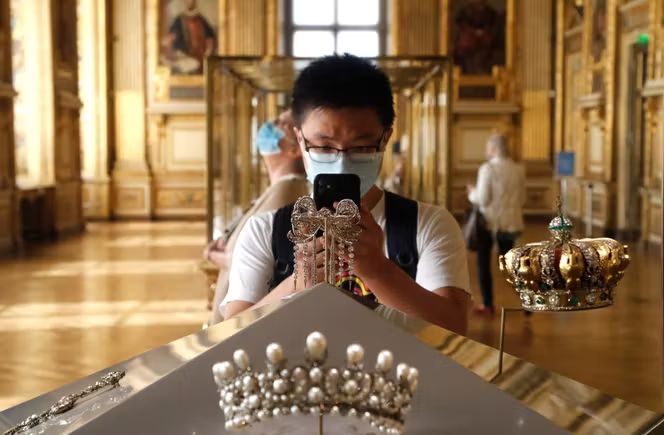
A visitor photographs the “Grand nœud papillon de l’Impératrice Eugénie” and her crown, displayed in the Apollo Gallery of the Louvre Museum in Paris, on July 6, 2020. FRANCOIS GUILLOT / AFP The Louvre Museum’s curator estimated on Tuesday, October 21, the damage from the jewels stolen on Sunday in the Apollo Gallery at €88 million, according to Paris prosecutor Laure Beccuau. A sum “extremely spectacular” but which “has nothing parallel or comparable to the historical damage,” the prosecutor added on RTL, specifying that the criminals “will never gain this considerable sum” if they “had the very bad idea of unsetting and melting these jewels.” The investigation is progressing, according to the prosecutor, “expertises are ongoing, four people have been identified as present at the scene, without certainty that there wasn’t a team to help them,” she also stated, without ruling out “the possibility of inside complicity” within the museum. Asked about the “fragility” of the jewel display cases, she said she could not “comment on the question, [her] expertise not covering this field of details.” Questioned in the National Assembly during government questions, Culture Minister Rachida Dati, for her part, assured that “the museum’s security systems were not faulty.” “It’s a reality, they worked,” she insisted. Rachida Dati preferred to raise the issue of public road surveillance, as the thieves entered the museum institution through a window using a service lift parked on the Seine-side road. “Perhaps we should question, and this is a reflection we are having with the Interior Minister [Laurent Nuñez], but also with the Paris City Hall, precisely regarding security on public roads, which did not exist at this stage,” she said.
Furthermore, her office received on Tuesday the Louvre Museum’s union organizations (CGT, SUD, CFDT, CFTC, FSU) to announce that the administrative investigation mentioned the day before was entrusted to the General Inspectorate of Cultural Affairs (IGAC), according to the unions. On this occasion, they deplored the reduction in staff dedicated to museum safety and security, down by “25% in ten years,” according to Elise Muller of SUD-Culture. They also denounce “budgets redirected towards museum projects to the detriment of renewing equipment dedicated to monitoring works and the public,” according to her. In its edition to be published Wednesday, the satirical newspaper Charlie Hebdo headlines “How far will humiliation go?” under a drawing showing two hooded criminals carrying away the Louvre Pyramid.
While the criminals are still at large, the Louvre, at the heart of a vast political-media storm, defended on Tuesday to Agence France-Presse (AFP) the quality of the display cases that housed the stolen jewels, reacting to an article in Le Canard enchaîné which claims they are “apparently more fragile than the old ones.” “The Museum affirms that the display cases installed in December 2019 represented considerable progress in terms of security, as the degree of obsolescence of the old equipment was proven and would have led, without replacement, to removing the works from public view,” the management wrote in a message to AFP. According to the satirical newspaper, an old armored display case installed in the gallery in the 1950s and equipped with a system allowing it to disappear “at the first alert” into a safe would likely have prevented the theft if it had been kept in place. The Louvre management explains, however, that this old system, fitted with a new mechanism in the 1980s, “had become inoperative and obsolete, with blocking phenomena in the descent of the side shutters.” “Several accidents have been deplored,” putting “the works in danger,” it assures.
Rachida Dati denounced in this regard “too much false information” and announced in a message on X “the creation of a fact-checking line accessible to the press via the Louvre Museum’s press service.” Asked by AFP, neither her ministry nor the Louvre Museum were able to specify its outlines or modalities. This burglary, which calls into question the reliability of the museum’s surveillance system, will also lead its director, Laurence des Cars, to be heard on Wednesday by the Senate’s cultural affairs committee.