Editor’s Note
**Editor’s Note:** This article examines the rising consumer interest in wearable EMF protection products, driven by growing awareness of wireless radiation and 5G expansion. We explore the market trends and consumer motivations behind this fast-growing wellness segment.
As consumer awareness of wireless radiation exposure continues to rise alongside expanding smartphone use, 5G infrastructure rollout, and growing consumer attention to wireless radiation exposure, wearable EMF products have become one of the fastest-growing segments of the personal wellness market. Search volume for terms including “EMF pendant,” “EMF protection jewelry,” and “negative ion EMF protection” has climbed steadily through 2025 and into 2026, driven largely by consumers who spend hours each day surrounded by Wi-Fi routers, Bluetooth devices, laptops, and cellular signals.
The market includes a wide range of products, from phone cases and laptop shields to adhesive stickers, plug-in harmonizers, shielding fabrics, and wearable jewelry. The wearable category – including pendants, bracelets, and rings – appeals to consumers who want a passive, always-on solution that requires no installation, charging, or device-specific application.
The FCC sets SAR limits for consumer devices at 1.6 watts per kilogram averaged over one gram of tissue. All cell phones and wireless devices sold in the U.S. must demonstrate compliance with this standard before reaching consumers.
Certain minerals, such as tourmaline, exhibit pyroelectric and piezoelectric properties – they can generate small electrical charges when subjected to heat or mechanical pressure. Published material science research confirms this property. However, whether the quantity of ions generated by a pendant-sized mineral composite reaches levels that produce measurable biological effects has not been established through independent peer-reviewed testing of commercial products.
Some manufacturers claim that negative ion generation neutralizes harmful EMF radiation. Published commentary from physicists notes that electromagnetic radiation consists of waves that travel in straight lines until absorbed, reflected, or scattered by physical materials. According to these sources, a pendant worn around the neck would only interact with electromagnetic waves that strike it directly. It would not absorb or redirect radiation traveling from a phone in your hand to other parts of your body unless the pendant were physically positioned between the device and the area in question.
Current published research has not established through peer-reviewed testing that wearable mineral pendants measurably reduce electromagnetic field exposure through negative ion generation. Negative ions and electromagnetic radiation are discussed separately in the published literature, and peer-reviewed studies have not established that generating negative ions from a wearable pendant neutralizes electromagnetic field exposure.
That said, some wearers do report subjective improvements in how they feel while wearing mineral-based jewelry. Perceived wellness benefits are commonly reported across similar products, and the placebo response is well-documented in wellness research. The distinction worth understanding is between reported personal experience and independently verified EMF shielding – and recognizing that difference helps you evaluate this product and every other wellness product.
However, the full list of all 36 minerals is not disclosed on the product page, FAQ, or product description. Without a complete mineral disclosure, consumers cannot independently verify which specific minerals are present, in what proportions they are included, or whether any individual mineral reaches a quantity that published research associates with measurable effects.
Published research on tourmaline’s pyroelectric properties confirms the mineral’s ability to generate small electrical charges under temperature changes. Whether the scale of this effect from a pendant-sized piece translates to meaningful negative ion output during everyday wear has not been established through controlled testing of commercial products.
Physical shielding products – including Faraday cages, conductive phone cases, and shielding fabrics – achieve their effect through physical principles of electromagnetic shielding. They use conductive or magnetic materials to absorb, reflect, or redirect electromagnetic waves. Their effectiveness can be measured in decibels of attenuation through FCC-accredited or independent laboratory testing.
Independent testing documentation is crucial. The company does not disclose the sample size, methodology, whether results were independently verified, or whether a control group was used. Consumers may wish to treat this as company-reported marketing data rather than an independently validated finding.
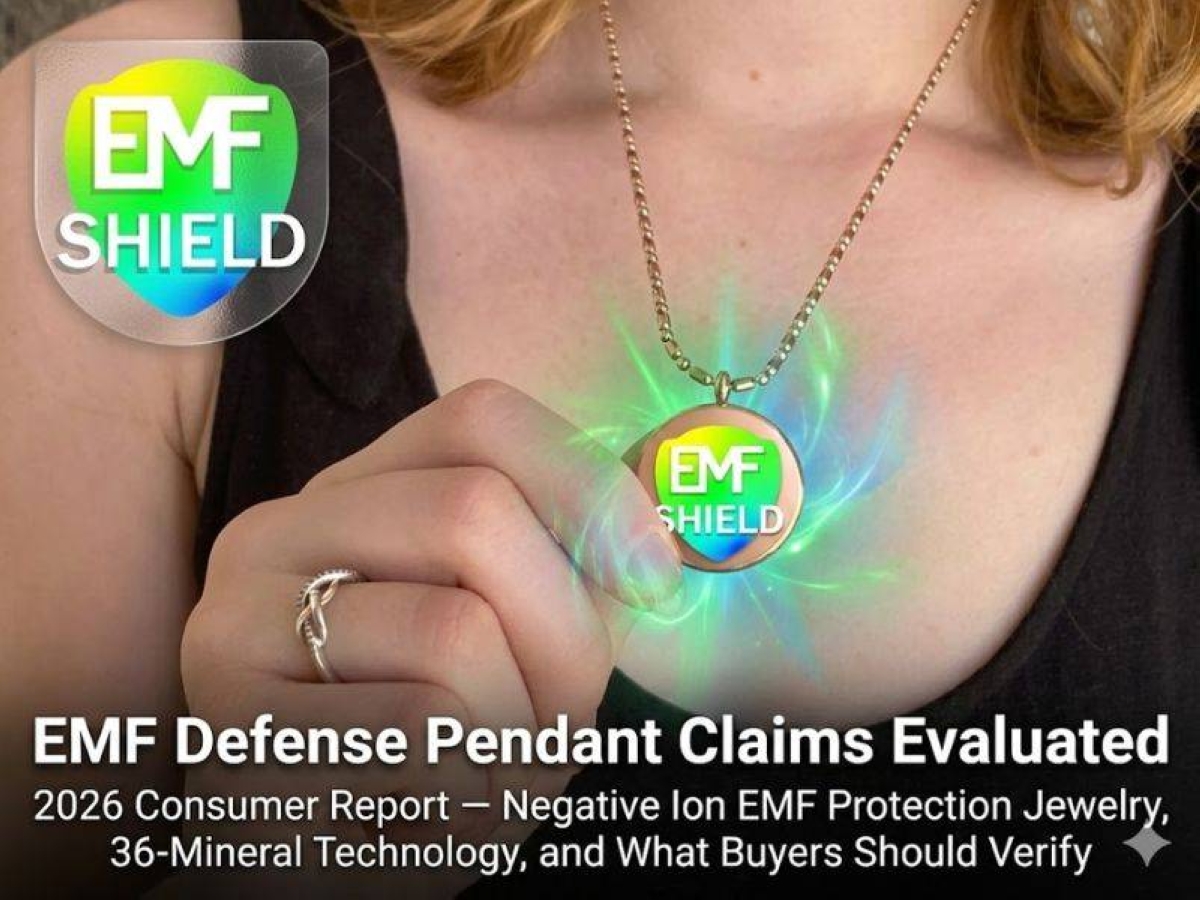
EMF protection jewelry is a wearable accessory marketed to reduce or harmonize electromagnetic field exposure from everyday electronics. These products typically contain minerals, metals, or other materials that the manufacturer claims interact with electromagnetic energy. The EMF Shield Defense Pendant specifically uses a blend of 36 minerals including black tourmaline and is marketed as generating negative ions for continuous EMF harmonization.
Current published research has not established that passive mineral pendants perform like physical shielding materials in blocking, absorbing, or redirecting electromagnetic radiation. Electromagnetic waves travel in straight lines and would only interact with the pendant where direct contact occurs. Some consumers report subjective wellness improvements while wearing these products, which may reflect personal perception, the placebo response, or other factors unrelated to measurable EMF reduction.
Consumers should verify EMF protection jewelry products for measurable electromagnetic field shielding. Published research has explored the properties of individual minerals such as tourmaline, but this research examines raw material characteristics rather than the performance of finished commercial pendant products. Consumers may wish to verify whether any independent testing supports the claims.
Look for independent testing documentation. If independently verified EMF reduction is your priority, consumers may wish to look for products that provide FCC-accredited or third-party laboratory testing data.
Search keywords: jewelry verification