Editor’s Note
**Editor’s Note:** This article explores the rise of “green gold”—recycled material that bypasses traditional mining to reduce environmental harm. By reusing existing resources, this approach cuts emissions and waste while preserving quality, signaling a shift toward more sustainable industry practices.
Tuesday, April 28, 2026.–
In an industry historically tied to mining extraction, the concept of “green gold” is beginning to establish itself as a concrete alternative. This refers to recycled material that does not come from new extractive operations, but from unused pieces that are reintegrated into the production cycle, maintaining their properties intact while significantly reducing their environmental impact.
Unlike the traditional model, whose extraction involves intensive water use, removal of large volumes of earth, and the use of chemicals, this approach reuses resources already in circulation. This allows for reduced emissions, elimination of mining waste, and a near-total reduction in the need for new extractive operations, without compromising quality or purity.
Internationally, this transformation is already underway. Sustainability has become a growing standard within the luxury industry, especially in Europe and the United States, where major brands have begun migrating towards recycled raw materials and circular economy models. In this context, traceability and the origin of the material have become as relevant as design or brand.
In Chile, this trend is beginning to take shape through actors operating under this logic. This is the case of Aurus Joyería, which has developed a model based on buying unused jewelry, processing it, and reintegrating it into the market, either as new pieces or as ingots.
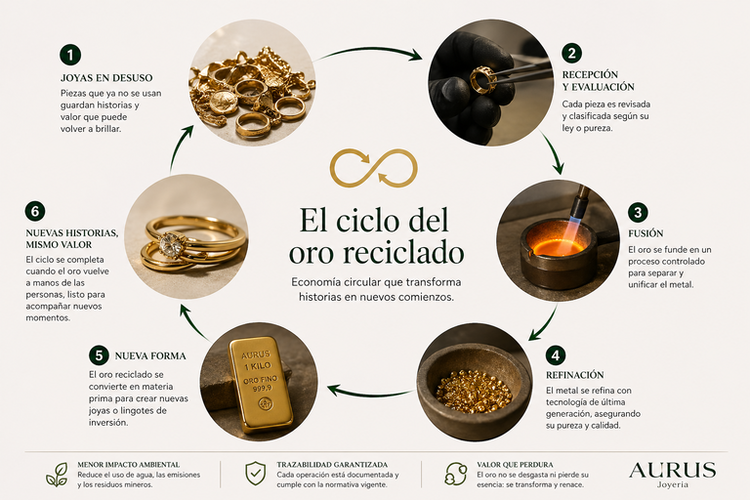
The model promoted by the company responds to a concrete application of circular economy logic. People can sell pieces they no longer use, which are then evaluated, classified, and melted down to be refined through controlled processes. This material re-enters circulation as raw material for jewelry or as a store of value in the form of ingots.
This circuit not only extends the useful life of the material but also opens a financial dimension for those who participate in it. The possibility of converting jewelry into immediate liquidity, or acquiring metal as a form of safeguard, positions this asset in a logic that goes beyond traditional consumption.
In this scenario, traceability becomes a central element. Each purchase and sale operation requires documentary support to certify the origin of the material, ensuring transparency throughout the chain and providing guarantees to both sellers and buyers.
While design and price remain decisive factors, sustainability is beginning to increasingly influence purchasing decisions, especially among more informed consumers. In this context, the use of recycled material not only responds to environmental concerns but also to a logic of value, where it is possible to maintain high standards without necessarily passing on higher costs to the customer.
With a global industry moving towards higher levels of sustainability and transparency requirements, all indications are that this type of practice will cease to be a differentiator and become an operational baseline. In this scenario, jewelry is beginning to redefine itself: no longer just as an object of design or luxury, but as part of a value chain where origin, impact, and its role as an asset become part of the same conversation.