Editor’s Note
**Editor’s Note:** This piece explores how Bvlgari transcends traditional jewelry retail by building a luxury ecosystem—from iconic designs to high-end hotels—strategically targeting affluent clients and adapting to evolving market trends.
Ranked sixth, Bvlgari offers a solution of “cross-industry integration into a luxury ecosystem.” Beyond its iconic Serpenti and扇形 designs, Bvlgari has expanded into the ultra-luxury hotel sector. When consumers waver on jewelry’s value retention, they pivot to selling “experiences” and “lifestyles,” using high-end accommodations to precisely attract high-net-worth clientele and, under the trend of gender fluidity, capture the male jewelry market.
Fifth-ranked Van Cleef & Arpels takes an opposite path: reinforcing extreme scarcity. They understand that raw materials fluctuate, but only “cultural capital” can support high premiums. Thus, the brand continues to open jewelry art schools globally, integrating jewelry with mechanical motion and dance art. Van Cleef & Arpels conveys a message: you are not buying gold and diamonds, but “micro-artworks” that can be passed down through generations.
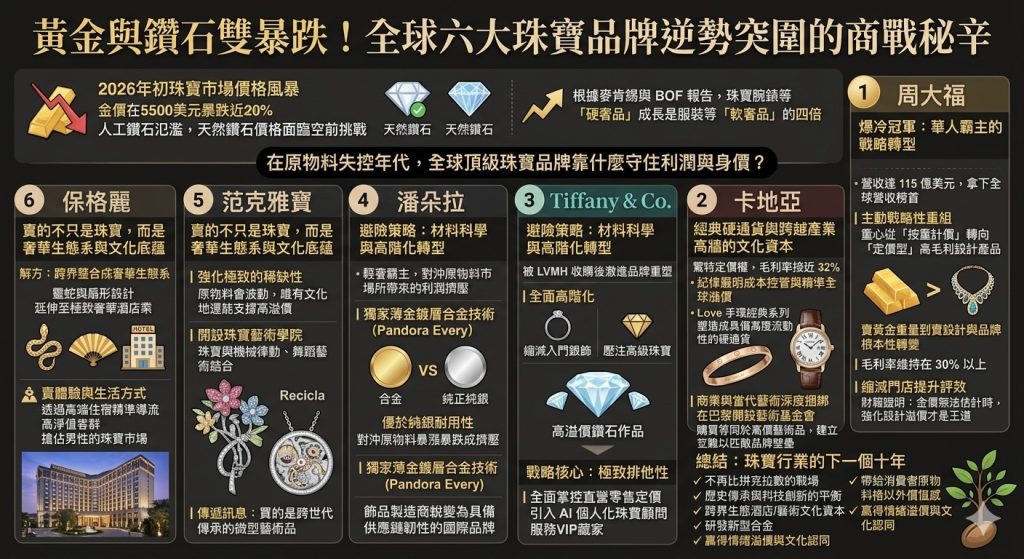
Fourth-ranked Pandora, as a affordable luxury leader, confronts silver price volatility and tariff threats head-on. Its key strategy is “material hedging”: promoting its exclusive thin-gold-plated alloy technology (Pandora Every), offering superior durability to sterling silver, and thereby hedging against profit compression from raw material markets. This transforms it from a jewelry manufacturer into an international brand with supply chain resilience.
Third-ranked Tiffany & Co., after being acquired by LVMH, executed an aggressive brand overhaul. Facing market disruption from lab-grown diamonds, Tiffany chose “full premiumization,” drastically reducing low-margin entry-level silver jewelry and focusing resources on high-profit fine jewelry. Its future strategic core is “extreme exclusivity,” planning to fully control direct retail pricing and introduce AI-powered personalized jewelry consultants to serve global VIP collectors.
Ranked second is Cartier. In 2025, Cartier demonstrated remarkable pricing power, with gross margins nearing 32%. Its secret lies in disciplined cost control and precise global price increases. Cartier has shaped classic collections like the Love bracelet into highly liquid “hard currency.” Additionally, the brand deeply intertwines commerce with contemporary art, opening an art foundation in Paris, making purchasing Cartier equivalent to buying high-value art, thus building an unassailable brand moat.
Claiming the top spot in global jewelry revenue is Chow Tai Fook, with revenues of $11.5 billion. Amidst drastic gold price fluctuations, Chow Tai Fook proactively underwent strategic restructuring, shifting focus from “pricing by weight” to “fixed-price” high-margin design products. This is a fundamental shift from selling gold by weight to selling design and brand, maintaining gross margins above 30%. By reducing store count to improve per-store efficiency, Chow Tai Fook’s financial reports prove: when gold prices are unpredictable, only strengthening design premium is the way forward.
The future jewelry market will no longer be a battlefield of carat counts, but a balance between historical heritage and technological innovation. Whether through hotel ecosystems, art and cultural capital, or developing new alloys, brands must deliver a “sense of value” beyond raw material prices. In an era of volatile gold prices, only by winning consumers’ emotional premium and cultural identity can brands remain invincible in the hard luxury market.