
Editor’s Note
**Editor’s Note:**
Gold jewelry sales in India’s organized retail sector are projected to fall another 13-15% this fiscal year, driven by soaring prices and import curbs. Yet, despite shrinking volumes, the sector is set for robust revenue growth of 20-25%, thanks to higher realizations, according to a CRISIL analysis of 70 retailers.
Gold jewelry sales in India’s organized retail sector are expected to decline further by 13-15% year-on-year in the current fiscal year, following an 8% drop last year. This is attributed to high gold prices and recent policy measures aimed at curbing imports of the metal. An analysis of 70 gold jewelry retailers by CRISIL Ratings, which account for one-third of the organized sector’s total revenue, indicates that despite the expected volume decline, the sector is poised to achieve strong revenue growth of 20-25% annually due to higher realizations.
Higher gold prices will increase inventory holding costs and raise debt taken from banks. However, the increase in both revenue and cash accruals is expected to reduce reliance on debt, keeping credit profiles stable. This is also indicated by the analysis of 70 gold jewelry retailers who hold a one-third share of the organized sector’s total revenue.
In fiscal year 2026, India imported 720 tonnes of gold, leading to an outflow of $72 billion in foreign exchange. With gold prices remaining high and as a measure to reduce the trade deficit and support the currency, the central government recently increased the customs duty on gold. The aim is to reduce demand for the precious metal and curb its imports. Consequently, sales volumes in this sector are expected to hit a decade-low, except for the COVID-affected fiscal year 2021.
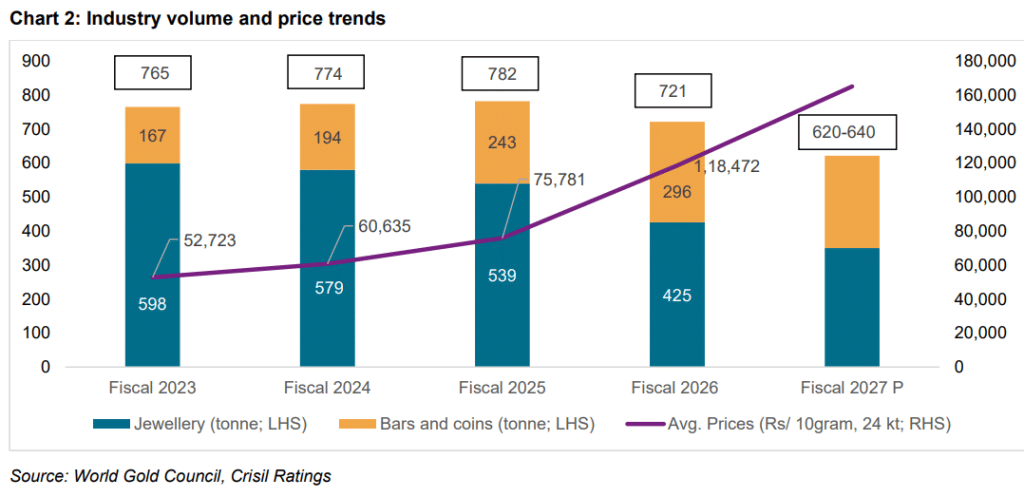
While price increases will benefit retailers on inventory, some of this gain may be passed on to customers in the form of higher discounts to boost sales. Additionally, higher promotional spending and trading in gold bars and coins will impact retailers’ gross margins. Nevertheless, total cash accruals and earnings before interest, tax, depreciation, and amortization (EBITDA) are expected to improve, aided by price increases.
In the last fiscal year, domestic gold prices saw an unprecedented 55% surge due to a rise in global gold prices amid geopolitical uncertainties and a weakening of the Indian rupee against the US dollar. The price surge has impacted purchasing power, leading consumers to shift towards lighter and lower-carat gold jewelry (16-22 carat range) and studded jewelry.
In contrast, investment demand has surged over the past two fiscal years. While jewelry sales have declined by 25%, sales of gold bars and coins have increased by over 50%. However, persistently high gold prices and the recent increase in customs duty on gold are likely to reduce demand across different segments.

However, at the current price of ₹1,60,000 per 10 grams (24 carat), earnings this fiscal year will be 35-40% higher year-on-year, improving cash accruals. Even though gold bars and coins yield lower value-added revenue, and higher promotional spending and discounts are needed to boost sales, gold jewelry sellers are expected to see a 20% year-on-year increase in total EBITDA this fiscal year.
This will partially offset the increase in inventory holding costs for retailers, as inventory days may rise from 150 days (compared to last fiscal year) to 160-180 days, and will also support retailers’ expansion plans.

Net Worth Ratio