Editor’s Note
**Editor’s Note:** This article examines the market dynamics behind the $400 Royal Pop pocket watch, focusing on how scarcity, resale value, and custom jewelry enhancements—such as diamond setting by Alex Moss—reshape luxury pricing and sales structures.
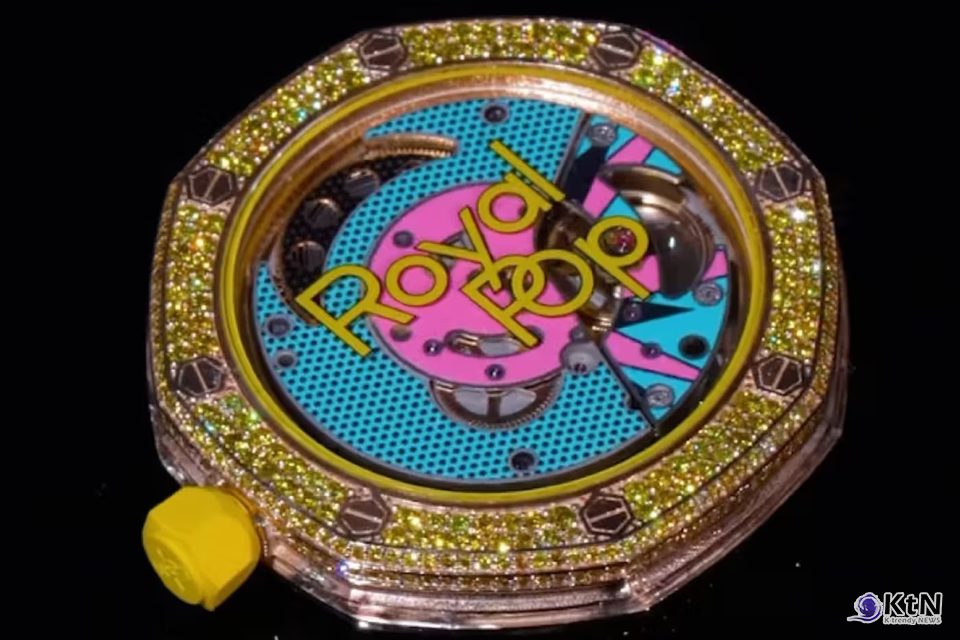
[KtN Report] Audemars Piguet & Swatch Royal Pop: The Luxury Market’s Calculation Fueled by Diamond Setting. Photo=Alex Moss Ny, K trendy NEWS DB ⓒK trendy News Unauthorized reproduction and collection, redistribution prohibited.
[KtN Reporter Park In-kyung] The ‘Royal Pop,’ which went on sale at some Swatch stores on May 16, was a $400 pocket watch at its regular price, but immediately after its release, it triggered queues, store closures, a surge in resale prices, and even external custom modifications. Shortly after Swatch and Audemars Piguet borrowed the octagonal design code of the Royal Oak to release it as a pocket watch, New York-based jeweler Alex Moss unveiled a custom piece with added diamond settings. The time it took for a mass-market collaboration to be repackaged as a high-end jewelry image was short.
The Royal Pop is not a wristwatch. Swatch introduced it as an 8-piece bioceramic pocket watch combining the modular feel of the 1980s Pop line with the design of the Audemars Piguet Royal Oak. It features a manual-winding SISTEM51 movement, and the models are divided into Lépine and Savonnette formats. Swatch limited purchases to one per person, one per day, and one per store.
Alex Moss’s custom piece retains the original product’s pink case and turquoise dial. The yellow indices, pink small seconds, and the Royal Pop lettering on the back are also preserved. The changed part is the bezel. The octagonal bezel is densely set with diamonds, and the eight screw motifs reminiscent of the Royal Oak remain at the center of the decoration. The weight of the design rests more on color, form, luster, and brand identity than on the precision of watchmaking.
The custom setting didn’t so much elevate the Royal Pop’s character as it amplified the commercial contradictions within it. The price of the bioceramic pocket watch lies in the realm of mass-market collaborations, while the diamond setting lies in the realm of custom jewelry targeting high-end clients. Adding gems to a $400 product is not about enhancing the mechanical value of the original piece. The gap between the low retail price and the high ostentatious cost creates the buzz.
In terms of design completeness, conflict precedes restraint. The pink, turquoise, and yellow hues evoke pop art toys, while the diamond bezel brings in the ostentatious grammar of hip-hop jewelry. The Royal Oak’s octagonal bezel was originally close to an architectural symbol of a high-end sports watch, but in the Royal Pop custom piece, it has been transformed into a frame for holding gems. Color and luster, which catch the eye on social media, take precedence over the proportion, finishing, and movement perfection valued by traditional watch enthusiasts.
It is hardly a coincidence that Audemars Piguet chose the pocket watch format rather than releasing a low-priced Royal Oak wristwatch directly. It retains the Royal Oak’s octagonal bezel, eight screws, and ‘Petite Tapisserie’ pattern but avoids a direct price comparison with its own wristwatches. The Royal Pop borrows the Royal Oak’s iconography but is not a substitute for it. In its official description, Audemars Piguet presented the Royal Pop as a pocket watch that can be worn around the neck, placed in a pocket, or used as a bag charm.
Swatch’s calculation is also clear. An accessible price, strong colors, limited sales, sales at select stores, and a one-per-person limit are ideal conditions for creating queues. From the early stages of sales, congestion and store closures occurred in some stores in the UK, Europe, and the US. The Guardian reported on the use of tear gas by Paris police, closures of some UK stores, pushing and queues in front of the New York Times Square store, and a surge in online resale prices. It also reported cases where the regular $400 product was traded for up to £3,000 on eBay UK and $4,000 in the US.
The sales method shown by the Royal Pop is akin to a microcosm of recent luxury marketing. Brands attract young consumers and collectors with low-priced collaborations, create scarcity through quantity limits and in-store sales. Resellers convert waiting time into price, and custom jewelers add gems to already buzzed-about items to create a more expensive image. The product is not just sold once; it becomes content multiple times through launch reports, queue videos, resale prices, and custom reveals.
From a jewelry trend perspective, Alex Moss’s Royal Pop is less a new invention and more an aggressive combination of ongoing trends. Large pendants, logo-centric jewelry, iced-out settings, bag charms and keyring accessories, and modular wearing styles have been consistently consumed in the younger consumer and celebrity markets. Bain & Company also analyzed that customization and modular products gained strength among younger consumers in the 2025 jewelry market. The Royal Pop custom piece is a case of pushing the boundaries of pocket watches, bag charms, pendants, and logo jewelry into a single object.
[KtN Report] Audemars Piguet & Swatch Royal Pop: The Luxury Market’s Calculation Fueled by Diamond Setting. Photo=Alex Moss Ny, K trendy NEWS DB ⓒK trendy News Unauthorized reproduction and collection, redistribution prohibited.
However, the numbers are complex for reading the growth of the jewelry market as a simple boom. Bain estimated that the personal luxury goods market in 2025 would be €358 billion, down about 2% from the previous year. In the same year, the watch market remained flat at around €52 billion, between -1% and +1%, while jewelry grew by 4-6% to €32 billion. Jewelry grew, but overall luxury consumption did not broadly recover.
Growth was more concentrated among top customers and specialist brands. Bain estimated that the number of luxury consumers in 2025 decreased from about 400 million in 2022 to around 330 million. Top customers spending over €20,000 annually accounted for just over 46% of total luxury spending. This is a significant increase from the 30% level in 2019. Even if the jewelry market grows, the revenue structure is not evenly distributed across a broad customer base.
Richemont’s recent results make the temperature difference between jewelry and watches even clearer. In the fiscal year ending March 2026, Richemont’s total sales were €22.42 billion, up 5% at actual exchange rates and 11% at constant exchange rates. Jewelry Maison sales increased 8% at actual exchange rates and 14% at constant exchange rates, while the specialist watch division decreased 4% at actual exchange rates. The operating margin for the Jewelry Maison was 30.5%, but the group’s gross margin fell from 66.9% to 64.4%. Rising gold prices, exchange rates, and US tariffs pressured profitability.
LVMH’s Watches & Jewelry division also shows the gap between apparent growth and profitability. In 2025, the division’s sales were €10.486 billion, down from €10.577 billion in 2024, and recurring operating profit fell from €1.546 billion to €1.514 billion. Organic sales growth was 3%, but profit decreased by 2%. Even if high-end jewelry and iconic products receive attention, it is not a market where the division’s overall profit automatically increases.
The diamond market also faces a reality different from its glamorous image. De Beers stated that rough diamond trading conditions were difficult throughout 2025, with synthetic diamond penetration, tariffs, and inventory adjustments pressuring demand. In 2025, De Beers’ average realized price was $142 per carat, down 7% from $152 the previous year, and its underlying EBITDA loss reached $511 million. While diamonds still hold strong symbolism in high-end jewelry stores, the price and profitability of the rough diamond market move independently.
The custom jewelry business has a dual nature in this market. A single photo can generate strong exposure, and a famous jeweler’s name accelerates the product’s narrative. Conversely, the customer base is narrow, production times are long, and the procurement prices of gold and diamonds squeeze margins. For custom pieces where the total diamond carat weight, metal weight, selling price, and client information are not disclosed, it is difficult to determine their actual sales contribution. The published images create a marketing effect, but profit and loss depend on material costs, labor, customer acquisition costs, and the likelihood of repeat orders.
The Royal Pop custom piece is difficult to view as a success story of luxury democratization. The low-priced collaboration product attracted public attention, limited sales stimulated the resale market, and the custom jeweler reprocessed the already heated interest into a high-price ostentatious product. Consumers responded more to signals recognized by others than to the watch’s time-telling function, and the market converted those signals into price.
The Audemars Piguet and Swatch Royal Pop is expected to be sold at some stores for a few more months, but the initial congestion and resale prices have already spread into areas difficult for the brands to control. Alex Moss’s diamond setting is not an event that changed the essence of the Royal Pop, but a case that compresses the process by which a collaboration product is reclaimed into a more expensive image through scarcity, resale, and jewelry customization. The jewelry market is growing, but the fruits of growth are concentrated among top customers, strong maisons, and some creators who can convert buzz into price.
![[KtN 리포트] 오데마 피게·스와치 로열 팝, 다이아몬드 세공이 키운 럭셔리 시장의 계산법. 사진=Alex Moss Ny, K trendy NEWS DB ⓒ케이 트렌디뉴스 무단전재 및 수집, 재배포금지](https://cdn.k-trendynews.com/news/photo/202605/202955_343258_5021.png)