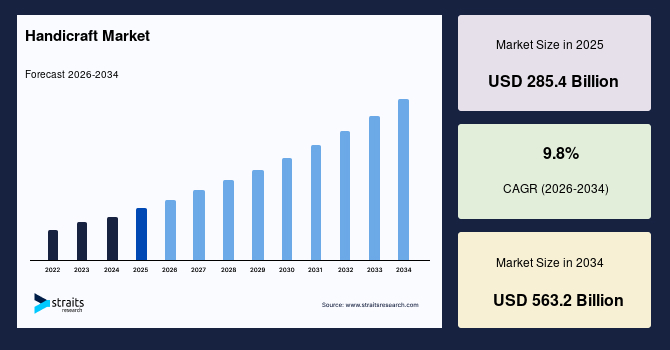
The global handicraft market, valued at USD 285.4 billion in 2025, is projected to grow to USD 563.2 billion by 2034 at a CAGR of 9.8%, according to a new report. For overseas jewelry buyers, this signals expanding opportunities in handmade and imitation jewelry, accessories, and culturally inspired products, particularly as consumer preference shifts toward sustainable and artisanal goods. North America held the largest market share at 54.26% in 2025, while Asia Pacific is expected to grow fastest at 11.9% CAGR.
Product-type breakdown
Textile and embroidered crafts dominated the product segment with a 34.29% market share in 2025, followed by metal handicrafts and imitation jewelry and accessories. The imitation jewelry and accessories category, which includes fashion rings, earrings, necklaces, and bracelets, is a key area for importers and distributors seeking cost-effective, trend-driven products. Buyers should note that handmade and artisan-style jewelry continues to gain traction in both residential and commercial markets.
Application and distribution channels
By application, the gifts and souvenirs segment is expected to grow at a CAGR of 12.6% during the forecast period, reflecting strong demand for jewelry sets and decorative accessories as personalized gifts. Specialty craft stores accounted for 64.41% of distribution in 2025, but online and e-commerce platforms are rapidly expanding, offering new channels for B2B buyers to source directly from artisan communities. Commercial buyers, including hospitality and retail chains, are also increasing procurement of bulk handicraft items.
Regional insights for buyers
North America remains the largest market, with the US alone valued at USD 42.25 billion in 2025. However, Asia Pacific's projected 11.9% CAGR highlights growing production and consumption in countries like India and China, where artisan networks are scaling. Japan's market, valued at USD 10.41 billion in 2025, presents opportunities for premium and culturally specific jewelry. Buyers should monitor regional trade policies and artisan certification standards when sourcing.
AI and technology impact
Artificial intelligence is reshaping the handicraft market through design personalization, demand forecasting, and trend prediction. Platforms like Etsy use AI-powered recommendation engines to improve product discovery, while tools like Canva help artisans create packaging and marketing visuals. For jewelry buyers, this means more efficient sourcing of customized designs and better alignment with evolving consumer tastes, particularly in bridal and fashion jewelry categories.
What buyers should watch
Importers and private-label brands should focus on the growing demand for sustainable, handmade jewelry and accessories, especially in the gifts and souvenirs segment. The rise of DIY craft subscription kits and e-commerce platforms offers new sourcing channels. Additionally, investment in digital marketplaces and artisan empowerment platforms, such as those supported by Next Bharat Ventures in India, indicates a shift toward scalable, tech-enabled supply chains. Buyers should evaluate suppliers' use of AI for trend alignment and inventory optimization.
Source: Read the original report | Published: June 04, 2026