Editor’s Note
Andrea Pérez turned a personal passion into a thriving business, leveraging family influence and hands-on retail experience. After learning jewelry-making through online videos, she sold 50 pieces in just two days. She left her job at A13, registered with the simplified tax regime and the Costa Rican Social Security Fund, and expanded her product line to include necklaces and materials like glass, crystals, and pearls—despite a delay in packaging supplies. Her entrepreneurial journey reflects resilience and strategic growth.
She watched videos, bought materials, and sold 50 pieces in two days.
She quit A13, registered under the simplified tax regime and the Costa Rican Social Security Fund, and expanded production with necklaces and other materials (glass, crystals, and pearls).
, because the packaging material she ordered was delayed. It exceeded expectations. “It was a
Andrea Pérez grew up in a business-oriented family, which was a decisive factor in her decision to become an entrepreneur.
“I worked from a young age during vacations,” she says.
Her father, Oscar Pérez, ran a security company until the 2008 financial crisis. He now works as a consultant.
At that time, after finishing high school, Andrea joined the store Ruta Urbana in Multiplaza and learned everything. Especially about consignment, where suppliers leave their products and receive income when they sell.
She then moved to Red Bull, handling activations, corporate events, brand ambassadors (athletes and models), and communities. Another business school.
On the recommendation of former coworkers, she was called by A13, a beverage importer, to handle marketing for aloe vera products.
She had an excellent salary, but had little time left to take public relations courses at the Universidad Latina, where she transferred after three years in physiotherapy at Ucimed.
In 2012, while browsing the social network Pinterest, she found posts about leather-woven bracelets. Crafts were not unfamiliar to her, as her mother Alejandra Pineda had taught her since childhood. It was a hobby.
She used the attic of the house in La Sabana, a space with wooden walls and a small window that became an oven in summer, as the fans barely made a difference.
She worked until dawn, accompanied via cell phone by a friend, Carolina Gassel, who studied architecture and designed the logo for Maracuyá.
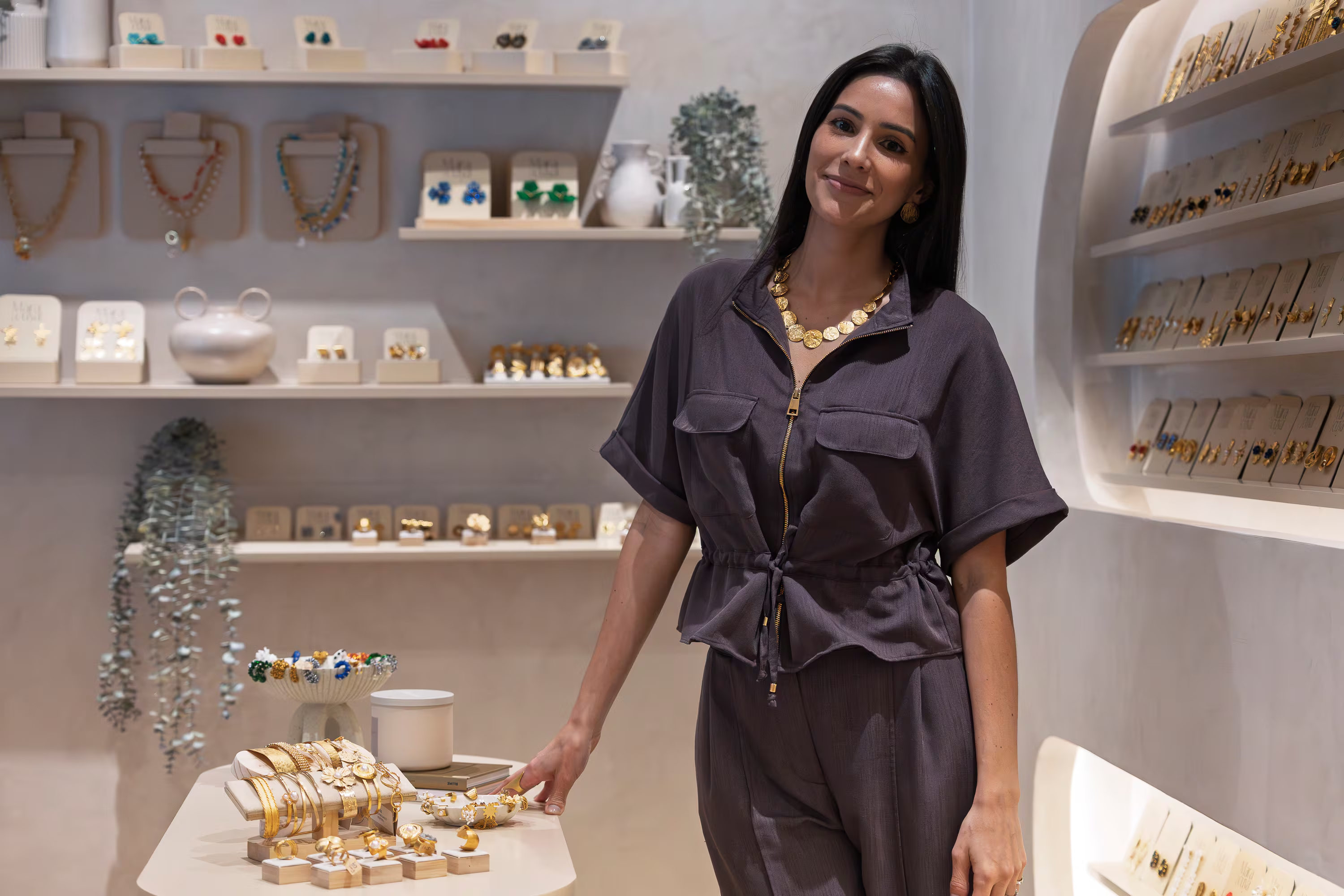
Andrea Pérez, founder of Maracuyá jewelry, in her new showroom.
(Jose Cordero/José Cordero)
She chose it after noticing that many national companies used exotic names, that no similar ones existed in jewelry, and that the passion fruit flower, easily linked to femininity, has striking colors.

With another friend, she took photos of the products, posted them on Facebook, and interest skyrocketed.
She went to markets and craft fairs, took advantage of Mother’s Day and Christmas, and visited stores in Escazú and San Pedro where her products were accepted on consignment. She sold up to ₡400,000 per month.
She realized the difference from the corporate world. “It wasn’t for me. It wasn’t what I wanted,” confesses Andrea, whose family always pushed her to start a business and even helped her pack orders. “I didn’t imagine at that moment that I would become a businesswoman.”
She produced, delivered, sold, and managed social media. She reached a peak and had to take further steps.
Her boyfriend Daniel Loría, who studied at Babson College—specializing in entrepreneurship and located in Boston—and co-founder of Poke, gave her some management tips. The main challenge to solve was manufacturing. That’s when the pandemic intervened in 2020.
All commerce closed from March of that year. Andrea was advised to look for a job at a company. But she bet big.
She invested in photo sessions with her cousins and friends as models, exclusive packaging, and a new version of the brand. The goal was year-end sales.
She had to resort to craft cardboard boxes. “It was a megahit,” she says.
In January 2021, with the boxes she ordered that finally arrived, she obtained a second sales peak. The most important thing was the change in situation: now boutiques were seeking her out.
She moved from the family home to a small apartment in Distrito 4, Escazú, where she used one of the bedrooms as a workshop and showroom.
Andrea explained that the passion fruit flower is easily linked to femininity and has striking colors.
(Jose Cordero/José Cordero)
Product presentation is one of Maracuyá’s focuses.
(Jose Cordero/José Cordero)
Andrea and her collaborators Yorleny Araya and Natalia Villalobos.

(Jose Cordero/José Cordero)
On social media, promotions, videos, and stories focused on building a community inspired by female empowerment, inclusion, and self-esteem, as well as connecting with her customers rather than just sales.
The company evolved towards a more robust concept, brand strengthening, proprietary design, and even international manufacturing.
Andrea bought earring parts from a Venezuelan goldsmith. They agreed that she would now have several products made in Colombia and Venezuela, while in Costa Rica two girls made the rest.
In 2023, Maracuyá moved to a warehouse in Guachipelín, near Blue Valley School. Initially, a friend helped her while Andrea had her wedding. Upon returning, she hired her first collaborator.
Customers ordered online, came to the warehouse to pick up orders, and bought other products. Óscar built a small showroom. At the same time, sales increased at points of sale.
Soon Andrea saw that in Guachipelín, visitors had to pass between trucks and containers from other warehouses on the same premises.
She looked for another location and found a space in the Trejos Montealegre shopping center, at the entrance to Escazú. Carolina designed it, and they inaugurated it at the end of 2025.
“This location is very good,” says Andrea. “We don’t work with precious metals or diamonds, but if you come in, you’ll take one or even four pieces.”
Maracuyá’s focus is female empowerment.
(Jose Cordero/José Cordero)
A ring from Maracuyá.
(Jose Cordero/José Cordero)
Earrings produced by Maracuyá.
(Jose Cordero/José Cordero)
Different luxury handmade jewelry products from Maracuyá.

(Jose Cordero/José Cordero)