Editor’s Note
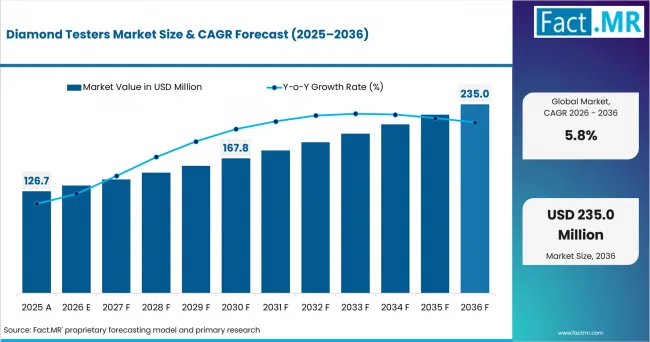
**Editor’s Note:** This article examines the growing commercial adoption of compact testing tools in jewelry workflows by 2025, with thermal conductivity testers dominating 46.0% of demand due to diamond’s unique thermal properties.
In 2025, compact testing tools already have a broad commercial role across jewelry intake, resale, and verification workflows.
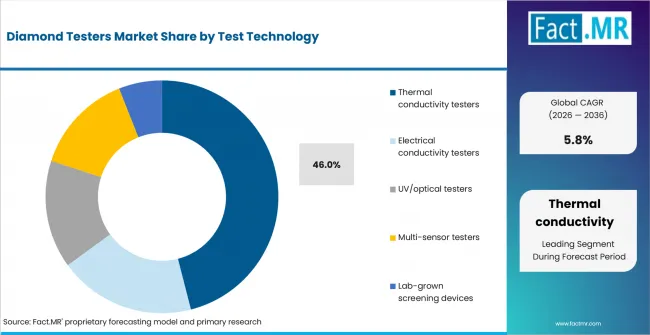
Thermal conductivity testers lead at 46.0% of demand because diamond’s unusually high thermal conductivity gives a probe a heat-transfer reading in seconds, a speed advantage almost no other gem material can match except moissanite, whose similarly efficient heat conduction is the exact reason electrical and spectroscopic methods still have to back it up.
Handheld pen tester leads at 52.0% of demand because the thermal and electrical probes inside these devices only need a single point of contact with a stone, a requirement the slim pen shape satisfies without the bulk of a benchtop unit, letting a jeweler test a ring, a pawn intake piece, or loose melee at the counter in the time it takes to touch the tip to the stone.
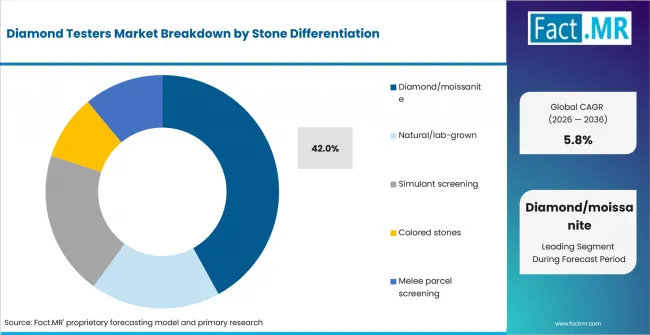
Diamond/moissanite leads at 42.0% of demand. Cubic zirconia and glass fail a thermal-conductivity reading outright, but moissanite conducts heat almost as well as diamond does and only separates from it on the electrical-conductivity check built into dual testers, since natural and lab-grown diamonds are electrical insulators while moissanite is a semiconductor. That specific pairing is what buy counters are actually screening for when a customer brings in a stone of uncertain origin.
Jewelry retailers lead at 41.0% of demand, driven by two overlapping obligations: the FTC’s Jewelry Guides require sellers to disclose whether a stone is mined, lab-grown, or simulant at the point of sale, and the same counter routinely verifies stones coming back in through trade-ins and buybacks, putting a tester in daily use far more often than an independent appraiser or a one-time consumer buyer needs one.
Online marketplaces lead at 34.0% of demand. A diamond tester is a compact, self-contained electronic instrument with a fixed spec sheet, so a buyer can compare accuracy claims and stone coverage across listed models without a supplier visit or an in-person demonstration, which is why handheld pen testers are sold and reviewed directly on consumer platforms rather than exclusively through jewelry trade distributors.
Shambhu Nath Jha, Senior Analyst at Fact.MR, states:
Jewelry retailers should select devices around their actual intake mix instead of assuming one sensing method resolves every stone-identification question.
GIA’s iD100 applies spectroscopic screening and returns a pass or refer result, illustrating how instrument makers are turning complex analysis into a practical triage decision. A referred result still calls for additional testing rather than a definitive conclusion.
The United States is projected to expand at a 6.2% CAGR from 2026 to 2036 because jewelry stores, pawnbrokers, appraisers, and collectors routinely encounter undocumented stones. The United Kingdom follows at 5.9% on its resale, antiques, and pawnbroking trade, while Belgium’s Antwerp trading offices support a 5.8% pace as lab-grown screening becomes routine. A 6.0% CAGR is forecast for the United Arab Emirates, where trading and premium retail reward rapid transaction confidence, and Hong Kong is anticipated to advance at 5.7% through its dense cross-border network of gem professionals.
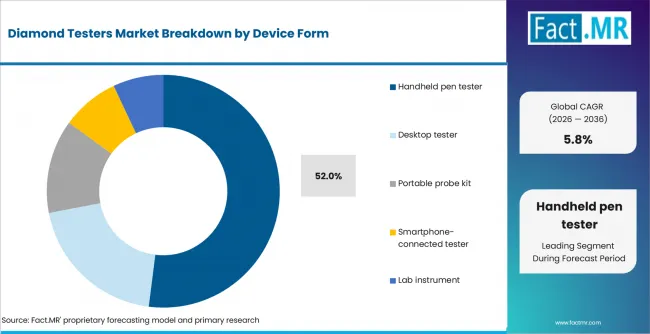
The leading shares are Thermal conductivity testers at 46.0% by Test Technology and Handheld pen tester at 52.0% by Device Form.
At 46.0% share in 2026, the leading position goes to Thermal conductivity testers because they provide a familiar and rapid first check in compact devices.
The 2026 leader is Handheld pen tester at 52.0% share because a compact probe can be used immediately wherever a stone enters the business.
A 42.0% share puts Diamond/moissanite first in 2026 because the distinction occurs frequently in ordinary jewelry intake and directly affects transaction confidence.
Diamond or moissanite differentiation accounts for 42.0% of demand and remains the most common reason to deploy a compact tester. Simulant screening represents 20.0%, while natural or laboratory-grown differentiation holds 18.0% and generally requires a different level of sensing and interpretation. Melee parcel screening at 11.0% and colored-stone testing at 9.0% create specialized workflows in which throughput or broader gem knowledge matters.
For User Group, the top 2026 position is Jewelry retailers at 41.0% share because they must make frequent verification decisions close to the customer and the transaction.
Jewelry retailers generate 41.0% of demand as testing supports intake, exchange, repair, and sales conversations. Pawn shops account for 17.0% and place a premium on fast, repeatable checks across varied incoming jewelry. Gem laboratories at 16.0%, wholesalers at 14.0%, and consumers or collectors at 12.0% span progressively different needs for screening depth, throughput, and technical guidance.
The leading 2026 share is 34.0% for Online marketplaces because buyers can compare compact tools, availability, and price without relying on a local specialist outlet.
Online marketplaces lead with 34.0% of sales, particularly for recognizable handheld formats and replacement purchases. Jewelry tool distributors hold 27.0% and remain important when buyers need application advice, demonstrations, or after-sales support. Direct brand sales at 16.0%, retail stores at 12.0%, and gem trade shows at 11.0% provide more controlled opportunities to explain device limits and advanced features.