Editor’s Note
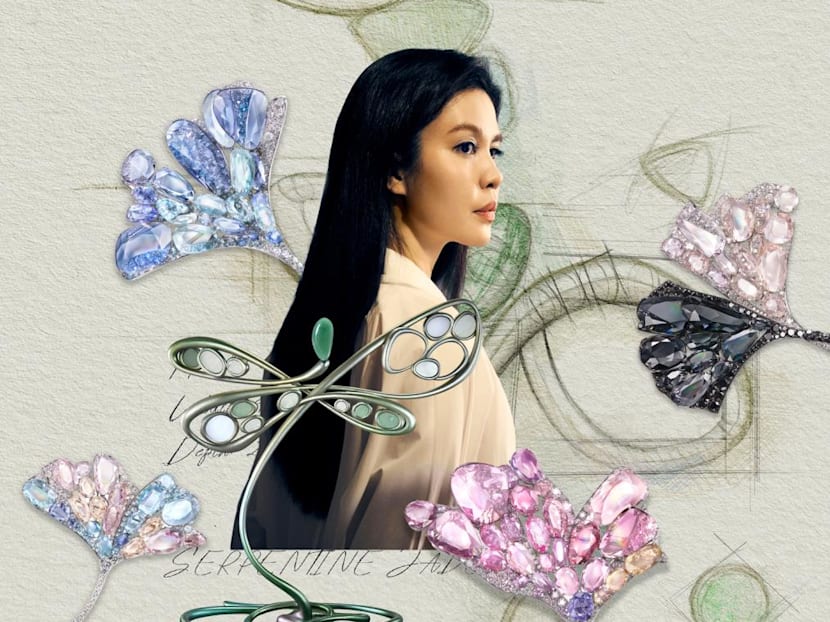
In an industry long defined by European heritage, Hangzhou-born, Shanghai-based artist-jeweller Feng J is forging a new path—blending Chinese artistic traditions with Impressionist light and colour to create a high jewellery language unmistakably her own.
Hangzhou-born, Shanghai-based artist-jeweller Feng J is known for high jewellery that blends Chinese artistic traditions with Impressionist ideas of light and colour. (Photos: Feng J; Art: CNA/Jasper Loh)
For more than a century, the world of high jewellery has revolved around a familiar constellation of houses: Cartier, Van Cleef & Arpels, Bulgari and their peers. For younger designers trying to break into its upper echelons, the industry has often been defined by heritage, European codes and a high barrier to entry.
Enter Feng J, the Hangzhou-born, Shanghai-based artist-jeweller who trained in Paris to master the codes of high jewellery – before developing a language unmistakably her own.
At the heart of Feng J’s appeal is a visual language that expands what high jewellery can be. She blends Impressionist ideas of light and colour with Chinese artistic sensibilities. Organic forms recur throughout her work – dragonflies suspended in mid-air, clovers unfolding in gemstones, flowers rendered in brilliant gradients.
The real surprise is not that Feng J has broken into the upper ranks of high jewellery. It is that, outside collecting circles, her name is still not more widely known.
Part of what makes Feng J intriguing is that her work resists easy categorisation. Technically, she is a high jeweller. In practice, many of her creations feel closer to painting or sculpture than conventional jewellery.
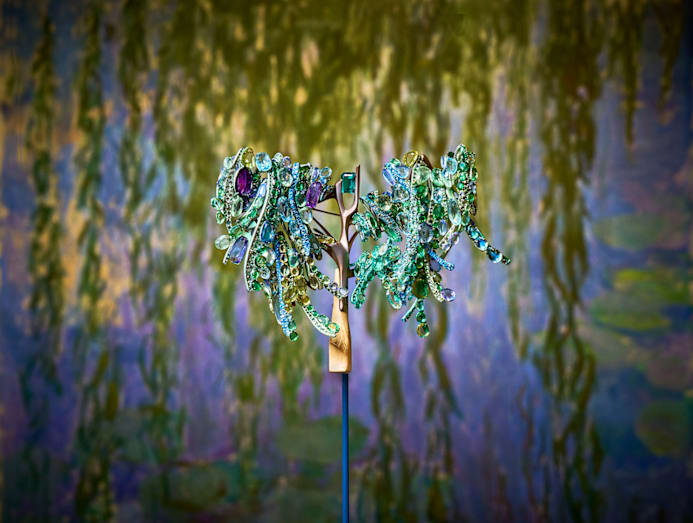
Feng J is known for treating gemstones like pigments, arranging colour in soft gradients to give her high jewellery a painterly quality. (Photo: Feng J)
Yet translating those influences – from Chinese ink painting to Monet’s Impressionism – into the language of French high jewellery required Feng J to develop a visual and technical vocabulary of her own.
Unlike many designers working in high jewellery today, she did not emerge from a dynastic European maison or inherit generations of jewellery-making expertise. She initially studied furniture design at the China Academy of Art before moving to London to pursue a master’s degree in Fashion Artefact at University of the Arts London. Jewellery entered her life almost by accident, after a single piece she created unexpectedly sold at auction.
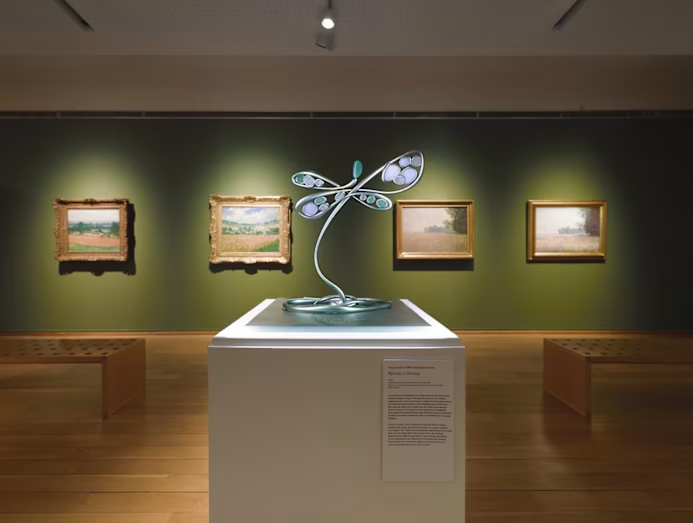
Feng J’s Libellule de l’Opera Garnier, shown at L’ecole, School of Jewelry Arts China, supported by Van Cleef & Arpels, as part of the exhibition Journey with Minerals (Nov 2025 – Mar 2026). (Photo: Feng J)
After training at the Haute Ecole de Joaillerie in Paris, she launched her maison in the French capital in 2016. At the time, Asian designers remained relatively rare in the upper tiers of high jewellery, an industry still closely tied to European heritage and tradition. Feng J quickly realised that imitating established maisons would leave little room for her own artistic identity.
One of the clearest expressions of that approach is Libellule du Palais Garnier, a showstopping brooch recently exhibited at L’ecole, School of Jewelry Arts in China, supported by Van Cleef & Arpels. Inspired by the architecture of the Opera Garnier in Paris, the piece creates the illusion of coloured stones suspended almost freely in air.
Titanium also appears frequently in her creations because of its unusual combination of strength and lightness. Under changing light, the material takes on subtle tonal shifts that reinforce the dreamlike quality she pursues throughout her work.
As the spotlight around her grew, so did Feng J’s audience. Younger collectors, in particular, have become increasingly receptive to work that moves beyond conventional ideas of jewellery as purely decorative or status-driven.
That shift reflects a broader change within luxury. Younger collectors move fluidly between fashion, art and design, often seeking creators with distinctive artistic identities rather than heritage alone. In that landscape, Feng J’s blend of Chinese visual traditions, Impressionist influences and experimental techniques feels less like an outlier than a sign of where contemporary high jewellery may be headed.
Still, she insists that high jewellery must aspire to something deeper than celebrity placement or material value alone. She creates just 35 pieces a year, working with her ateliers in Hong Kong, while some pieces are made in Paris.
Timepieces & Jewellery
high jewellery
Advertisement
People
From multimillion-dollar auction sales to museum recognition and celebrity clients, the Chinese artist-jeweller has built a distinctive language around painterly gemstones and floating settings.
New: You can now listen to articles.
This audio is generated by an AI tool.
By
Azimin Saini
By
Azimin Saini
11 Jul 2026 05:39AM
(Updated: 11 Jul 2026 05:50AM)
Bookmark
Bookmark
Share
WhatsApp
Telegram
Facebook
Twitter
Email
LinkedIn
Set CNA as your preferred source on Google