Editor’s Note
This article highlights Wallace Chan’s latest large-scale exhibition at Shanghai’s Long Museum, marking a significant milestone in his 50-year career across jewelry, sculpture, and material research.
After unveiling a parallel exhibition during the Venice Biennale in June, Wallace Chan, the Hong Kong-based, self-trained Chinese artist, has unveiled a large scale exhibition at Shanghai’s Long Museum by the Westbund waterfront. Dubbed “Wallace Chan: Vessels of Other World,” the exhibition is a culmination of the 70-year-old artist’s 50 years of practice, which spans jewelry art, sculpture and material research. The exhibition, open to the public, will run from Saturday to Oct. 25.
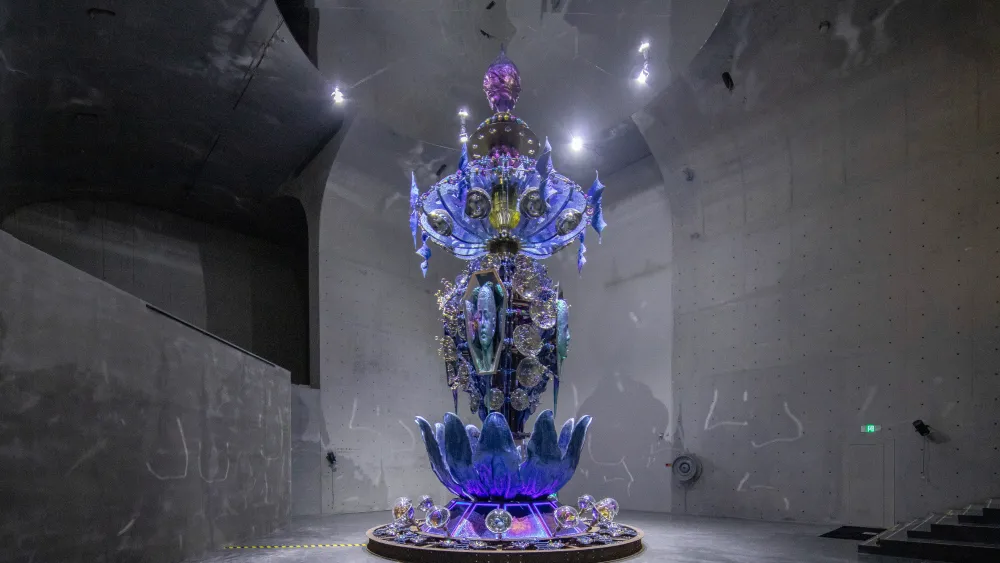
As a jewelry creator, Chan understands how light can reshape perception, heightening a work’s sense of intrigue, mystery and wonder. That philosophy extends into Long Museum’s dramatically darkened galleries, where a winding corridor guides visitors through a dimly lit archaeological site, an odasian sphere adorned Gothic garden, before opening onto a hidden vista, unveiling one of Chan’s largest sculptural works, “Rebirth.” The intricately designed vessels, which are around 10 meters tall, are testimony to Chan’s mastery of titanium, an industrial material often associated with technological advancement. Composed of thousands of titanium parts and chromed adornments, the vertical structures offer a distilled history of the organic world, the cosmic forces and human kind’s ultimate transcendence toward eternity. The imposing sculpture, inspired by Olea Sancta — oils used in Catholic rites of blessing and purification — reimagines the sacred substance in mechanical form, one that would make sense in a Steven Spielberg science fiction film, as it is adorned with chromatic titanium petals, molten faces, warped clocks, the 12 Chinese zodiac signs and the astrological signs.

A pioneer in the artistic use of titanium, Chan noted that the lightweight metal — often associated with the aerospace industry — is “one increasingly integrated into human life and least rejected by the human body,” Chan said.
Another imposing sculpture, titled “Birth,” is a rotating shrine with a kaleidoscopic interior that emulates the experience of viewing Chan’s proprietary carving technique, the Wallace Cut, which creates ever-changing visuals depending on the angle.
Five years in the making, the exhibition marks a fruitful collaboration that began when Wang Wei, co-owner and director of Long Museum, first became a collector of Chan’s jewelry works. Thus a major section of the exhibition is dedicated to Chan’s jewelry art, highlighting his butterfly brooches, which incorporate intricate mechanisms that allow them to dance on the wearer’s shoulders. For Chan, who was inspired by the story of a butterfly that flew from Wakayama, Japan, all the way to Hong Kong, the iridescent insect has become a symbol of freedom and love.
Another section presents some of Chan’s earlier works, tracing his artistic journey back to 1974, when he founded his own workshop at the age of 17. In 1987, Chan created the Wallace Cut, a technique developed using modified dental drills with the gemstone submerged in water, producing a three-dimensional effect that reveals the stone’s hidden internal dimensions. For Chan, who began working with humble materials such as concrete, copper and stainless steel after a monastic retreat when he was in his forties, developing a deeper dialogue with materials continues to shape his creative process.