Editor’s Note
Richemont reported a strong start to fiscal 2027, with first-quarter sales rising 20% at constant exchange rates, driven by 24% growth in its Jewellery Maisons and a sequential improvement in watch sales across all regions and channels.
On July 15, Swiss luxury group Richemont reported results for the first quarter of fiscal 2027, ended June 30, 2026. Sales reached €6.329 billion, up 20% year over year at constant exchange rates and 17% at actual exchange rates.
Alongside strong growth from its Jewellery Maisons, including Cartier and Van Cleef & Arpels, Richemont’s watch business improved sequentially. Sales increased across every region and distribution channel, giving the group a strong start to the year despite a volatile macroeconomic and geopolitical environment.
Richemont’s fiscal 2027 first-quarter sales reached €6.329 billion, up 20% at constant exchange rates and 17% at actual exchange rates
The Jewellery Maisons business area, which includes Cartier and Van Cleef & Arpels, grew 24%, marking its seventh consecutive quarter of double-digit growth
While fashion and leather goods remained under pressure at LVMH and Kering, their jewelry divisions continued to grow, highlighting a shift in the luxury market’s key growth drivers
The Jewellery Maisons business area, which accounts for approximately 75% of group sales, remained the primary driver of Richemont’s growth.
Combined sales across Buccellati, Cartier, Van Cleef & Arpels, and Vhernier reached €4.732 billion, representing an increase of 24% at constant exchange rates and 21% at actual exchange rates.
Both jewelry and watch lines delivered strong performances, with sales rising across every Maison, region, and distribution channel. The results marked the seventh consecutive quarter of double-digit growth for the Jewellery Maisons business area.

Sales at the Specialist Watchmakers business area reached €873 million, rising 8% at constant exchange rates and 6% at actual exchange rates.
Although the pace of growth remained below that of jewelry, the results pointed to resilient demand and signs of recovery in a high-end watch market that has faced an extended period of normalization.
Sales increased across every region. The Americas grew 27% at constant exchange rates, supported by continued strength in local demand. Growth was broad-based across markets, distribution channels, and business areas, with particularly strong performances from the Jewellery Maisons and Specialist Watchmakers.
Within the Jewellery Maisons business area, DTC accounted for approximately 85% of sales. Richemont’s direct distribution model, which allows the group to control customer relationships, pricing, product assortment, and the overall brand experience, remains a central pillar of its growth strategy.
Nevertheless, jewelry remained the most significant contributor to overall group growth. Demand for high and fine jewelry continues to expand at a faster pace than the improvement seen across Richemont’s Fashion and Accessories Maisons.
In the first quarter of 2026, the Fashion and Leather Goods business group at LVMH Moët Hennessy Louis Vuitton reported a 2% organic decline, while Watches and Jewelry grew 7%. Organic revenue growth for the group as a whole was limited to 1%.
A similar pattern emerged at Kering. Fashion and Leather Goods sales declined 3% on a comparable basis in the first quarter of 2026, while the group’s jewelry division, which includes Boucheron and Pomellato, grew 22%. Kering’s overall revenue was flat on a comparable basis.

These figures alone do not prove that consumer spending has shifted entirely from handbags to jewelry. However, a comparison of the leading luxury groups’ performances in early 2026 shows that fashion and leather goods have lost momentum, while jewelry continues to deliver comparatively strong growth.
Even amid continued price increases, jewelry may be easier for consumers to justify as a purchase because of its rarity, intrinsic material value, and ability to be owned and passed down across generations.
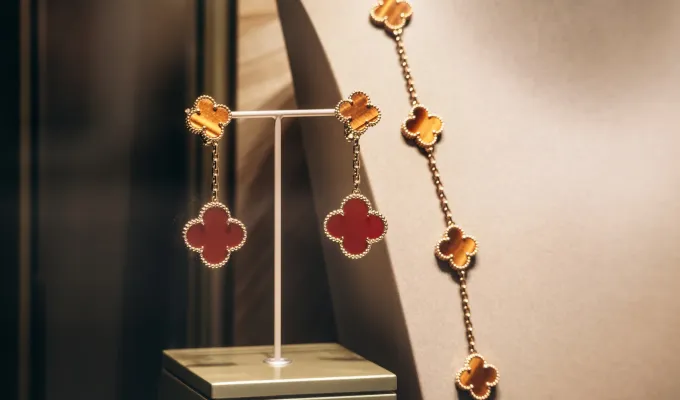
With global jewelry Maisons such as Cartier and Van Cleef & Arpels at the center of its portfolio, Richemont is among the luxury groups best positioned to benefit from this structural shift.
Raw material costs remain elevated, while geopolitical and macroeconomic uncertainty continues. Even so, Richemont achieved growth across every region, distribution channel, and business area during the quarter. The role of jewelry as a new engine of growth for the global luxury market is becoming increasingly difficult to ignore.
Richemont attributed the momentum to a continuous flow of new creations and its efforts to sustain the desirability of its iconic collections. Rather than relying on individual blockbuster products, the group continues to reinterpret the design codes and craftsmanship it has developed over decades for today’s luxury consumer.
Performance improved sequentially, with Vacheron Constantin, Jaeger-LeCoultre, and A. Lange & Söhne delivering particularly strong results.
By region, the Americas, Japan, and the Middle East and Africa posted double-digit growth. Asia Pacific was broadly stable, as lower sales across China, Hong Kong, and Macau combined were nearly offset by growth elsewhere in the region, particularly in South Korea.

Japan Climbs 36%, While the Americas Rise 27%
Asia Pacific rose 21%. Strong demand in Hong Kong and Macau helped drive a double-digit increase across China, Hong Kong, and Macau combined. Other major Asian markets also performed strongly, including South Korea and Taiwan.