Editor’s Note
**Editor’s Note:** This digest highlights a resilient watch sector, a legal clash between Princess Cruises and Almod, and headwinds facing diamond mines. We also examine whether the De Beers brand still holds sway with today’s consumers.
The watch business is still strong. Princess Cruises sues Almod. Why diamond mines are struggling. It’s The Jewelry Wire daily digest for Tues., July 21, 2026.
What is De Beers’ value as a brand name?
Note: I originally wrote and intended to run this piece about two weeks ago. But there’s been so much happening I kept holding it. It’s still worth discussing.
A comment from Avi Krawitz on the recent “Diamond Dudes” podcast about how “De Beers equals diamonds” has led to a discussion over De Beers’ value as a brand name. Even De Beers CEO Al Cook has weighed in.
I remain skeptical that is what De Beers should be focusing on. Let me explain why:
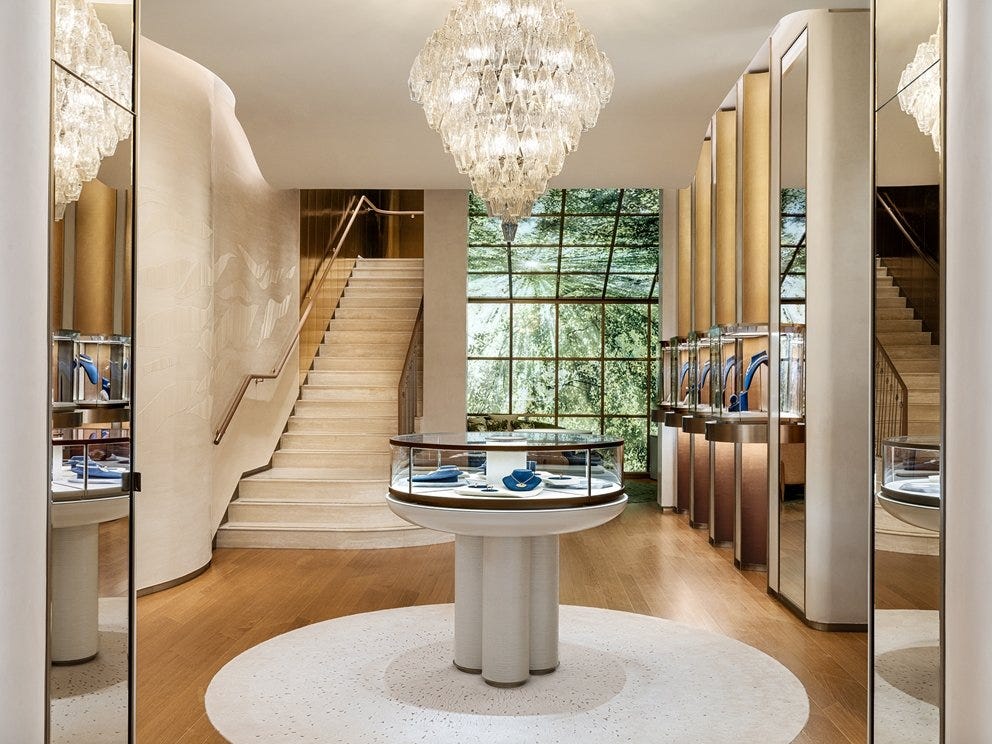
The new De Beers London store—in Paris. Courtesy: De Beers
Not all the perceptions people have of De Beers are positive. You can argue with those perceptions, but you can’t deny they exist.
More importantly, the track record of the De Beers retail chain—which is now called De Beers London (because most luxury brands are associated with a city)—is not great. The brand has always needed an identity and a positioning that would draw customers from better-known names like Cartier and Tiffany. In the 20-plus years De Beers has existed as a retail entity, it has never developed one. As the company’s former managing director Gary Ralfe said way back in 2006,
That’s because a well-known name is not a brand. De Beers may be a well-known miner, but that doesn’t make a De Beers brand a name consumers want to buy from, unless it’s saying its diamonds are cheaper because there’s no middleman. And that doesn’t seem to be the positioning it’s going for.
Any De Beers brand would likely be limited to high-end independents, the same stores that carried its Forevermark brand—which, let’s not forget, was briefly renamed “De Beers Forevermark.” And those stores aren’t where the problem is. It’s the smaller mom-and-pops—which largely went to lab-grown because consumers liked the cost savings and retailers, the higher margins (not necessarily in that order). Those are the stores the natural business has lost and needs to get back. I don’t know if you’re going to win back the lab-grown customer—who is attracted mostly by the lower price and perceived social benefit (likely in that order)—with a “De Beers” brand, especially if it carries a premium.
In fact, many feel that it was De Beers’ abandonment of category-driving advertising to focus on its proprietary brands that helped fuel the rise of lab-grown.
Now, from what I hear, the company’s recently introduced Origin brand (which is officially called Origin De Beers Group) is well done and could help provide a blueprint for introducing the “diamonds do good” story to consumers, something the industry is still figuring out how (and if) to do. However, like Forevermark, Origins is only sold at high-end independents.
De Beers clearly believes a lot of value exists in its name. But right now, given it’s putting mines on pause and laying off hundreds of workers, it has more important things on its plate.
Swatch Group reported a 9.5% increase in sales in its watch and jewelry segment for the first half of 2026, with U.S. sales jumping 27%.
Among the points it called out in its release:
- It called its mega-hyped Royal Pop collaboration a “resounding success,” saying it generated 25 billion views on social media (yes, that’s billion, with a “b”).
- Breguet had an “excellent half year.”
- Harry Winston had outstanding sales in all regions, including a 20% increase in China (including Hong Kong and Macau).
- While it didn’t provide full figures for Omega, it said that brand’s retail business grew 20%, which represents 42% of total turnover. That brand’s health was hotly debated in Swatch’s recent dust-up with Morgan Stanley.
- Longines, Tissot, and Hamilton all saw “double-digit” increases in turnover.
On the not-so-positive side, Swatch’s workforce shrank by 1.5% in the first half of 2026 due to what it called “natural fluctuations.” It currently has over 31,000 employees.
Global Swiss watch exports increased by almost 11.2% in June, to nearly 2.4 billion francs, with shipments to the United States increasing 12.7%, according to statistics released today by the Federation of the Swiss Watch Industry (FH).
Lower-end watches, with an export price between 500 and 3,000 francs, continued to struggle, with sales falling 4.7%. However, exports from the 200–500 francs segment jumped 54.1%, and watches priced at over 3,000 francs grew by 14.2%.
There’s some sour feelings on board the Love Boat. Princess Cruise Lines is suing Almod Diamonds Ltd. in New York federal court, claiming the owner of Diamonds International owes it $3.2 million under an agreement that lets Almod operate jewelry boutiques on its Sun Princess cruise ships. Almod tells The Jewelry Wire it denies the allegations and will soon file a response.
A post on the “Diamond Shakeout” by Hal Macintosh makes a distinction that not everyone in the industry is aware of but is crucial for understanding why so many mines are either closing or being put on hiatus: